
0-10V Dimming vs. Smart Lighting: The Ultimate Comparison Guide (2026 Edition)
By Powerstar
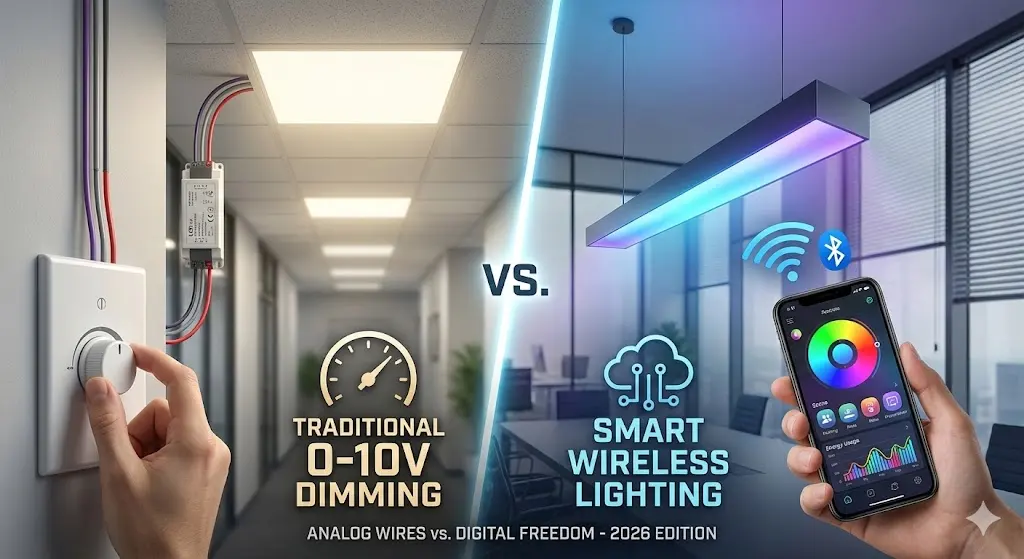
Struggling to choose between 0-10V dimming vs. smart lighting? We break down the installation costs, wiring requirements, and control features to help you decide.
0-10V dimming vs. smart lighting is a common comparison for commercial building owners seeking better energy efficiency and lighting control flexibility. In the rapidly evolving world of commercial architecture and interior design, lighting is no longer just about illumination—it is about control, atmosphere, and energy efficiency. For decades, the industry standard has been straightforward. However, a major shift has occurred, leaving many contractors, facility managers, and business owners facing a difficult decision.
The debate of 0-10V Dimming vs. Smart Lighting is one of the most critical discussions in modern construction and retrofitting. When evaluating 0-10V Dimming vs. smart Lighting, smart lighting systems clearly offer advanced automation, data integration, and remote management advantages.
Choosing the wrong system can lead to bloated budgets, inflexible spaces, and future compatibility headaches. On one hand, you have the reliable, analog workhorse; on the other, a digital, wireless ecosystem that promises limitless possibilities. From a long-term ROI perspective, 0-10V Dimming vs. smart Lighting highlights the limitations of traditional analog dimming in modern retail and office environments.
This comprehensive guide breaks down the technical differences, cost implications, and functional benefits of both systems to help you decide which solution fits your 2026 project goals.
Understanding the Technical Differences: Analog Signals vs. Digital Ecosystems
To truly understand the 0-10V Dimming vs. Smart Lighting comparison, we must first look at how they communicate with the LED driver.
0-10V Dimming is an analog protocol. It is one of the earliest and simplest electronic lighting control signaling systems. The concept is basic: the control signal is a DC voltage that varies between zero and ten volts.
- At 10 Volts: The light operates at 100% output.
- At 0 Volts: The light dims to its minimum level (or turns off).This system requires a dedicated pair of low-voltage wires specifically for the dimming signal, running from the switch (dimmer) to each LED driver.
Smart Lighting, conversely, usually relies on digital communication protocols. These can be wired (like DALI-2) or, increasingly common in 2026, wireless (Zigbee, Bluetooth Mesh, or Wi-Fi). Instead of varying voltage to dim a light, smart systems send data packets. These packets can tell a fixture to turn on, dim to 50%, change color temperature (CCT), or report energy usage data back to a central dashboard.
Installation Costs and Wiring Complexity in Commercial Spaces
For contractors and budget-conscious project managers, the “sticker price” of the fixture is only half the story. The real battleground in the 0-10V Dimming vs. Smart Lighting debate is labor and wiring.
The Hidden Cost of 0-10V
While 0-10V drivers and dimmers are generally cheaper to buy upfront, they are often more expensive to install. Why? Copper and Labor.
Every dimmable zone requires hardwiring. If you have a large office and want to divide it into 20 different lighting zones, your electrician must run distinct low-voltage control wires to every single group. If the tenant wants to change the zoning layout next year, you have to rip open the ceiling and rewire.
The Wireless Advantage
Smart lighting systems, particularly wireless mesh networks, eliminate the control wires entirely. You simply provide main power (Line/Neutral) to the fixture. The control happens over the air.
- Labor Savings: Installation speed increases significantly.
- Material Savings: No low-voltage cabling required.For many modern projects, the labor savings on a smart system often offset the higher hardware cost of intelligent drivers.
Functionality and User Experience: Beyond Basic Brightness
When analyzing 0-10V Dimming vs. Smart Lighting, the gap in functionality is massive. 0-10V is a “one-trick pony,” while smart lighting is a complete ecosystem.
0-10V Capabilities:
- Dimming: Smooth dimming from 100% down to 1%, 5%, or 10% (depending on the driver).
- Reliability: Extremely stable because it is hardwired. It does not depend on internet connections or gateways.
- Limit: It is strictly one-way communication. The light cannot “talk back” to tell you it has failed or how much energy it is consuming.
Smart Lighting Capabilities:
- Tunable White & RGB: Adjust color temperature from warm (3000K) to cool (6000K) based on the time of day (Circadian Rhythm lighting).
- Scheduling: Automate lights to turn off after business hours.
- Remote Access: Control the entire building’s lighting from a smartphone or cloud dashboard.
- Grouping: Re-zone lights via an app without touching a single wire.
If your project requires Human Centric Lighting (HCL) or flexible zoning, 0-10V is simply not an option.
HRetrofitting and Renovation: The Deciding Factor
Is your project a new build or a renovation? This is often the tie-breaker. Many facility managers choose smart lighting after analyzing 0-10V Dimming vs. Smart Lighting in terms of scalability, maintenance, and future-proof design.
In New Construction, walls are open, and running extra wires for 0-10V is standard procedure. It is easy to integrate into the initial electrical plan.
However, in Retrofit Projects (upgrading an existing office, warehouse, or retail store), 0-10V can be a nightmare. Installing new control wiring in a finished ceiling (“fishing wires”) is labor-intensive, messy, and disruptive to business operations.
This is where Smart Lighting dominates. By using wireless controls, you can replace old non-dimmable fixtures with smart fixtures using the existing power wires. You instantly gain dimming capabilities and smart control without cutting into drywalls or ceilings. For retrofits, the winner of 0-10V Dimming vs. Smart Lighting is almost exclusively smart lighting.
Future-Proofing and Energy Code Compliance (IECC & Title 24)
Is analog dead? When comparing 0-10V lighting vs. Smart Lighting, the winner for retrofit projects is clear. Say goodbye to opening up ceilings for control wires.
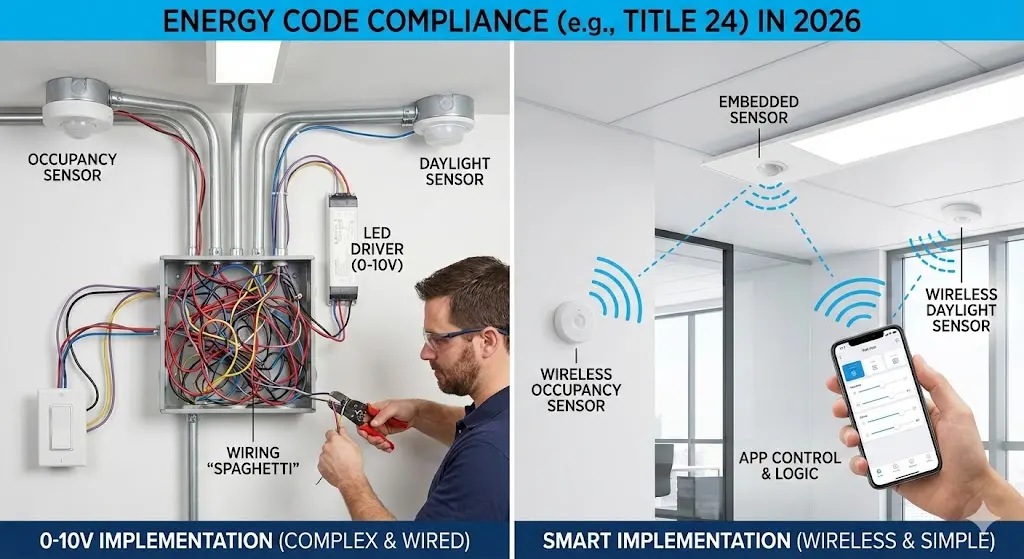
In 2026, energy codes in the US (like California’s Title 24) and Europe are becoming stricter. They require features like:
- Occupancy Sensing: Lights off when no one is present.
- Daylight Harvesting: Lights dim automatically when sunlight is available.
0-10V Implementation:
To achieve this with 0-10V, you need to install separate, physical sensors and hardwire them into the control loop. It is complex and creates a “spaghetti” of wires in the junction box.
Smart Implementation:
Many smart fixtures come with embedded sensors. Even if they don’t, wireless battery-powered sensors can be stuck to the wall or ceiling and paired in seconds. The system handles the logic via software. If energy codes change, you can often update the firmware or settings without changing the hardware.
The debate of 0-10V lighting vs. Smart Lighting isn’t just about hardware—it’s about labor costs. Why pay for copper when you can go wireless?
Comparison Summary Table
To summarize the key distinctions, refer to the table below:
| Feature | 0-10V Dimming | Smart Lighting (Wireless) |
| Signal Type | Analog (Voltage) | Digital (Data) |
| Wiring | Power + Control Wires | Power Only (Wireless Control) |
| Hardware Cost | Low | Medium to High |
| Installation Cost | High (Labor Intensive) | Low (Plug & Play) |
| Flexibility | Fixed Zoning (Hardwired) | Flexible Zoning (App-based) |
| Advanced Features | Dimming Only | Tunable White, Timers, Remote Control |
| Best For | Simple, static spaces | Dynamic, modern, or retrofit spaces |
Troubleshooting and Maintenance Realities in Commercial Environments
While 0-10V lighting provides the stability of a wired connection, Smart Lighting offers the flexibility that modern, dynamic workspaces demand.
When a lighting system fails, business operations are disrupted. Understanding the maintenance profile of 0-10V Dimming vs. Smart Lighting is crucial for facility managers.
Common 0-10V Challenges: The “Achilles’ heel” of 0-10V systems is Voltage Drop. Because it relies on an analog DC signal, if the wire run is too long (over 300 feet) or the wire gauge is too thin, the signal degrades.
- The Symptom: Lights at the end of the circuit appear dimmer than lights at the start, or they flicker when dimmed low.
- The Fix: This often requires installing signal amplifiers or rewiring with thicker cables—a costly and invasive repair.
Common Smart Lighting Challenges: Smart systems are generally immune to voltage drop, but they face Network Latency and Compatibility issues.
- The Symptom: “Popcorning” effect (lights turning on one by one rather than in unison) or devices dropping off the network.
- The Fix: This is usually a software or gateway issue. It can often be fixed remotely via an Over-the-Air (OTA) update or by adding a repeater node to strengthen the mesh network.
For maintenance teams, 0-10V requires a multimeter and a ladder. Smart lighting requires a tablet and a login.
Frequently Asked Questions (FAQ) about Lighting Controls
Including an FAQ section is a powerful SEO tactic to capture “People Also Ask” snippets in Google Search.
Can I upgrade my existing 0-10V fixtures to smart lighting?
Yes. You can install wireless bridging devices (smart nodes) that connect to the 0-10V input of your existing drivers. This converts your “dumb” wired system into a wireless smart system without replacing the fixtures.
Does 0-10V dimming cause flickering?
It can. Low-quality 0-10V dimmers or incompatible drivers often struggle at low levels (below 10%), causing visible flicker. Smart digital systems typically handle low-end dimming much more smoothly.
Is smart lighting secure from hackers? Modern commercial protocols like Zigbee 3.0 and Bluetooth Mesh use banking-grade encryption (AES-128). While no system is unhackable, a properly configured local lighting network is extremely secure and typically isolated from the main corporate Wi-Fi.
What is the maximum distance for 0-10V wiring?
Generally, you should not exceed 300 feet (90 meters) for the control run to avoid significant signal loss, whereas wireless smart mesh networks can extend indefinitely as long as devices are within range of each other to hop the signal.
Conclusion: Which System Wins in 2026?
Ultimately, the choice of 0-10V lighting vs. Smart Lighting comes down to one question: Are you building for today’s budget or tomorrow’s needs?
So, who wins the battle of 0-10V Dimming vs. Smart Lighting? The answer depends entirely on your specific project constraints.
Choose 0-10V Dimming if:
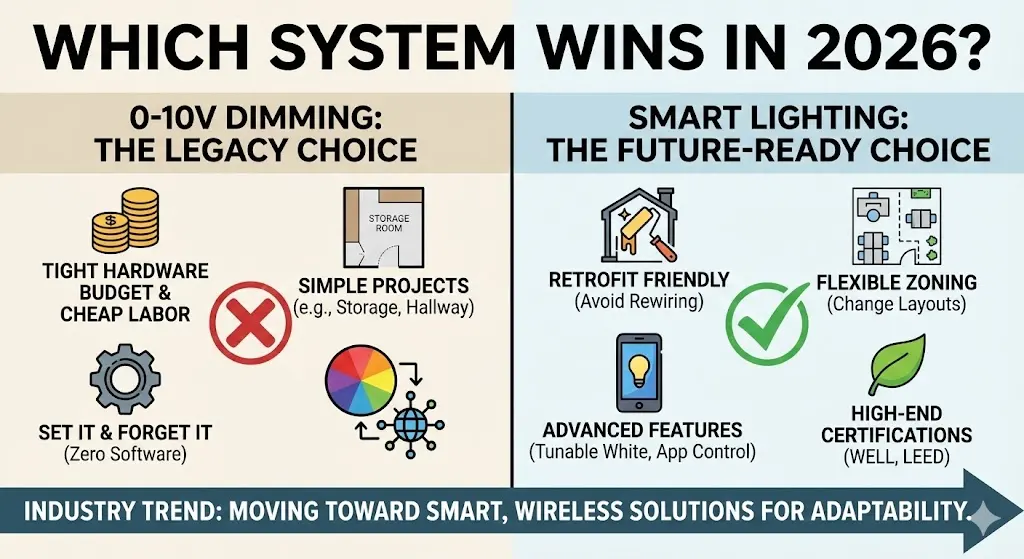
- You have a tight hardware budget and cheap labor availability.
- It is a simple project (e.g., a storage room or basic hallway) that requires no color tuning or regrouping.
- You want a “set it and forget it” system with zero software setup.
Choose Smart Lighting if:
- You are retrofitting an existing building and want to avoid rewiring.
- You need flexibility to change office layouts or lighting zones in the future.
- You want advanced features like Tunable White, energy monitoring, or app control.
- You are aiming for high-end certifications like WELL or LEED.
As we move deeper into the digital age, the industry is clearly trending toward smart, wireless solutions. While 0-10V remains a reliable legacy standard, smart lighting offers the adaptability required for the modern commercial environment.