



Dali-2 Smart Led Lighting vs. Dali-1: Why Your Commercial Dimming Isn’t as Smooth as You Think
By Powerstar
- Introduction
- I. DALI-1 vs. DALI-2: From “Basic Control” to “Project-Grade Standard”
- II. Case Study: Dimming Anomalies Caused by Mixing DALI-1 and DALI-2
- III. Why Mixing DALI-1 and DALI-2 Causes Low-Level Dimming Problems
- IV. How We Solved It: Short-Term Fix vs. Long-Term Strategy
- V. Why DALI-2 Is the Right Choice for Commercial Spaces
- VI. Our DALI-2 Luminaire Solutions
- Conclusion: DALI-2 Is an Investment in Reliability
Atmosphere is Everything—Until the Lights Start Jumping:why DALI-2 Smart LED Lighting is Critical for Modern Commercial Projects?
In today’s commercial lighting projects, performance is no longer judged only by lumen output or fixture appearance. What really separates a professional system from an average one is how well it behaves when dimming.
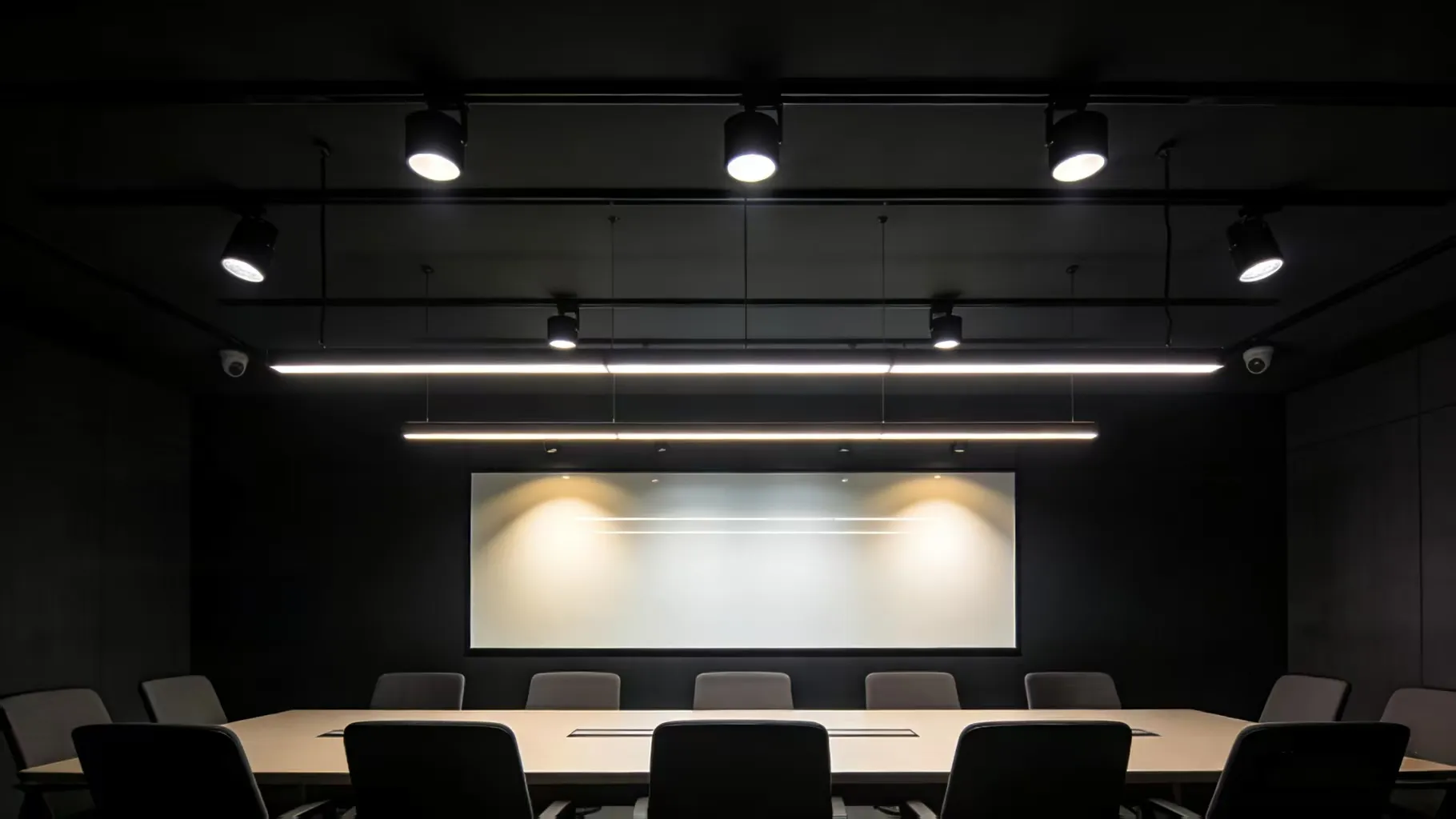
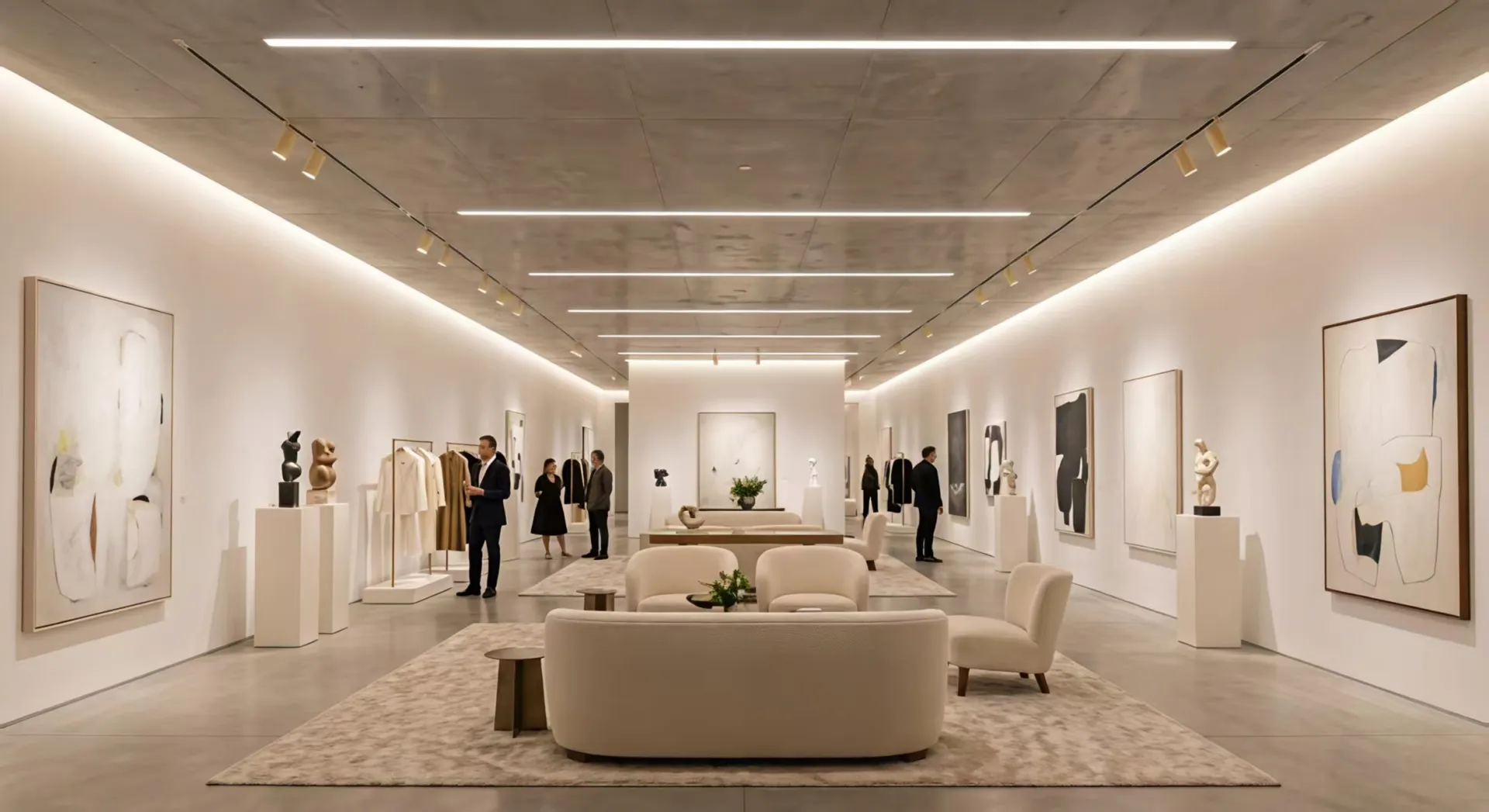
Retail stores, premium offices, boutique hotels, galleries, and exhibition spaces all rely on lighting to shape atmosphere. In these environments, brightness needs to change smoothly, predictably, and consistently—especially at low levels. Any sudden jump, flicker, or mismatch between fixtures is immediately noticeable and often unacceptable.
Yet in many real projects, dimming still feels “off”. Lights appear stable at higher levels, but once you dim down, problems begin. The most common complaint sounds familiar:
“Between 1% and 10%, the light suddenly jumps, and above that, nothing really changes.”
In practice, this issue is very often linked to one root cause: mixing DALI-1 and DALI-2 components within the same system, usually without fully understanding how differently they behave.
This article breaks down the real differences between DALI-1 and DALI-2 Smart LED Lighting, using an actual project experience to explain why DALI-2 has become the preferred standard for commercial-grade dimming—and how choosing the right luminaires can eliminate risk before it appears on site.
I. Dali-1 vs. Dali-2: From “Basic Control” to “Project-Grade Standard”
At first glance, DALI-1 and DALI-2 seem compatible. They share the same communication concept, wiring topology, and addressing logic. However, when applied to real commercial projects, the difference becomes obvious.
DALI-1 was never designed as a fully unified system standard. It defined basic communication, but left many critical behaviors—such as dimming curves and minimum output levels—to individual manufacturers.
DALI-2, on the other hand, is a complete system standard, formalized under the IEC 62386 series and enforced through mandatory certification.
In simple terms:
- DALI-1 enables dimming
- DALI-2 guarantees how that dimming behaves
| Feature | DALI-1 | DALI-2 |
|---|---|---|
| Standard completeness | Early protocol, partial definitions | Full IEC 62386 system |
| Certification | No unified certification | Mandatory DALI-2 certification |
| Interoperability | Manufacturer-dependent | Guaranteed cross-brand |
| Dimming curve | Not strictly defined | Standard logarithmic curve |
| Project suitability | Small or simple systems | Commercial & engineering projects |
For small installations, DALI-1 may be sufficient. But once multiple luminaires, scenes, and user expectations come into play, its limitations become clear.
II. Case Study: Dimming Anomalies Caused By Mixing Dali-1 and Dali-2
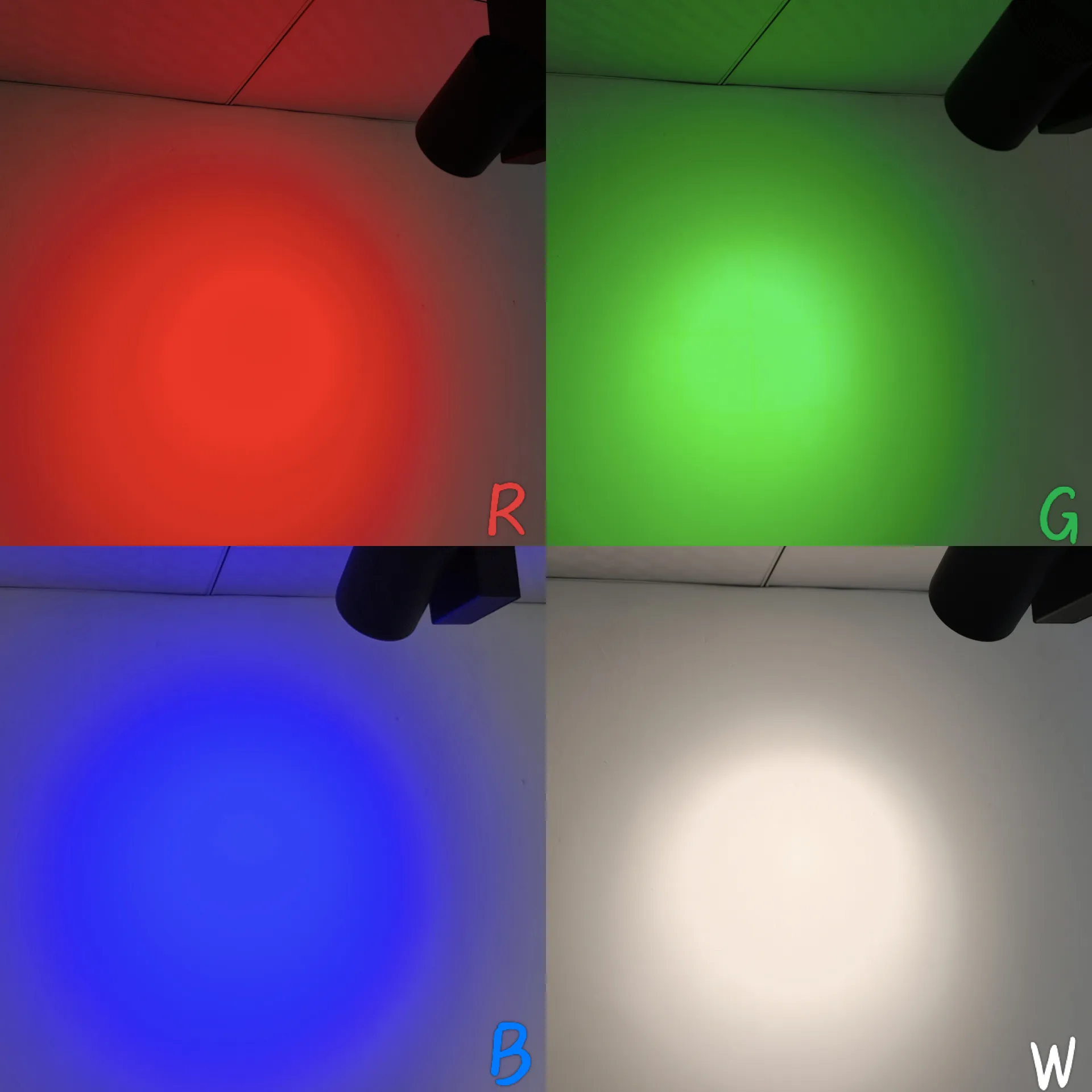
In a recent commercial installation, 8 LED track lights were connected to a single DALI control bus. During commissioning, several problems appeared immediately:
- Low-level brightness jump: When dimming from 1% to 10%, the lights did not increase gradually. Instead, brightness jumped suddenly to a visibly high level.
- High-level saturation: Above 10%, further dimming adjustments produced little or no visible change.
- Inconsistent fade behavior: Even within the same group, fixtures responded with different fade-in and fade-out speeds.
After remote diagnostics with the DALI power supply manufacturer, hardware failure was ruled out. The real cause was confirmed: DALI-1 and DALI-2 drivers were operating on the same bus.
On paper, this configuration “works”. In reality, it creates unpredictable dimming behavior—especially at low brightness levels.
III. Why Mixing Dali-1 and Dali-2 Causes Low-Level Dimming Problems
To understand the 1%–10% brightness surge, we must examine the technical discrepancies between the two standards.
| Feature | DALI-1 (Old Standard) | DALI-2 (New Standard) | Impact on Commercial Lighting |
| Certification | Self-tested; lacks unity | Mandatory DiiA certification | Ensures global cross-brand interoperability |
| Dimming Curve | Vague; manufacturer-defined | Mandatory Standard Logarithmic Curve | Guarantees brightness consistency |
| Fade Time | Low precision (0.7s – 90s) | High precision (0.1s – 16min) | Enables ultra-smooth scene transitions |
| Input Devices | Drivers only | Supports sensors, panels, controllers | More integrated and intelligent system |
| Data Feedback | Minimal to none | Energy monitoring & diagnostics | Simplifies facility management |
1. Different Dimming Curve Definitions
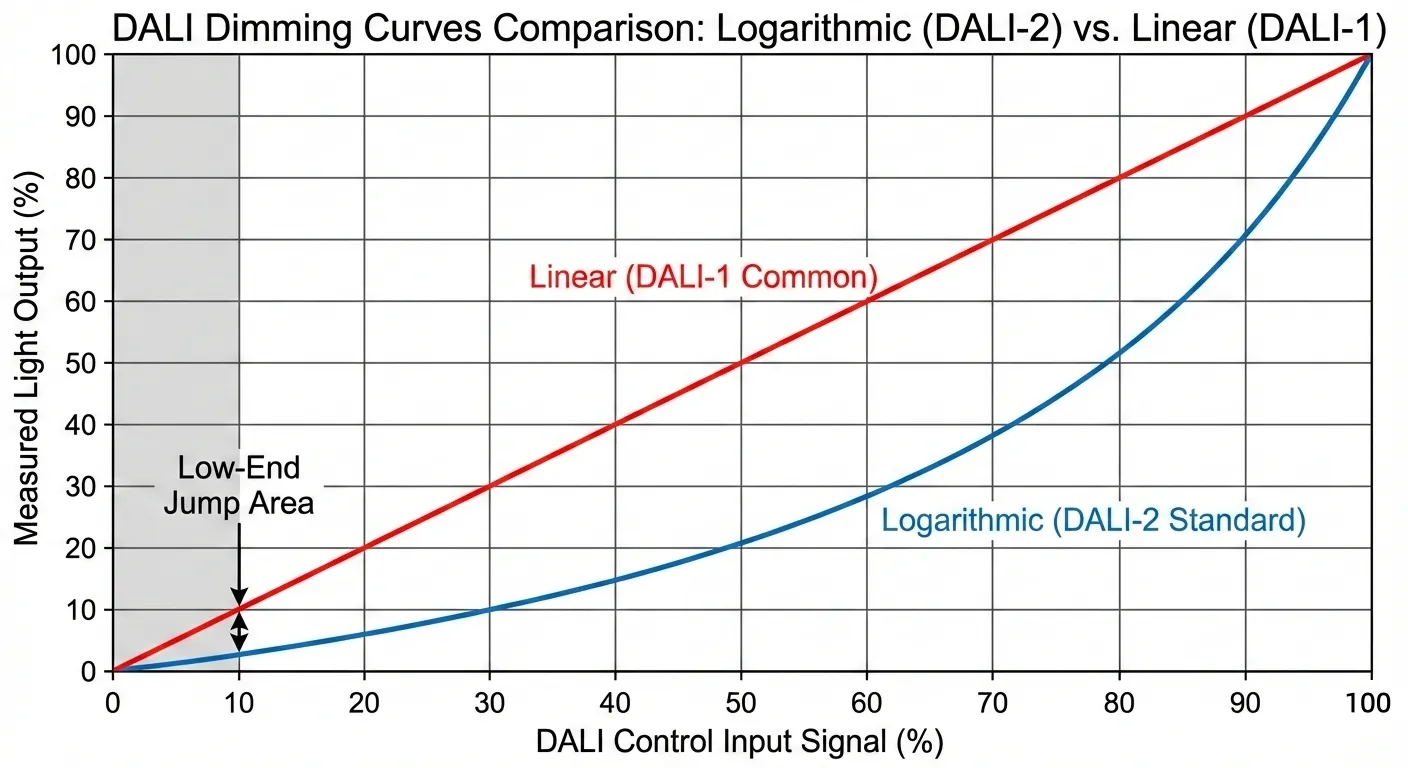
DALI-2 Smart LED Lighting follows a mandatory logarithmic dimming curve, designed to match human visual perception. This ensures that even between 1% and 10%, brightness changes remain smooth and continuous.
DALI-1 does not enforce a unified curve. Each manufacturer implements its own solution. At low levels, many DALI-1 drivers jump directly to the lowest stable physical output the hardware can maintain—skipping several perceived steps entirely.
2. Minimum Physical Output Limitations
Low-brightness stability is critical in high-end spaces. Many DALI-1 drivers have a physical minimum output around 5–10%. When the controller sends a 1% command, the driver simply cannot execute it.
The result is a sudden brightness jump once the command crosses the driver’s threshold—exactly what users perceive as “jerky dimming”.
3. Human Vision Amplifies the Problem
Our eyes are far more sensitive to brightness changes in dark environments than in bright ones. DALI-2’s logarithmic curve accounts for this behavior.
DALI-1 drivers often respond linearly. As a result, a 10% command may translate into a much higher physical current output, creating a visually exaggerated brightness surge—especially noticeable when multiple fixtures change simultaneously.
IV. How We Solved It: Short-Term Fix vs. Long-Term Strategy
1. Temporary Solution: Parameter Adjustment
In this project, a workaround was implemented through DALI configuration software:
- All drivers were forced to use a logarithmic dimming curve
- Minimum output levels were aligned, raising DALI-2 fixtures to match the DALI-1 drivers’ limitations
- Fade Time values were unified across all eight track lights
This improved the visual experience significantly.
However, this was a compatibility fix—not a standard-compliant solution. It required manual tuning and would need to be repeated if any fixture were replaced.
2. The Correct Approach: Full DALI-2 System
For new commercial projects, the most reliable solution is simple:
use a fully unified DALI-2 Smart LED Lighting system from the start.
This ensures:
- Identical dimming behavior across all fixtures
- Stable low-brightness performance
- Perfectly synchronized scene transitions
- Easier maintenance and future expansion
V. Why Dali-2 Is the Right Choice for Commercial Spaces
| Aspect | DALI-2 Advantage |
|---|---|
| Dimming quality | Smooth and stable, even below 10% |
| System behavior | Predictable and repeatable |
| Scalability | Easy integration with sensors and panels |
| Maintenance | No re-commissioning after replacement |
| Compliance | Meets lighting consultant and specifier expectations |
VI. Our Dali-2 Luminaire Solutions
As a manufacturer focused on commercial lighting, we design our Track Lights, Downlights, and LED Linear Lights with DALI-2 as the baseline, not an option.
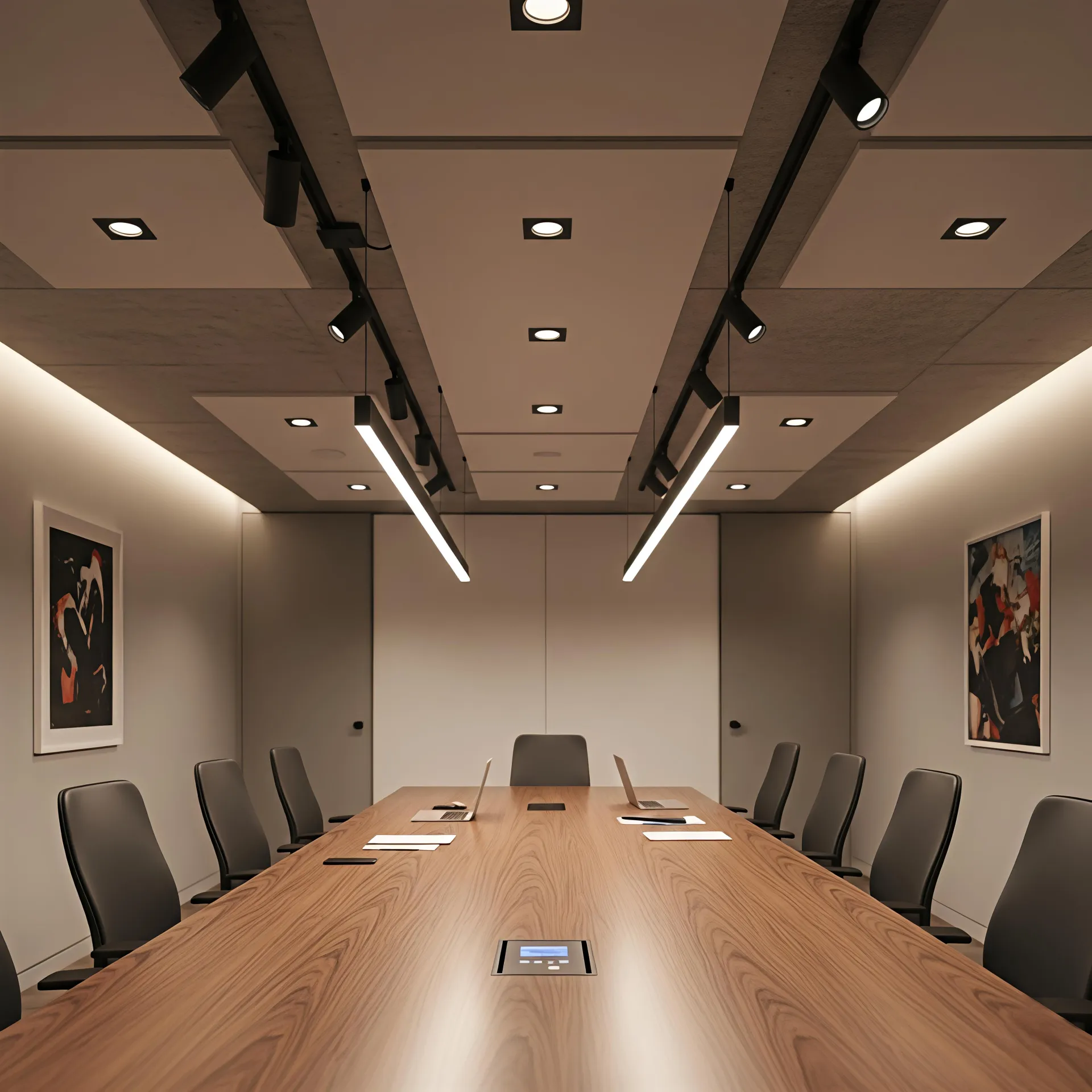
Our Product Advantages:
- 100% DALI-2 Certification: Every fixture uses high-quality DALI-2 drivers, ensuring seamless integration with Lutron, Helvar, and Schneider control systems.
- Deep Dimming Technology: Our downlights achieve flicker-free dimming down to 0.1%, ideal for high-end dining and galleries.
- Pre-set Consistency: Every batch undergoes rigorous dimming curve testing to guarantee zero brightness variance across large installations.
- Multi-functional Integration: Supports DT8 protocol for Tunable White control, allowing commercial spaces to shift between warm and cool tones using a single DALI address.
Conclusion: Dali-2 Is an Investment in Reliability
In commercial lighting, dimming problems are rarely caused by a single defective component. They are usually the result of system-level decisions made early in the project.
While mixing DALI-1 and DALI-2 may appear acceptable during design, it introduces hidden risks—especially at low brightness levels and during long-term maintenance.
DALI-2 Smart LED Lighting is not just about control. It is about predictability, consistency, and reduced project risk.
For any commercial space where lighting quality truly matters, adopting a fully unified DALI-2 system is not an upgrade—it is a necessity。

