



DALI Group Lighting Control vs Individual Lighting Control: Which Is Better?
By Powerstar
In modern commercial lighting projects, flexibility and efficiency are no longer optional—they are essential. As intelligent lighting systems become the standard, many designers and facility managers face the same question: DALI Group Lighting Control vs Individual Lighting Control— which is better?
Both control methods are built on the DALI protocol standardized by the DALI Alliance, yet they serve different operational goals. Understanding the differences is critical when designing energy-efficient, scalable, and cost-effective lighting systems.
Group Lighting Control in DALI
DALI Group Lighting Control allows multiple luminaires to be assigned to a logical group and controlled simultaneously via a single command. Each DALI device can belong to one or more groups, enabling flexible control strategies without changing physical wiring.
Typical groupings include:
- Lighting zones in open offices
- Aisles or product areas in retail stores
- Functional zones in commercial buildings
Because grouping is software-based, layouts can be reconfigured easily as space usage changes.
Individual Lighting Control in DALI
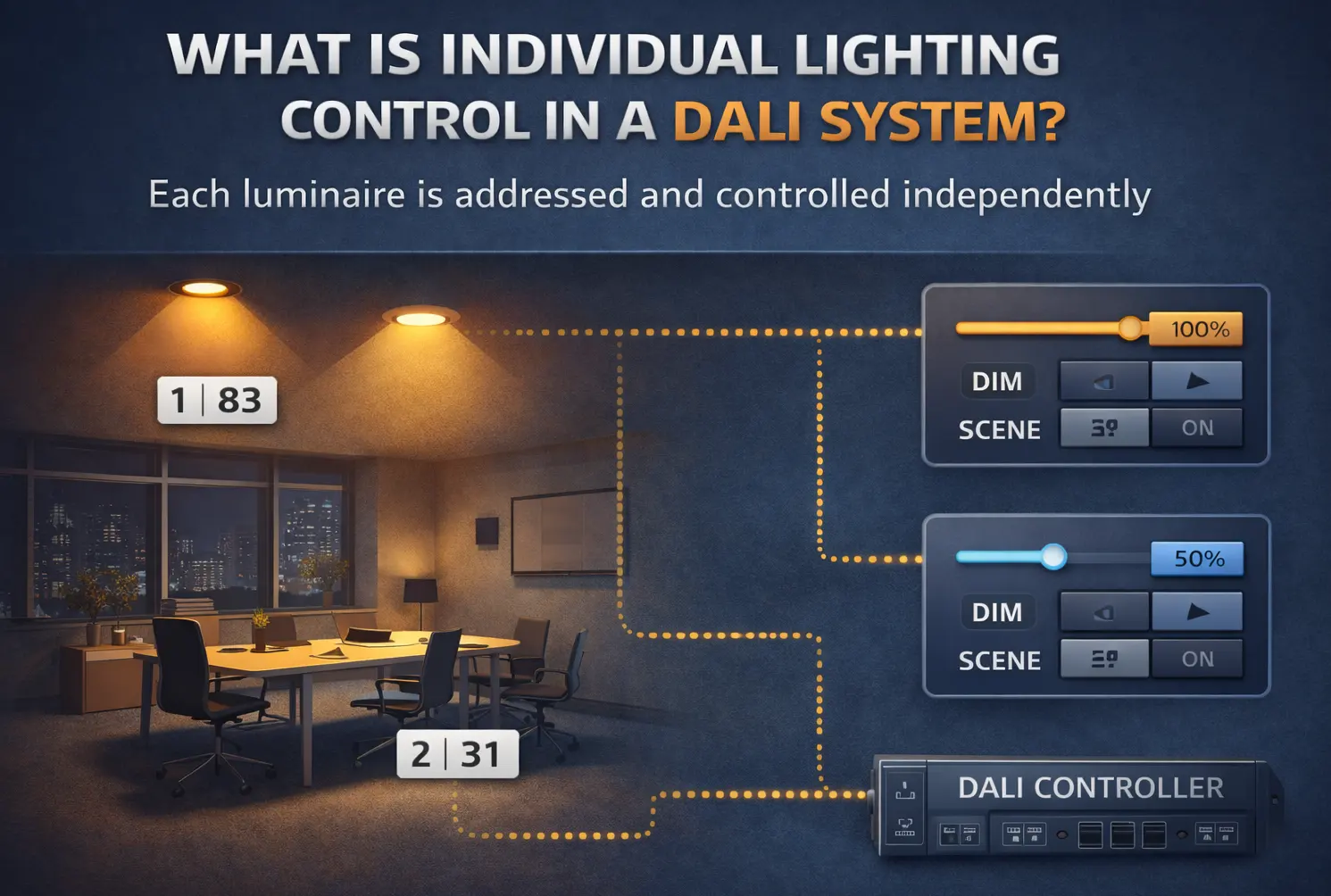
Individual lighting control means that each luminaire is addressed and controlled independently. Brightness, scenes, and behaviors can be adjusted per fixture, offering maximum granularity.
This approach is often used in:
- Museums and galleries
- High-end architectural lighting
- Spaces with highly specific visual requirements
While powerful, individual control can introduce higher system complexity.
2 Comparison: Core Differences
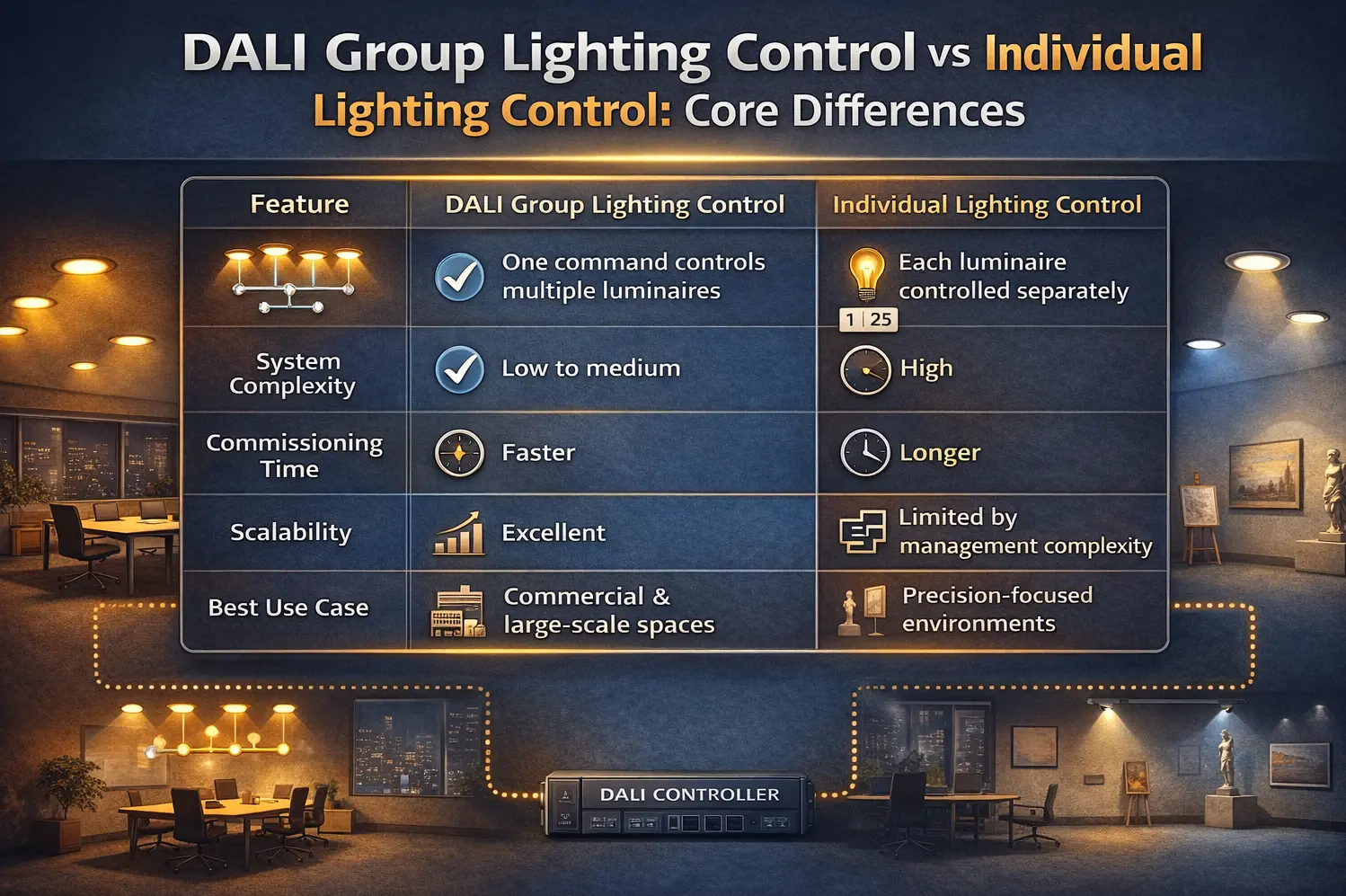
The table below summarizes the fundamental differences between the two approaches:
| Feature | DALI Group Lighting Control | Individual Lighting Control |
|---|---|---|
| Control Method | One command controls multiple luminaires | Each luminaire controlled separately |
| System Complexity | Low to medium | High |
| Commissioning Time | Faster | Longer |
| Scalability | Excellent | Limited by management complexity |
| Best Use Case | Commercial & large-scale spaces | Precision-focused environments |
Why DALI Group Lighting Is Better for Commercial Lighting Systems?
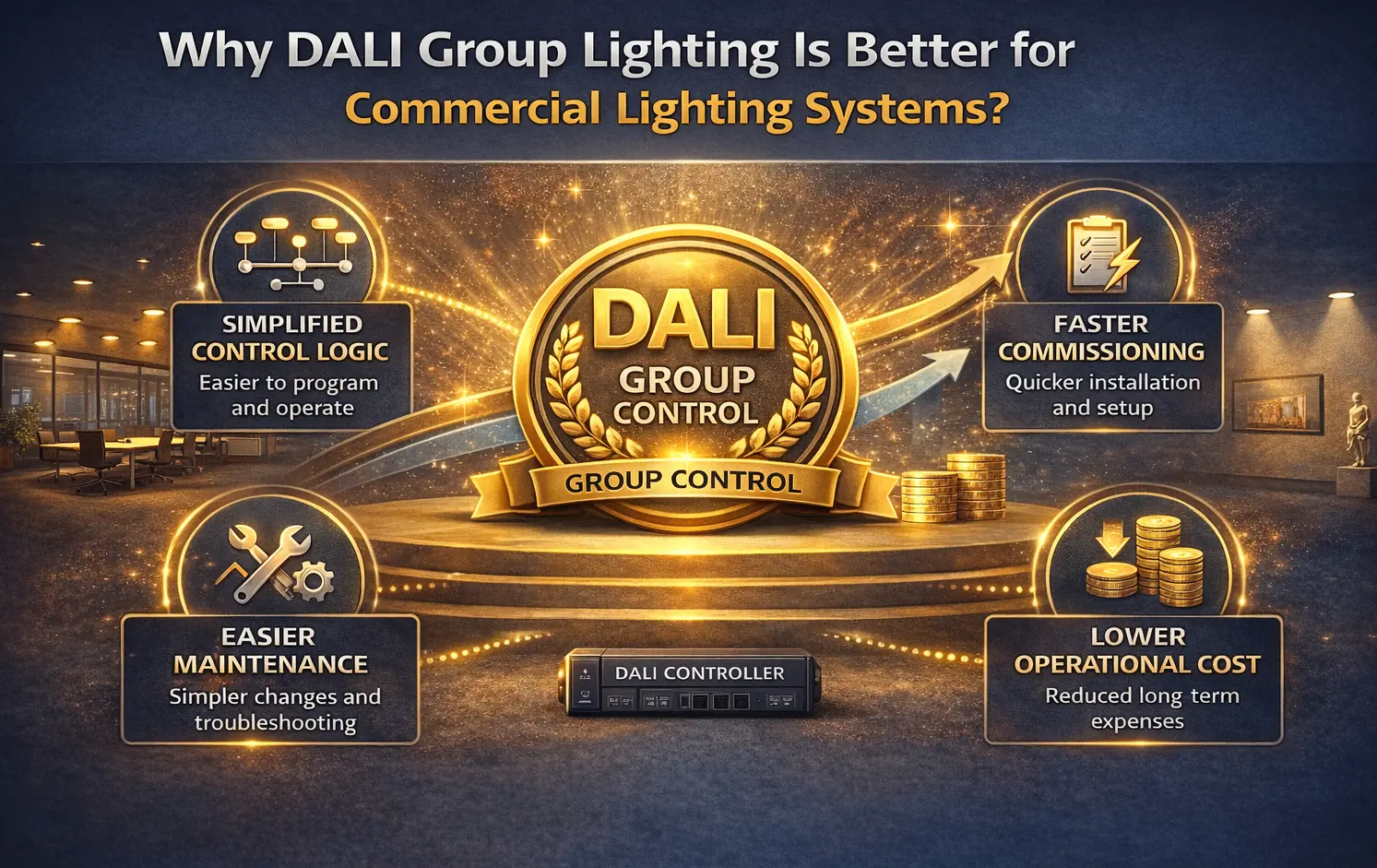
For most commercial projects, DALI Group Lighting Control delivers a better balance between flexibility, efficiency, and operational simplicity.
Key advantages include:
- Simplified control logic
- Faster commissioning
- Easier maintenance
- Lower long-term operational cost
In offices, supermarkets, shopping malls, and warehouses, controlling lighting by function or zone is far more practical than managing each fixture individually.
Energy Efficiency: DALI Group Lighting Control vs Individual Control
Energy saving is one of the strongest arguments for adopting DALI systems. However, group-based control often delivers more consistent real-world savings.
Why grouping saves more energy:
- Enables synchronized dimming across zones
- Works seamlessly with occupancy sensors
- Supports daylight harvesting strategies
| Energy Factor | Group Control | Individual Control |
|---|---|---|
| Daylight Dimming | Zone-based optimization | Overly granular |
| Occupancy Control | Reliable and predictable | Complex logic |
| User Behavior | Easier to manage | Risk of misuse |
In practice, group control reduces energy waste caused by inconsistent user interaction.
DALI Group Control for Scene Lighting and Space Flexibility
One of the strongest features is scene management.
Scenes allow predefined lighting settings to be activated instantly, such as:
- Work mode
- Presentation mode
- Cleaning mode
| Scene Feature | Group Control Advantage |
|---|---|
| Scene Recall | Faster and more reliable |
| Reconfiguration | Software-based |
| User Training | Minimal |
This makes group control ideal for spaces that change function throughout the day.
Installation and Commissioning: Which Is More Efficient?
From an engineering perspective, DALI Group Lighting Control significantly reduces commissioning time.
| Installation Aspect | Group Control | Individual Control |
|---|---|---|
| Addressing | Simple group assignment | Individual mapping |
| Programming | Straightforward | Time-consuming |
| Future Changes | Easy | Labor-intensive |
For large-scale commercial installations, these differences directly impact project cost and delivery timelines.
When Individual Lighting Control Makes Sense
Despite its advantages, DALI group lighting is not always the best option.
Individual control may be preferred when:
- Each luminaire must respond uniquely
- Lighting design is highly artistic
- Visual focus outweighs operational efficiency
However, these scenarios are the exception rather than the rule in standard commercial environments.
DALI Group Lighting Control and Long-Term Maintenance
Maintenance efficiency is often overlooked during system design. Group-based control simplifies:
- Fault diagnosis
- Device replacement
- System upgrades
Technicians can manage entire zones without reprogramming individual addresses, reducing downtime and labor costs.
Which Is Better: Final Verdict
For most commercial and energy-focused projects, DALI Group solution is the better choice.
Choose if you need:
- Scalable commercial lighting
- Reliable energy savings
- Simplified operation and maintenance
- Faster project deployment
Choose Individual Lighting Control if you need:
- Extreme precision per luminaire
- Architectural or display-focused lighting
In the majority of real-world commercial applications, group control offers the best balance between performance, cost, and efficiency.
Conclusion: Why DALI Group Lighting Control Dominates Commercial Projects
As commercial lighting systems continue to evolve, simplicity and scalability are becoming more valuable than excessive granularity. It aligns perfectly with these demands, making it the preferred solution for offices, retail spaces, and large commercial buildings.
By choosing the right control strategy from the start, project stakeholders can achieve long-term energy savings, operational stability, and future-proof lighting infrastructure.

