
Efficiency Beast: A Deep Dive into the Tech Behind 160 lm/W Recessed LED Downlights
By Powerstar
If you are still specifying standard 100 lm/W fixtures for your projects, you are leaving massive energy savings on the table compared to modern 160 lm/W recessed LED downlights For years, the industry standard hovered comfortably around 90 to 100 lumens per watt (lm/W). Facility managers and lighting designers accepted this as the baseline. But technology doesn’t stand still.
This isn’t just a marginal improvement; it is a generational leap in luminous efficacy. We are calling it the “Efficiency Beast” because it fundamentally changes the math of lighting design. Whether you are retrofitting a corporate office, designing a high-end retail space, or managing a 24/7 healthcare facility, understanding the mechanics behind these ultra-high-efficiency fixtures is crucial.
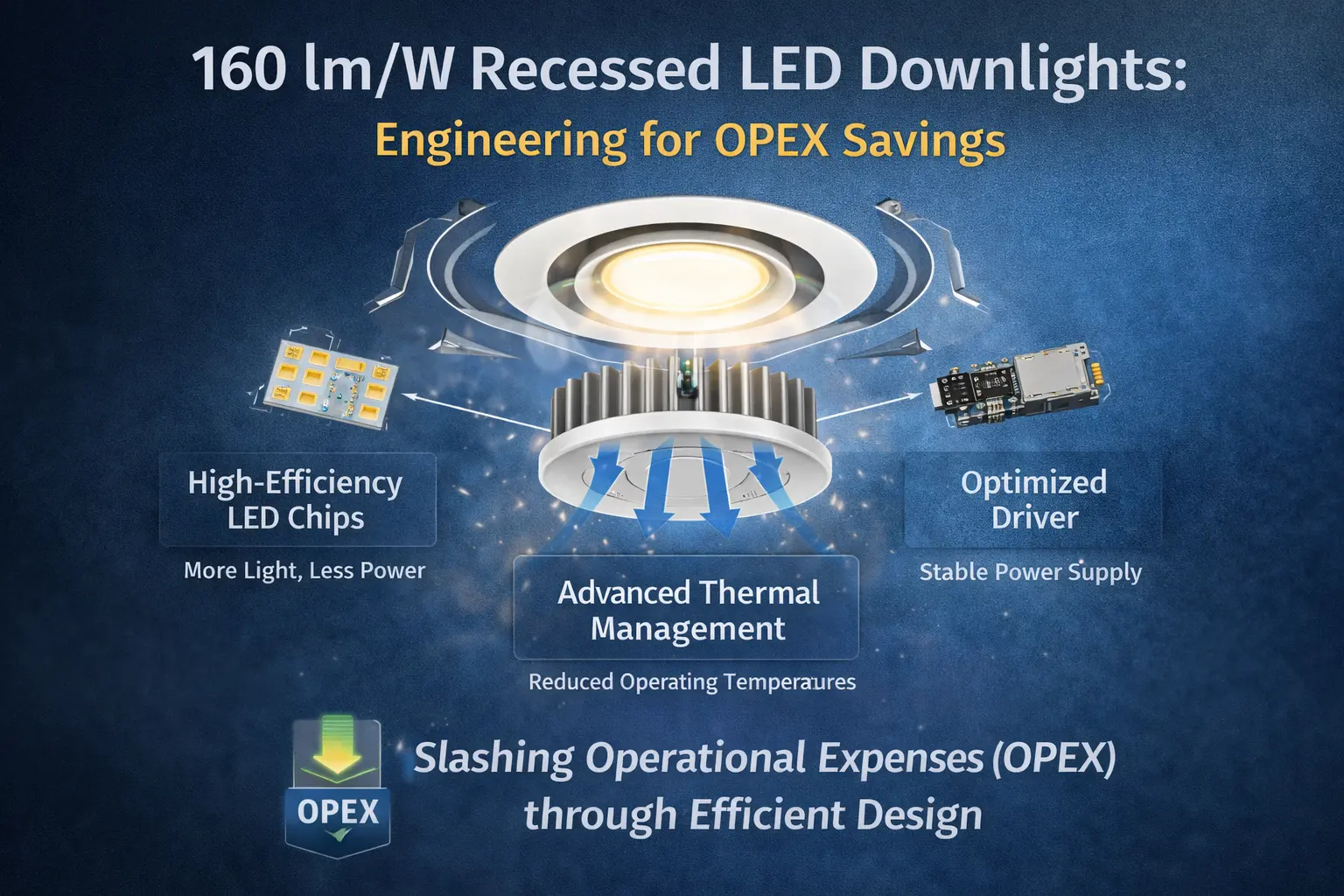
In this deep dive, we will peel back the layers of the 160 lm/W recessed LED downlights to understand the engineering that makes them tick, and why they are fast becoming the secret weapon for slashing operational expenses (OPEX).
The Metric That Matters: Why 160 lm/W?
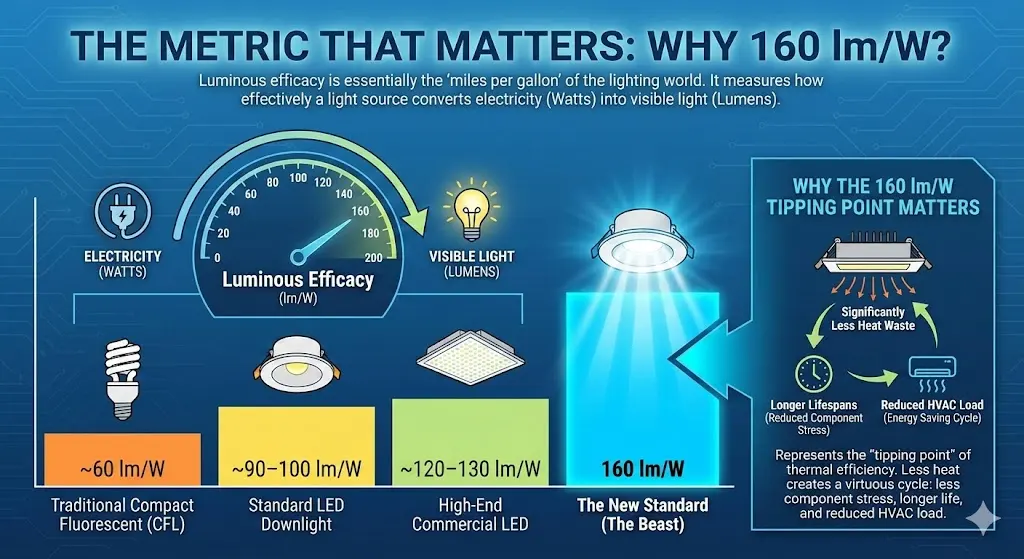
Before we tear down the hardware, we must contextualize the metric. Luminous efficacy is essentially the “miles per gallon” of the lighting world. It measures how effectively a light source converts electricity (Watts) into visible light (Lumens).
- Traditional Compact Fluorescent (CFL): ~60 lm/W
- Standard LED Downlight: ~90–100 lm/W
- High-End Commercial LED: ~120–130 lm/W
- The New Standard (The Beast): 160 lm/W
Why does this specific jump to 160 lm/W matter? Because it represents the “tipping point” of thermal efficiency. When a fixture reaches this level of efficacy, it means significantly less energy is being wasted as heat. This creates a virtuous cycle: less heat means less stress on the components, which leads to longer lifespans and reduced load on your HVAC systems.
Under the Hood: The Anatomy of an Efficiency Beast
Achieving 160 lm/W recessed LED downlights is not as simple as overdriving a standard LED chip. It requires a holistic engineering approach where every component is optimized for transmission and conversion.
Here is what differentiates a 160 lm/W fixture from a generic off-the-shelf product:
1. Top-Tier LED Chip Binning
Not all LEDs are created equal. Manufacturers of ultra-high efficiency downlights utilize premium “binning.” They select only the highest-performing chips from wafers (often from top-tier brands like CREE, Citizen, or Bridgelux).
- Current Density: These chips are often under-driven. Instead of pushing a chip to 100% capacity (which generates heat and drops efficiency), engineers might use twice as many chips running at 50% capacity. This “soft driving” technique is a key secret to hitting the 160 lm/W mark while maintaining stability.
2. Advanced Thermal Management
Heat is the enemy of efficiency. Even though 160 lm/W recessed LED downlights run cooler than their predecessors, thermal management remains critical to maintain that curve over 50,000+ hours.
- Cold Forged Aluminum: Unlike die-cast aluminum which can have air pockets, cold forged heat sinks offer superior thermal conductivity (typically 226 W/m·K vs 96 W/m·K for die-cast).
- Aerodynamic Design: The housing is often designed with convection channels that allow air to flow naturally through the heatsink, pulling heat away from the junction point of the LED.
3. High-Transmittance Optics
You can have the most efficient chip in the world, but if you cover it with a cheap diffuser, you lose that light.
- The Challenge: Standard milky diffusers can block 20-30% of light output.
- The Solution: High-efficiency fixtures use optical-grade PMMA or Polycarbonate lenses with light transmission rates exceeding 93-95%. They use micro-prismatic structures to diffuse the light (reducing glare) without killing the lumen output.
The Financial Argument: ROI and Total Cost of Ownership
For the B2B buyer, technical specs are interesting, but the ROI (Return on Investment) is vital. Let’s break down the math of switching to 160 lm/W recessed LED downlights.
Imagine a commercial corridor requiring 200,000 lumens of total light output.
- Scenario A: Standard LEDs (100 lm/W)
- Total Wattage Required: 2,000 Watts
- Annual Consumption (12 hours/day, 365 days): 8,760 kWh
- Scenario B: Efficiency Beast (160 lm/W)
- Total Wattage Required: 1,250 Watts
- Annual Consumption: 5,475 kWh
The Result: You save nearly 38% on electricity bills instantly. When you factor in the reduced cooling load (since the lights emit less heat), the savings often push past 40%. For large-scale projects like airports, shopping malls, or office towers, this translates to thousands of dollars in pure profit added to the bottom line annually.
Beyond Efficiency: Longevity and Maintenance
There is a hidden cost in lighting that often dwarfs the electricity bill: Maintenance.
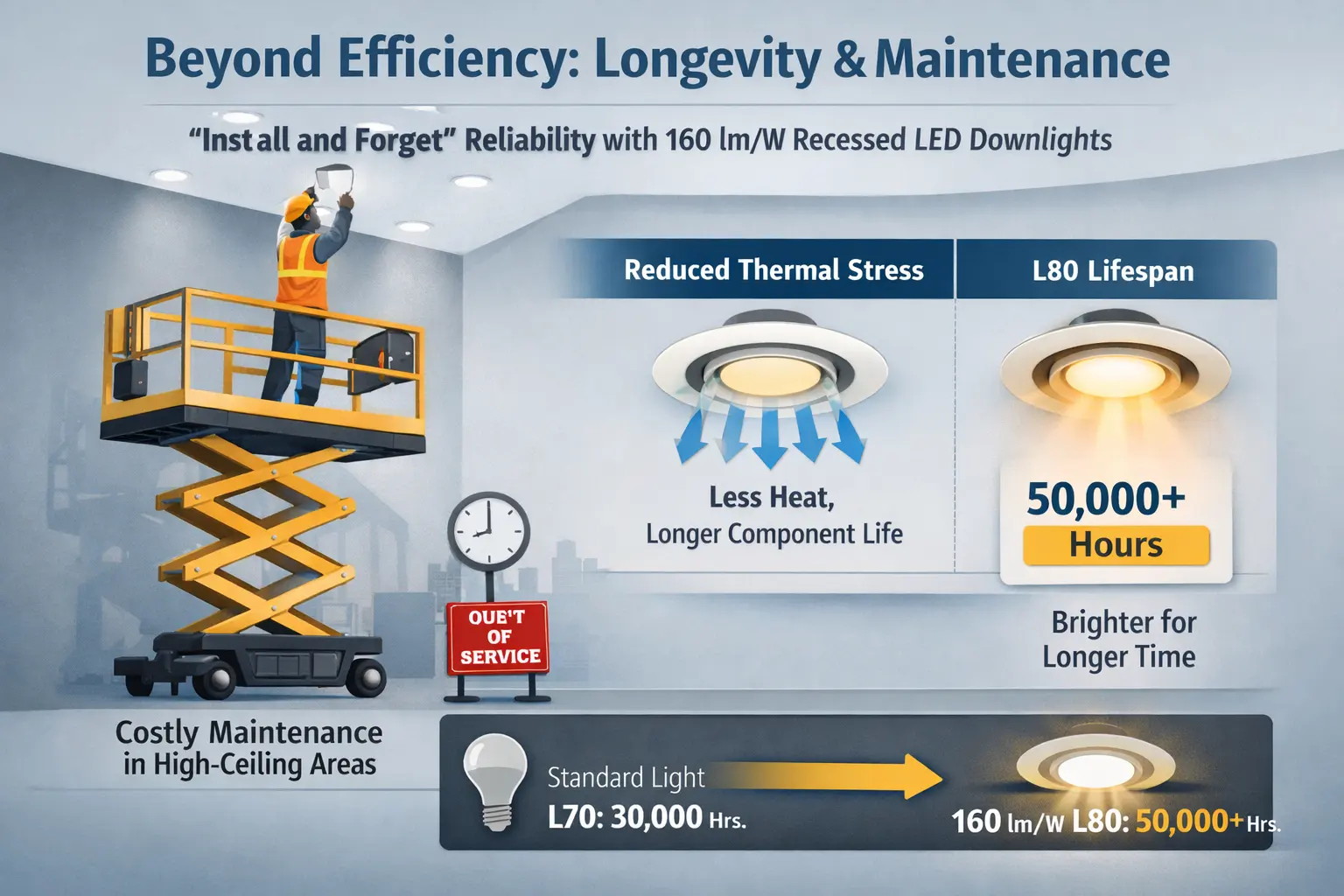
In high-ceiling applications—such as hotel lobbies, double-height retail stores, or conference centers—changing a light bulb isn’t just about unscrewing a bulb. It involves renting a scissor lift, hiring labor, and potentially shutting down operations during business hours.
160 lm/W recessed LED downlights are engineered for what we call “Install and Forget” reliability.
- Reduced Thermal Stress: Because the fixture converts more energy into light and less into heat, the internal driver capacitors and LED phosphor degrade much slower.
- Lumen Maintenance (L80B10): A standard light might hit L70 (70% brightness remaining) at 30,000 hours. A 160 lm/W fixture, running cooler, often boasts L80 lifespans exceeding 50,000 to 60,000 hours.
Debunking the Myths: Efficiency vs. Light Quality
A common misconception among lighting designers is that high efficiency requires sacrificing light quality (CRI). In the past, this was true. The easiest way to get high lumens was to use a very cool, green-tinted phosphor mix (Low CRI, High CCT).
However, modern phosphor technology has bridged this gap.
- CRI 90+ Capability: It is now entirely possible to manufacture 160 lm/W recessed LED downlights with a Color Rendering Index (CRI) of 90 or higher. This ensures that merchandise in a store looks vibrant and skin tones in an office look healthy.
- UGR (Unified Glare Rating): High brightness can lead to high glare. The best 160 lm/W fixtures pair the high-output chip with deep-baffle reflectors or honeycomb louvers. This ensures UGR<19, making them suitable for office environments where screen glare is a concern.
Application Scenarios: Where the Beast Roams
Where should you deploy these high-performance fixtures? While they work everywhere, they offer the fastest payback in specific scenarios:
- 24/7 Operations: Hospitals, airports, and hotel lobbies where lights never turn off. The payback period for 160 lm/W recessed LED downlights in these environments is often less than 12 months.
- Green Building Certifications: Projects aiming for LEED (Leadership in Energy and Environmental Design) or WELL certifications need to meet strict power density requirements (watts per square foot). These fixtures are the easiest way to earn those points without sacrificing brightness.
- High-Ceiling Retail: In supermarkets or car showrooms with 4m+ ceilings, you need punchy light to reach the floor. High efficacy ensures you get that lux level without a massive energy footprint.
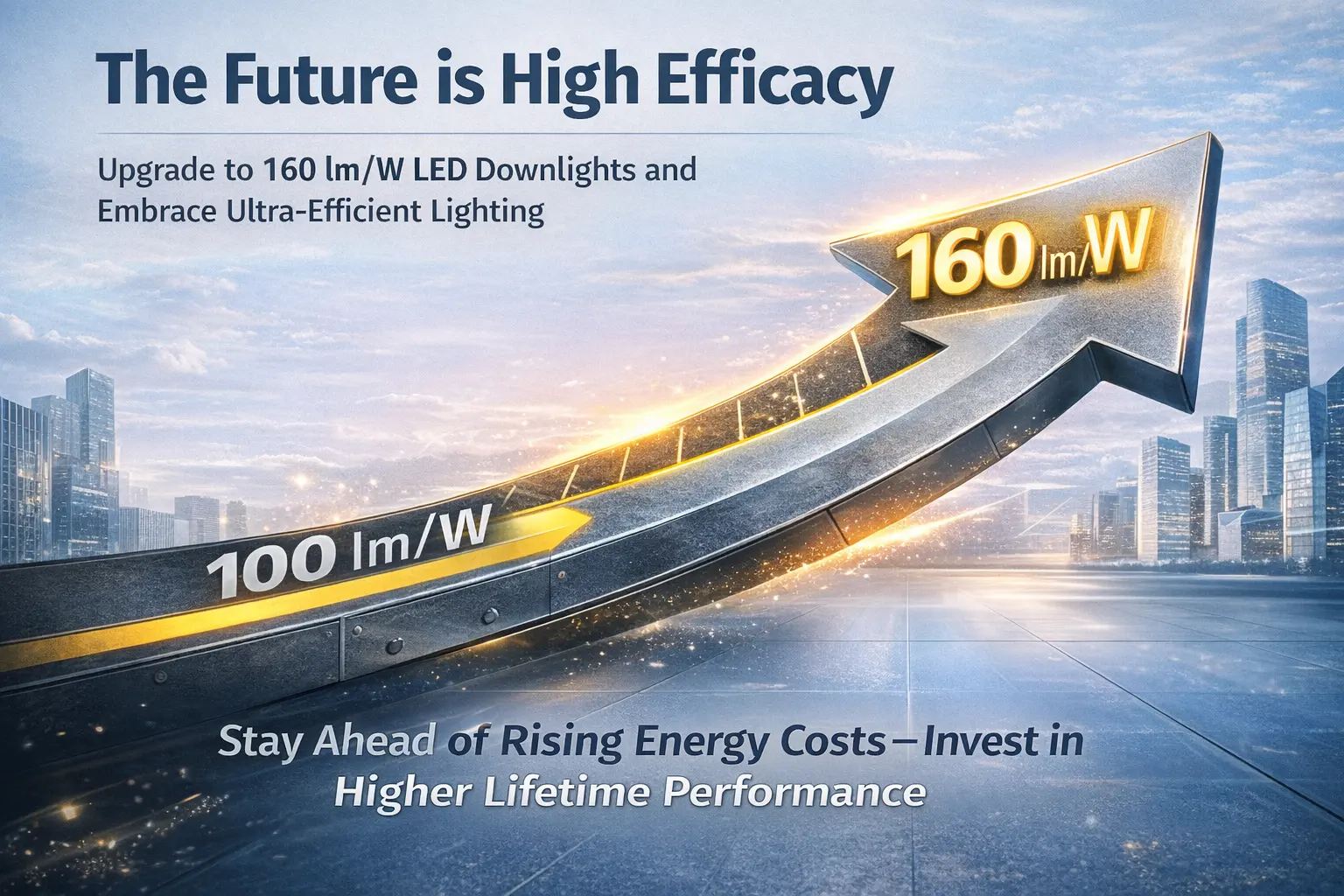
Conclusion: The Future is High Efficacy
The era of the 100 lm/W standard is drawing to a close. As global energy regulations tighten and electricity costs rise, the shift toward ultra-efficient lighting is inevitable.
Choosing 160 lm/W recessed LED downlights is no longer just a choice for the “eco-friendly”; it is a strategic business decision. It signals a commitment to quality, sustainability, and fiscal responsibility.
Don’t let your lighting budget be consumed by outdated technology. Embrace the beast, and let efficiency drive your lighting design forward.