



How Smart Lighting Greatly Reduce Electricity Cost in Stores?
By Powerstar
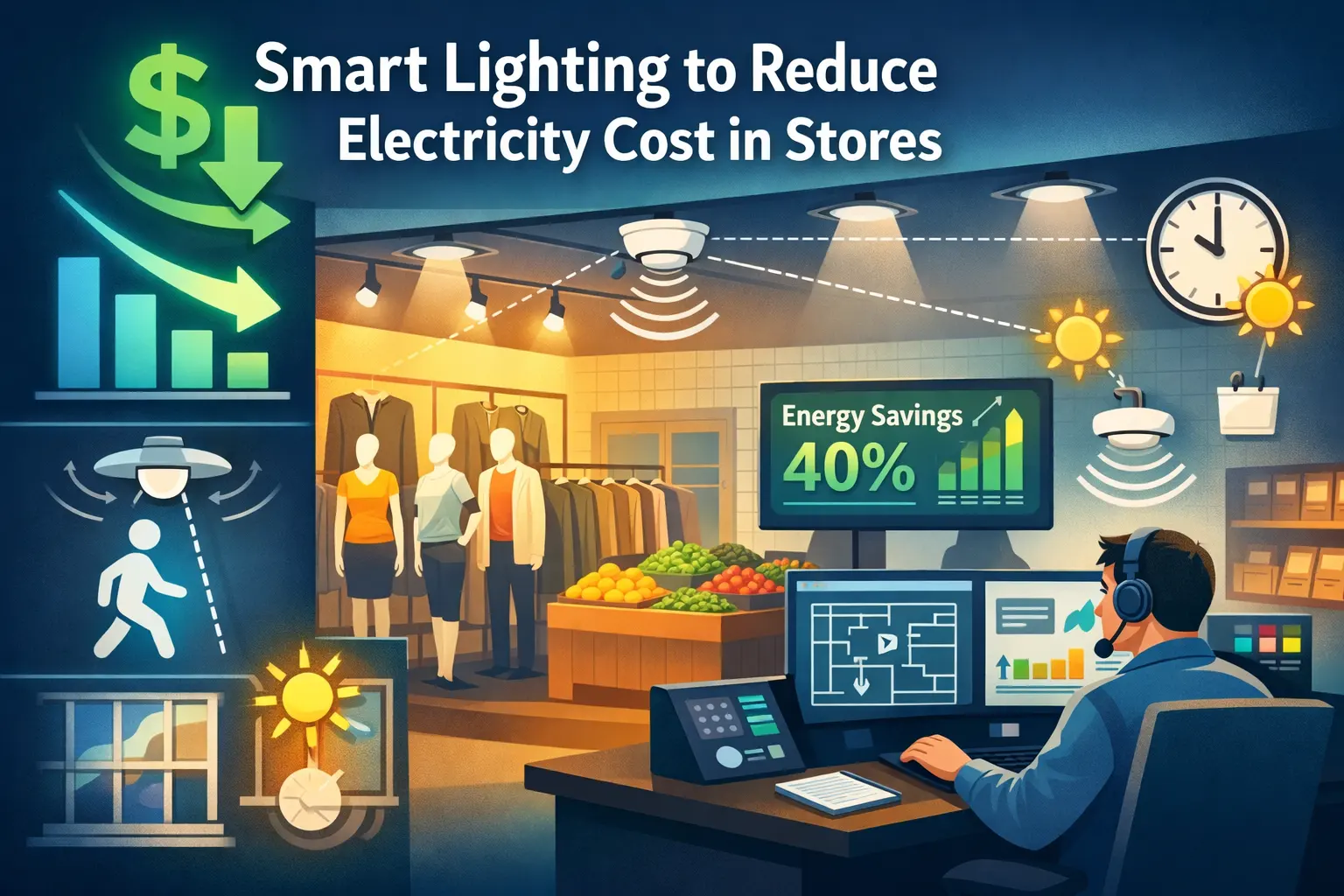
Rising electricity prices have become a major operational challenge for retail stores and chain brands worldwide. Lighting alone can account for a significant portion of total energy consumption, especially in supermarkets, fashion stores, convenience stores, and large retail spaces with long operating hours.
This is why more businesses are turning to smart lighting to reduce electricity cost in stores—not as a trend, but as a measurable cost-saving strategy.
This article explains how smart lighting systems help retail stores lower electricity bills, which technologies deliver the highest savings, and why smart lighting has become one of the fastest-return investments in commercial retail environments.
Why Lighting Is a Major Driver of Retail Electricity Bills
Retail lighting is often designed for visual merchandising, comfort, and brand presentation. The issue is not that lighting is “too bright,” but that it is frequently overused—running at full output regardless of traffic, time of day, or available daylight.
Common cost drivers include:
- Extended operating hours (including cleaning and restocking time)
- Uniform brightness across zones with different needs (aisles vs. displays vs. back-of-house)
- No occupancy-based control in low-traffic areas
- No dimming strategy during off-peak hours
- Poor maintenance visibility (faulty drivers or misconfigured schedules)
This is precisely why many teams explore smart lighting to reduce electricity cost in stores—because it targets wasted runtime and over-illumination, not just lamp efficiency.
How Smart Lighting Reduces Electricity Cost in Stores
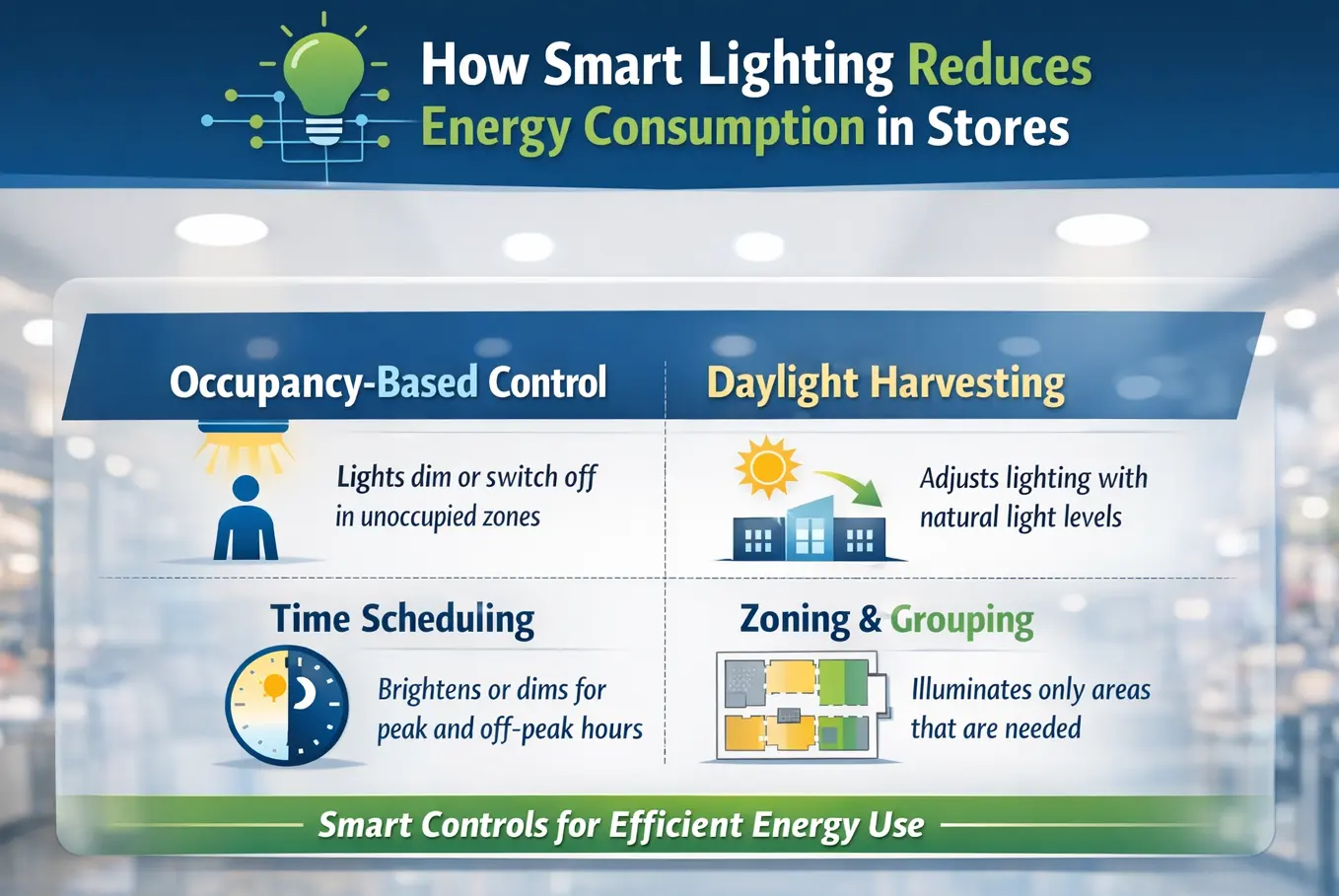
how smart lighting reduces energy consumption in stores
The core value of smart lighting lies in intelligent control, not just efficient luminaires. Smart systems dynamically adjust lighting based on real-world conditions, significantly lowering unnecessary energy usage.
Key mechanisms include:
- Occupancy-based control: Lights dim or switch off automatically in unoccupied zones
- Daylight harvesting: Artificial lighting adjusts according to available natural light
- Time scheduling: Different brightness levels for peak and off-peak hours
- Zoning and grouping: Only relevant areas are illuminated when needed
Together, these features explain how smart lighting reduces energy consumption in stores while maintaining a consistent and professional shopping environment.
Smart Lighting for Energy Reduction for Retail Stores Through Zoning and Scenes
One of the fastest ways to unlock savings is to move from “all lights behave the same” to a zoning model aligned with retail operations.
A practical zoning approach:
- Window / storefront zone: prioritize daylight harvesting and glare control
- Feature display zone: scene-based emphasis during peak traffic
- Main aisles: stable target level with mild dimming during off-peak
- Checkout zone: consistent brightness for safety and customer comfort
- Back-of-house: aggressive occupancy control and shorter runtime
Typical scene examples:
- Opening scene: moderate lighting, gradual ramp-up
- Peak scene: full merchandising impact
- Off-peak scene: reduce ambient levels while maintaining display highlights
- Cleaning / restocking: task lighting where needed, not everywhere
This is why “smart lighting energy saving for retail stores” is strongly tied to the concept of scene control. Even a 10–20% reduction in average dimming level for several hours per day can materially reduce consumption—especially across multiple locations.
Retail Smart Lighting Energy Reduction with Sensors and Automation
Sensors are often the difference between a “controllable” lighting system and a “cost-saving” one. Automation removes reliance on human behavior, which is inconsistent across shifts and locations.
Key sensor types used for retail energy reduction:
- Occupancy / motion sensors: ideal for low-traffic zones and back-of-house
- Daylight sensors: valuable near glass storefronts, atriums, and skylights
- Traffic-aware logic (advanced setups): helps tune scenes to customer flow patterns
Best practice is not to over-sensor every square meter. Instead, focus sensors where:
- lights are frequently left on unnecessarily
- daylight influence is strong
- traffic is intermittent or unpredictable
This approach increases the ROI of smart lighting to reduce electricity cost in stores by allocating hardware where it produces the highest savings.
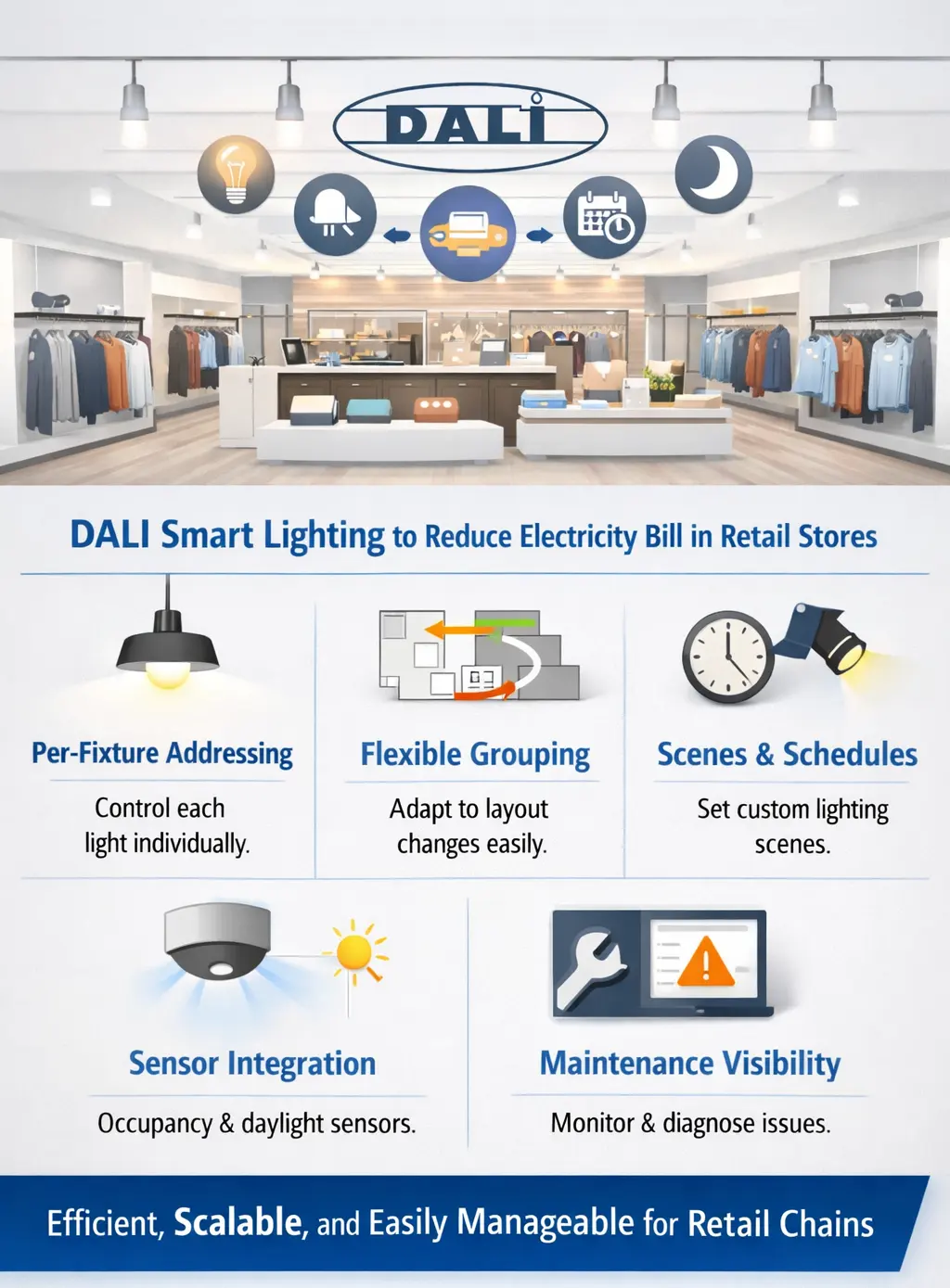
DALI Smart Lighting to Reduce Electricity Bill in Retail Stores
For commercial projects, DALI (Digital Addressable Lighting Interface) is widely adopted because it enables addressable control, dimming, grouping, and scene management at scale.
How DALI supports retail cost reduction:
- Per-fixture addressing: control at luminaire level without rewiring zones
- Flexible grouping: reconfigure layouts when merchandise or store design changes
- Scenes and schedules: consistent brand lighting across time periods
- Integration with sensors: occupancy and daylight logic without manual switching
- Maintenance visibility: easier fault detection and driver-level feedback (depending on device capabilities)
If you manage chain stores, a DALI-based approach often simplifies standardization: you can replicate scene templates and zoning logic across sites, then fine-tune locally for store geometry.
When customers search “DALI smart lighting energy saving,” they usually want a system that is both efficient and manageable, not just technically advanced. This is an important angle to emphasize in your article.
Smart Lighting ROI for Retail Stores: What Savings to Expect
Decision-makers ultimately ask: “How much will this save, and how quickly?” The most credible way to answer is to frame savings around controllable variables:
- Operating hours (e.g., 12–16 hours/day)
- Baseline lighting load (installed watts and typical dimming behavior)
- Daylight availability (storefront, skylights, region)
- Traffic patterns (constant vs. variable)
- Control strategy (scheduling only vs. scheduling + sensors + daylight harvesting)
A practical ROI narrative:
- Fast wins: scheduling + scene dimming across the entire store
- High-impact zones: occupancy control in back-of-house and low-traffic areas
- Incremental optimization: daylight harvesting near windows and atriums
- Scalable savings: multiplying benefits across multiple stores
For chain operations, even modest per-store savings become significant when rolled out across dozens of locations—one of the core reasons smart lighting to reduce electricity cost in stores is increasingly prioritized by retail facility teams.
Energy Efficient Smart Lighting for Shops: Implementation Checklist
To ensure your project delivers real cost reduction, use this implementation checklist:
- Define store zones and target light levels (by function, not by aesthetics alone)
- Create at least 3–5 lighting scenes aligned to operations (opening, peak, off-peak, closing, cleaning)
- Deploy occupancy sensors in back-of-house, storage, and intermittent zones
- Add daylight harvesting near storefronts or skylight areas
- Ensure your control system supports easy reconfiguration (important for retail layout changes)
- Standardize templates across locations, but allow site-level calibration
- Track results using energy monitoring and adjust schedules after 2–4 weeks of real operation
If you include this checklist in your SEO article, it increases perceived expertise and supports conversion, because it answers “what do I do next?”
Conclusion: Smart Lighting to Reduce Electricity Cost in Stores Without Compromising Experience
Retail lighting is both an operational cost and a brand asset. The most effective solutions do not simply “turn lights down”—they apply controls that match lighting output to real conditions: occupancy, daylight, time-of-day, and zone purpose.
When designed correctly, smart lighting to reduce electricity cost in stores becomes a repeatable strategy for single shops and chain networks alike. By combining scheduling, zoning, sensors, and scalable control protocols such as DALI, retailers can reduce waste, stabilize operating costs, and maintain a consistent customer experience across locations.

