



Surprised? Dali-2 Dimmable Led Track Lighting Has 2 Dimming Modes You Should Know!
By Powerstar
- Introduction
- 1. Comprehensive Guide to DALI-2 Dimmable LED Track Lighting Dimming Curves
- 2. Technical Comparison: Logarithmic vs. Linear Dimming Curves
- 3. Real-World Industry Cases
- 4. Troubleshooting Common DALI-2 Dimming Issues
- 5. Commercial Application
- 6. Our Professional DALI-2 Dimmable Lighting Solutions
- 7. Conclusion: Making Light and Shadow Serve the Space
As commercial lighting enters a fully intelligent era, DALI-2 dimmable LED track lighting has become a standard solution for high-end retail stores, galleries, museums, and modern office spaces. However, simply choosing luminaires that support the DALI protocol is far from enough.
In real projects, lighting designers and system integrators often encounter unexpected problems:
uneven dimming, visible brightness jumps at low levels, poor synchronization between fixtures, or uncomfortable visual transitions — even when premium luminaires are used.In most cases, these issues are not caused by the luminaires themselves, but by an incomplete understanding of the two core DALI dimming modes: Logarithmic Dimming and Linear Dimming.
This article takes you deep into the technical fundamentals of DALI-2 dimming, explains how these two dimming curves work in real applications, and shows how to optimize DALI-2 dimmable LED track lighting for different commercial lighting scenarios.
1. Comprehensive Guide to DALI-2 Dimmable LED Track Lighting Dimming Curves
In the DALI-2 standard (IEC 62386-102), the dimming curve defines the relationship between the control signal (0–254) and the actual light output or power.
1.1 What is Linear Dimming? (Optimizing Linear Dimming for Industrial Lighting)
Principle: The change in the control signal is linearly proportional to the light output or power of the luminaire.
Characteristics: As the control signal increases step-by-step, the light output increases proportionally. Sensors measure brightness values that are directly proportional to the light output.
Best Use Cases: Closed-loop control systems (light sensors/PLC/BMS), engineering lighting, tunnel lighting, and industrial sites.
Pros & Cons: It is simple, predictable, and easy to standardize. However, manual dimming feels “jumpy” at low brightness levels, and changes at high brightness are barely perceptible to the human eye.
1.2 What is Logarithmic Dimming? (Enhancing Visual Comfort in Retail Lighting)
Principle: The control signal simulates how the human eye perceives brightness (based on Weber–Fechner Law).
Characteristics: Changes are extremely fine at low brightness levels and gradually decrease as brightness increases. This makes dimming operations feel much smoother and more natural.
Best Use Cases: Commercial, retail, and exhibition spaces where manual dimming is the primary operation.
Pros & Cons: It enhances visual comfort and the customer experience through smooth manual dimming. However, it may cause instability or oscillations in sensor-based closed-loop systems and is more complex to deb
1.3 Human Physiology: The Weber-Fechner Law
To understand dimming, one must first understand the human eye. According to the famous Weber-Fechner Law, the human perception of a stimulus is logarithmic. Simply put, in a dark environment, even a slight increase in brightness is very noticeable to the human eye; however, in a bright environment, the same amount of increase in brightness is barely perceptible.
- Logarithmic Dimming: This is a “human-centric” algorithm. It sets extremely dense digital steps in the low-brightness range (0% – 20%), occupying approximately 75% of the DALI dimming levels. This means that dimming becomes exceptionally delicate in the areas where the human eye is most sensitive.
- Linear Dimming: This is a “device-centric” algorithm. The light output grows in a direct 1:1 proportion with the digital commands. This mode ignores the bias of visual perception and pursues absolute precision in electrical parameters.
1.4 Mandatory Requirements of the DALI-2 Standard
In the early DALI-1 era, different manufacturers had varying definitions of dimming curves, leading to uneven brightness when mixing luminaires from different brands. The DALI-2 standard (IEC 62386-102) explicitly stipulates that all certified drivers must support the standard logarithmic curve by default. This ensures visual consistency for cross-brand luminaires under the same control system.
2. Technical Comparison: Logarithmic vs. Linear Dimming Curves
To help you choose the right DALI-2 dimming curve selection, refer to the following performance comparison:
| Key Dimension | Logarithmic Dimming Curve | Linear Dimming Curve |
| Visual Transition | Smooth, “breathing” feel; every step feels uniform to the eye. | Abrupt, “jumpy” feel; changes are too fast at low levels. |
| Low-brightness Resolution | Extremely high; supports smooth dimming down to 0.1% or 0.01%. | Lower; difficult to achieve stable adjustment below 5%. |
| Luminous Flux Response | Non-linear growth to offset human visual perception errors. | Linear growth based on a straight-line slope. |
| Power Consumption | Slow growth initially, rapid growth at high levels. | Power increases linearly with the dimming value. |
| System Synchronization | Excellent; the universal default for DALI-2 devices. | Challenging; requires manual configuration and can be affected by host algorithms. |
| Primary Goal | Visual comfort, atmosphere, and premium experience. | Energy statistics, plant lighting, and data analysis. |
3. Real-World Industry Cases: Why Dali Dimming Curve Selection Matters
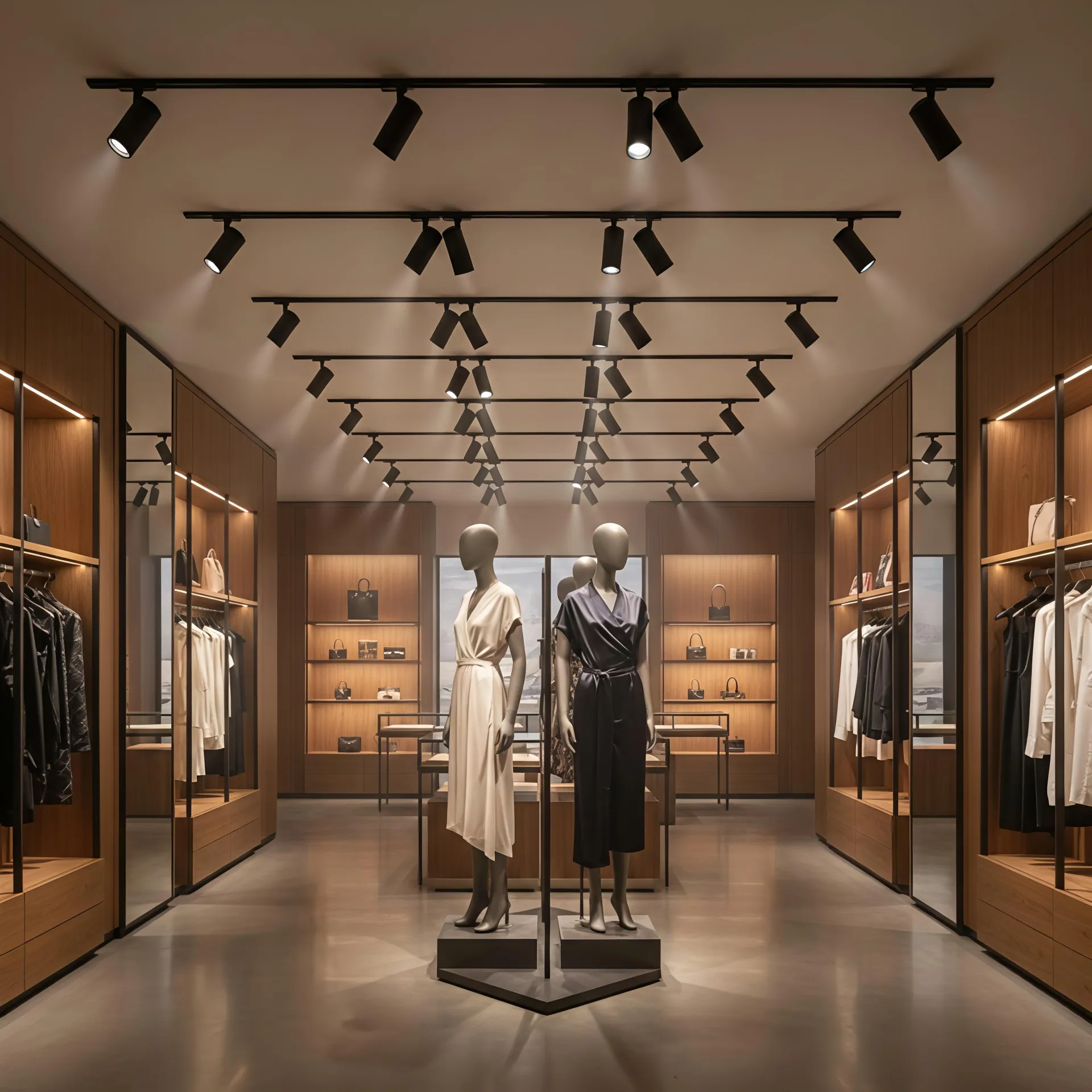
Case A: The “Sudden Drop” Crisis in a Luxury Store
A high-end fashion boutique used DALI-2 Dimmable LED Track Lighting in its display windows. The owner wanted to lower the brightness to 2% at night to create a mysterious atmosphere.
- Problem: The drivers were set to linear mode by default. When dimming from 5% to 2%, the lights flickered violently and the brightness “fell off a cliff,” ruining the visual experience.
- Solution: The technical team switched the curve to logarithmic mode via DALI configuration tools. Utilizing its high-resolution characteristics, they achieved a smooth 3-second fade, making the light transition feel like silk.
Case B: Accurate Energy Monitoring in a Smart Office
A Grade-A office building needed to integrate its lighting into an energy analysis platform to calculate carbon emissions per floor.
- Challenge: With logarithmic dimming, the error in estimating power consumption was as high as 15% because the DALI value was not proportional to power.
- Solution: Engineers set all DALI-2 Linear Lights in public areas to linear mode. This ensured the control signal directly matched the power percentage, increasing energy monitoring accuracy to over 98%.
4. Troubleshooting Common DALI-2 Dimming Issues
When deploying flicker-free deep dimming solutions, you may encounter these common technical bottlenecks:
- “Fast-then-Slow” Dimming Feel: If the light feels like it has already reached 90% brightness when the knob is only turned halfway, it is a classic sign of the linear curve. The fix is to change the driver to logarithmic mode.
- Multi-brand Incompatibility: If Brand A track lights and Brand B downlights show different brightness at the same percentage, you must calibrate the dimming mapping using DALI-2 certification tools.
- Flicker at Ultra-low Levels: Jumpy steps in linear mode can cause driver instability at 0.1% brightness. Switching to logarithmic mode and setting a proper MIN LEVEL will ensure stable current.
5. Commercial Application: Why We Recommend Logarithmic for “Visual-First” Projects
5.1 DALI-2 LED Track Lighting (Spotlighting Perfection)
Track lights are primarily used for spotlighting in museums or high-end retail. Logarithmic dimming ensures that scene transitions are gradual and invisible, avoiding any distraction for the viewer.
5.2 DALI-2 LED Downlighting (Ensuring Uniformity)
In large spaces with groups of downlights, the human eye is sensitive to brightness variances on the ceiling. Uniformly using the logarithmic curve is key to maintaining a premium, consistent look across the entire space.
5.3 Linear & Panel Lighting (Creating “Ritualistic” Fades)
Linear and panel lights have large luminous surfaces. Using a logarithmic curve with a longer Fade Time allows the light to fill the space like flowing water, a sense of “ritual” that linear dimming cannot replicate.
6. Our Professional DALI-2 Dimmable Lighting Solutions
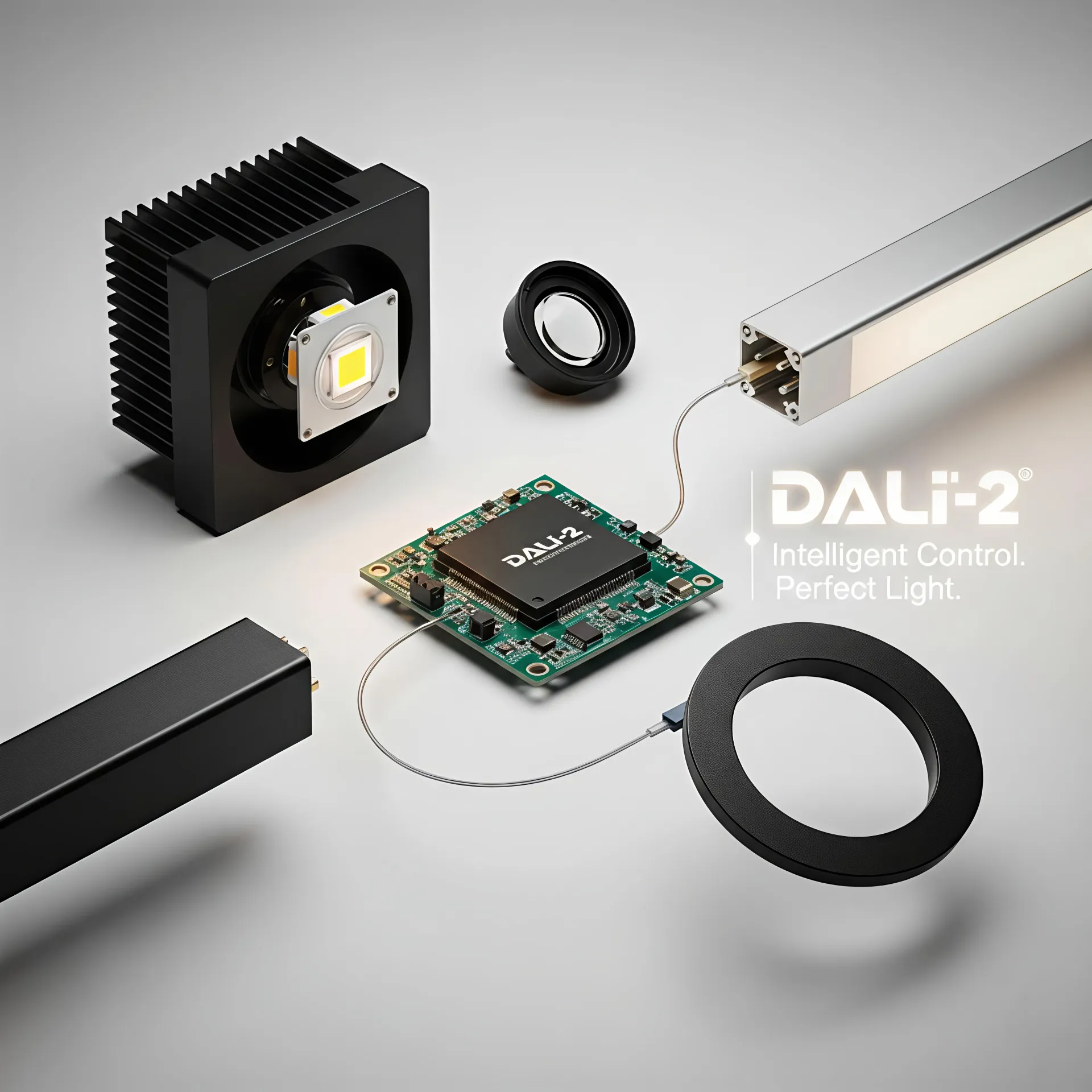
As a professional commercial lighting provider, our DALI-2 Dimmable LED Track Lighting series offers several technical advantages:
- Protocol Compatibility: Fully compatible with DALI-2 (Part 102/207) for dynamic curve switching.
- NFC Rapid Configuration: Batch-configure dimming curves via a smartphone app without even powering on the fixtures, significantly reducing on-site labor.
- Stable Deep Dimming: Achieve 0.1% flicker-free dimming to meet the strictest gallery requirements.

7. Conclusion: Making Light and Shadow Serve the Space
In the world of DALI-2 Dimmable LED Track Lighting, there is no absolute winner between the two modes; they are tools for different purposes.
- Linear Dimming: Best for stability in closed-loop systems (downlights and linear lights in steady-state lighting).
- Logarithmic Dimming: Best for a smooth visual experience (track lights and display areas).
The best practice is to choose based on the product type and application or adopt a dual-layer strategy: use linear dimming for the control layer to ensure engineering stability, and logarithmic curves for the user operation layer to ensure visual perfection.

