



Turn on the Sales: How High Lumen Retail Lighting for Foot Traffic Transforms Your Business?
By Powerstar
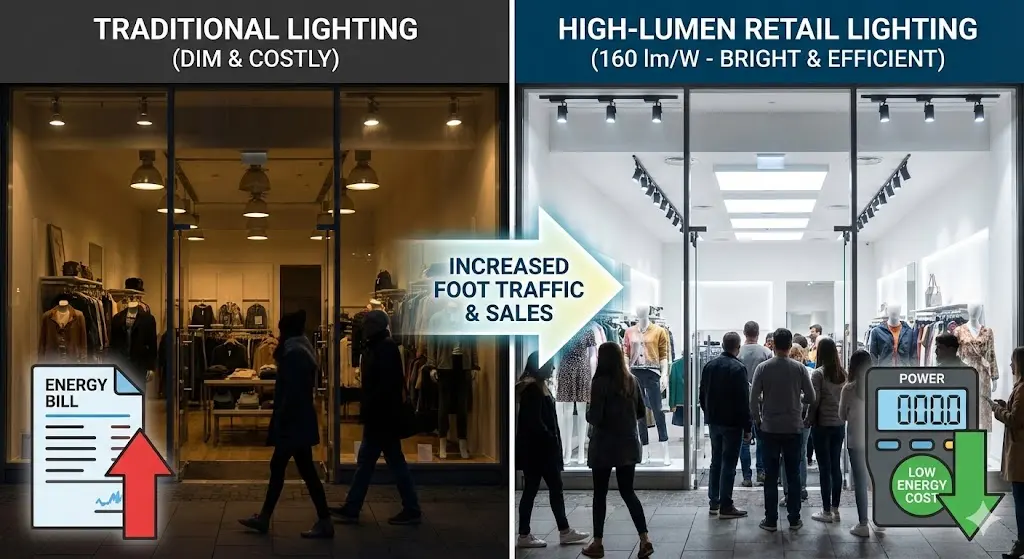
“Many store owners underestimate the power of high lumen retail lighting for foot traffic, missing out on potential customers who simply walk past their dim storefronts.”
In the fiercely competitive world of retail, the battle for a customer’s attention is won or lost in the first three seconds. Before a customer sees your price tags or touches your merchandise, they perceive one thing: Light
Many store owners view lighting merely as a utility—a necessary expense to keep the shop from being pitch black. This is a costly mistake. Lighting is, in fact, your most powerful silent salesman.
With the advent of 160 lm/W (lumens per watt) technology, the rules have changed. It is now possible to drastically increase store brightness to attract customers while simultaneously lowering energy costs. This guide explores the strategic use of high lumen retail lighting for foot traffic and why upgrading from traditional lighting to high-efficacy LEDs is the smartest marketing investment you can make this year.
The Psychology of Light: Impact of Storefront Brightness on Customer Behavior
Implementing high lumen retail lighting for foot traffic is not just an electrical upgrade; it is a strategic marketing investment that pays for itself in increased visits. Human beings possess an innate trait known as phototaxis—we are naturally drawn to light. In a busy shopping district or a crowded mall, your storefront competes with dozens of visual distractions. A dimly lit store sends subconscious signals of being “closed,” “unwelcoming,” or “low energy.”
Conversely, a bright, luminous storefront acts as a beacon.
To effectively utilize high lumen retail lighting for foot traffic, one must understand the “Contrast Ratio.” If your store is only as bright as the street outside, you blend into the background. To stop a passerby in their tracks, your window display needs to be significantly brighter than the ambient environment.
- Perceived Value: Brighter stores are often perceived as cleaner, more modern, and more trustworthy.
- The “Open” Signal: High brightness levels eliminate ambiguity. Even from a distance, customers know you are open for business.
- Guidance: Light directs the eye. High-lumen lighting doesn’t just attract people to the door; it guides them through the entrance and onto the sales floor.
What is 160 lm/W? The Advantages of High Efficacy LED Technology
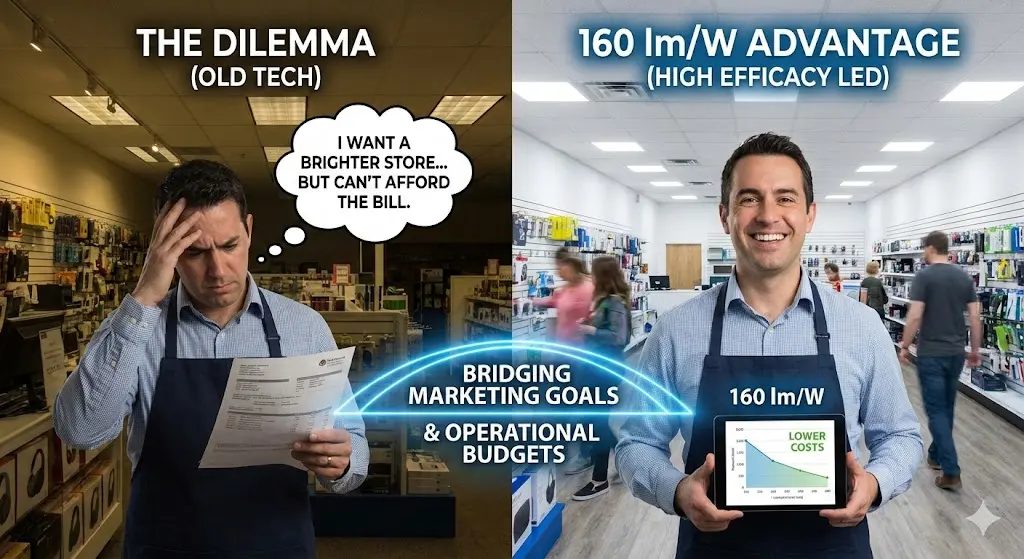
For years, retailers faced a dilemma: “I want a brighter store to attract customers, but I can’t afford the electricity bill.”
This is where 160 lm/W technology bridges the gap between marketing goals and operational budgets.
The “Miles Per Gallon” of Light
Luminous Efficacy (measured in lumens per watt, or lm/W) is essentially the fuel economy of your light fixture.
- Traditional Metal Halide: ~70-80 lm/W (Inefficient, high heat).
- Standard LED: ~90-100 lm/W (Better, but average).
- High-Efficacy LED: 160 lm/W+ (The new gold standard).
Using 160 lm/W LED technology means you get 60% more light than a standard LED for the exact same amount of electricity. This technological leap gives retailers the freedom to blast brightness at the storefront—maximizing that critical “high lumen retail lighting for foot traffic” strategy—without fearing the monthly utility bill.
Traditional vs. High-Efficiency LED Comparison: A Clear Winner
To understand why traditional lighting is killing your conversion rate (and your wallet), let’s look at the data. Many stores are still operating with outdated Metal Halide (MH) or Compact Fluorescent (CFL) fixtures.
Here is how they stack up against modern High-Efficacy LEDs:
| Feature | Traditional Metal Halide | Standard LED (100 lm/W) | High-Efficacy LED (160 lm/W) |
| Brightness Output | Degrades quickly (loses 40% light in 6 months) | Stable | Ultra-High & Stable |
| Energy Waste | High (50% energy lost as heat) | Low | Minimal |
| Lifespan | 10,000 – 15,000 Hours | 30,000 Hours | 50,000+ Hours |
| Maintenance | Frequent bulb changes required | Moderate | Zero maintenance for years |
| Heat Emission | High (Increases AC load) | Low | Negligible |
| Foot Traffic Impact | Low (Dim/Yellowing light) | Medium | High (Bright/Crisp light) |
By switching to high-efficacy fixtures, you aren’t just saving energy; you are maintaining the “Day 1” brightness required to consistently pull customers in off the street.
Maximizing ROI of High-Efficiency Commercial Lighting
When you invest in high lumen retail lighting for foot traffic, you are looking at a dual Return on Investment (ROI): Operational Savings and Revenue Growth.
1. The Operational ROI
Because 160 lm/W fixtures convert electricity to light so efficiently, you can replace a 70W Metal Halide lamp with a 20W or 30W High-Efficacy LED and achieve better brightness. This immediately slashes lighting energy costs by 60-70%. Additionally, the reduced heat emission means your air conditioning system works less, further reducing overhead.
2. The Revenue ROI
This is the hidden metric many business owners miss.
- If brighter lighting increases your foot traffic by just 5%…
- And your conversion rate remains stable…
- Your total revenue increases significantly without spending a penny on ads.
High-efficiency lighting pays for itself through energy savings, but it generates profit through increased customer visits.
Visual Merchandising Lighting Strategies to Convert Traffic
Having the hardware (160 lm/W LEDs) is the first step; placing them correctly is the second. Simply flooding a store with white light can look clinical. To truly leverage high lumen retail lighting for foot traffic, you need a design strategy.
The Window Display “Punch”
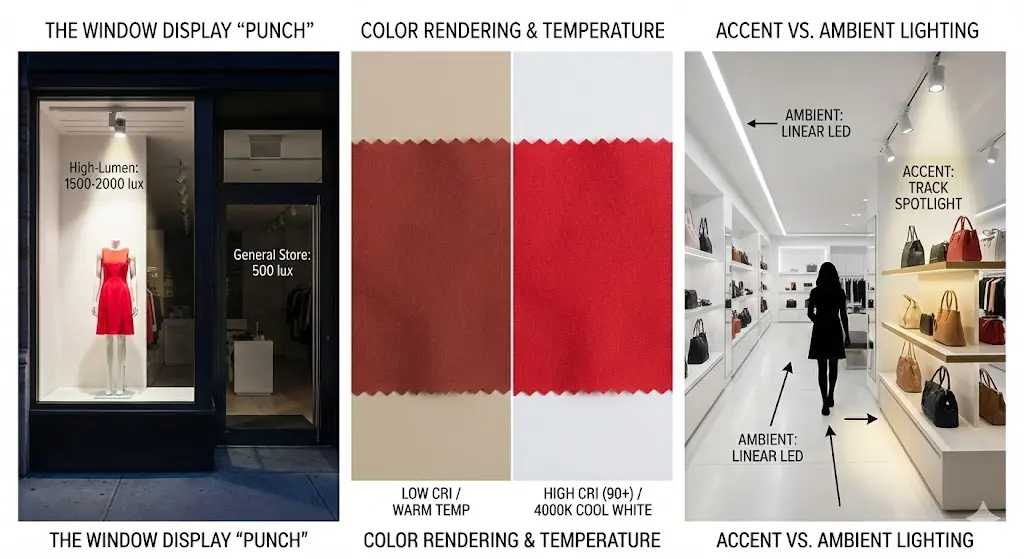
Use your highest lumen output fixtures here. If the general store lighting is 500 lux, your window display should be at least 1500-2000 lux. This contrast creates a dramatic stage that captures attention from the street.
Color Rendering and Temperature
High efficacy doesn’t mean poor color. Ensure your 160 lm/W fixtures have a CRI (Color Rendering Index) of 80 or higher (preferably 90+ for fashion and food).
- CRI: Determines how “true” colors look. A red dress should look red, not muddy brown. High CRI makes merchandise look expensive and desirable.
- Color Temperature: Use 4000K (Neutral White) or 5000K (Cool White) for window displays to mimic daylight and appear bright and energetic.
Accent Lighting vs. Ambient Lighting
Use your high-efficacy linear lights for ambient (general) lighting to keep the floor bright. Then, use high-lumen track lights to spotlight specific high-margin products. This guides the customer’s journey once they have entered the store.
Sustainable Retail Lighting Design: The Future is Green and Bright
Modern consumers are increasingly eco-conscious. Upgrading to high-efficacy lighting is a powerful CSR (Corporate Social Responsibility) story.
You can market your store not only as a bright and welcoming place but also as an environmentally responsible business. Sustainable retail lighting design using 160 lm/W fixtures reduces the carbon footprint significantly compared to traditional lighting. This resonates with younger demographics (Gen Z and Millennials) who prefer shopping with brands that share their values.
💡 Frequently Asked Questions About Retail Lighting & Foot Traffic
Q: How many lumens do I need for a retail store to increase foot traffic?
A: To stand out from the street, aim for a Contrast Ratio of 3:1. If the street outside is 300 lux, your storefront windows should be at least 1,000 lux. For the general sales floor, aim for 500-800 lux, and for detailed displays (like jewelry or electronics), target 1,500+ lux. Using 160 lm/W fixtures allows you to hit these high numbers without overloading your electrical circuits.
Q: Will increasing brightness increase my store’s temperature?
A: With traditional lights (halogens/metal halide), yes. However, with 160 lm/W High-Efficacy LEDs, the answer is no. Because these LEDs convert nearly all energy into light rather than heat, you can double your brightness while actually lowering the heat load on your air conditioning system.
Q: What is the best color temperature to attract customers?
A: For most retail scenarios, 4000K (Cool White) is the industry standard for attracting traffic. It mimics natural daylight, making the store feel “awake” and vibrant. However, high-end boutiques or bakeries may prefer 3000K (Warm White) to create a cozy, intimate atmosphere.
Q: What is the ROI period for upgrading to 160 lm/W lighting?
A: For a typical retail store operating 12 hours a day, the ROI (Return on Investment) is usually 8 to 14 months. This calculation includes energy savings and reduced maintenance, but it does not account for the potential profit increase from higher foot traffic—which can make the payback period even shorter.
Module 3: Strategic Zoning Guide
“How” to design, not just “What” to buy.
📐 The “Light Mapping” Strategy: Where to Put the Lumens
Don’t waste money lighting the floor. Use the “160 lm/W advantage” to focus light where it makes money.
Zone 1: The Transition Zone (Entrance)
- Goal: Decompression.
- Strategy: High brightness (1000+ lux).
- Why: Customers need to adjust from the outdoors. A bright entrance reduces the “threshold fear” and pulls them deep into the store.
Zone 2: The Power Wall (Right Side)
- Goal: First Impression.
- Strategy: Intense vertical illumination (Wall Washers).
- Why: Studies show 90% of customers turn right upon entering. Use high-CRI track lights here to illuminate your newest or most profitable collection.
Zone 3: The Cash Wrap (Checkout)
- Goal: Accuracy and Comfort.
- Strategy: Softer, glare-free lighting (500 lux).
- Why: This is a transactional zone. You want the staff to see clearly, but the light shouldn’t be aggressive. It allows the customer to relax while paying.
Conclusion: Light is Your Competitive Advantage
In the battle for foot traffic, you cannot afford to be the dimmest store on the block. Traditional lighting creates a barrier to entry, masking your products in shadows and inflating your operational costs.
The solution lies in the synergy of marketing and engineering. By adopting high lumen retail lighting for foot traffic, specifically utilizing 160 lm/W technology, you achieve the holy grail of retail management:
- Maximum Visibility: Attracting more walk-in customers.
- Minimum Cost: reducing energy bills to their absolute lowest.
- Superior Experience: Creating a vibrant atmosphere that encourages sales.
Don’t let potential customers walk past your door simply because they didn’t see it. Upgrade your lighting, brighten your future, and watch your foot traffic grow.

