



Upgrade Traditional Lighting to DALI: A Practical Guide
By Powerstar
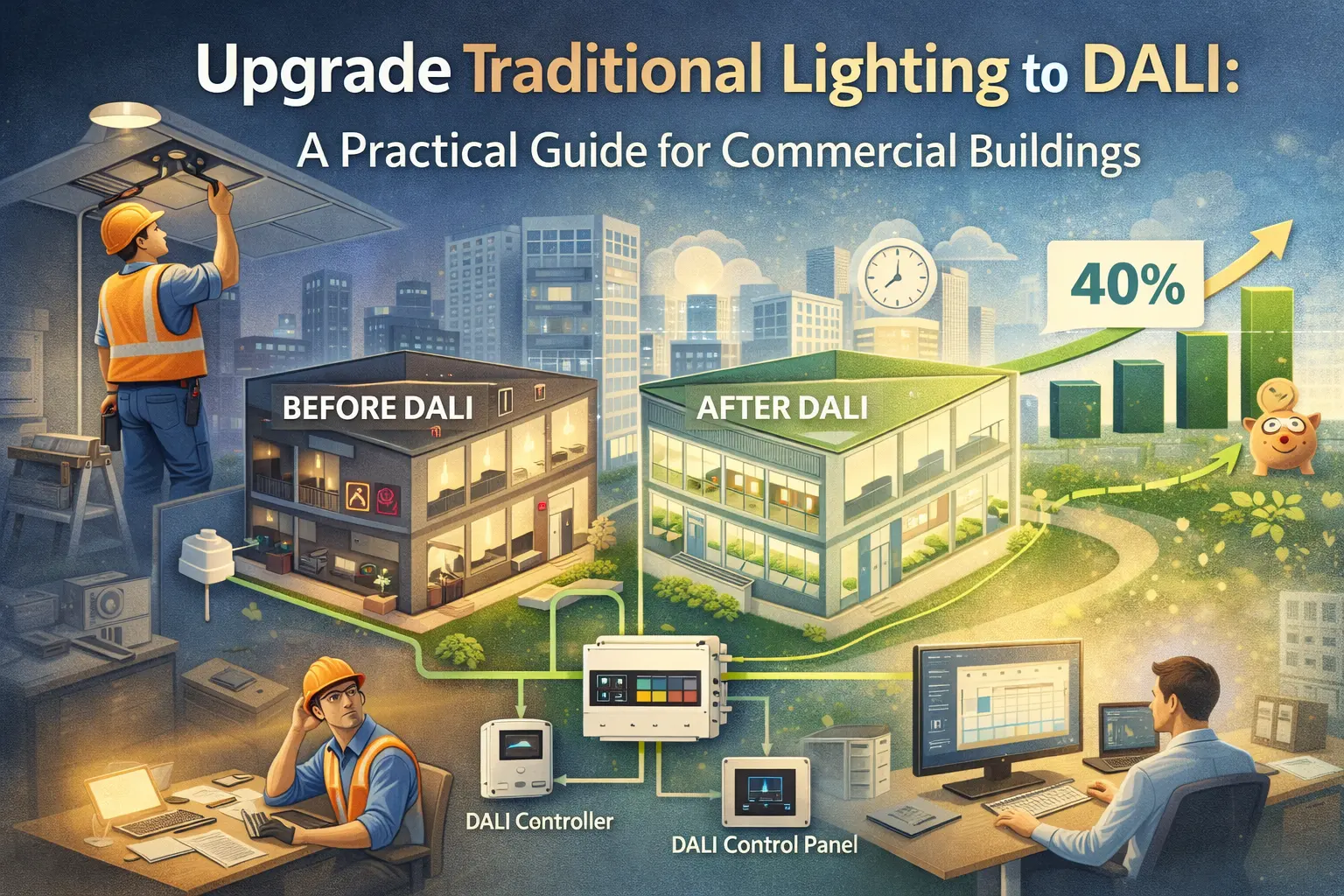
Upgrading traditional lighting to DALI has become a preferred strategy for commercial buildings aiming to improve energy efficiency, lighting flexibility, and long-term operational control. Instead of fully replacing existing lighting infrastructure, a DALI upgrade focuses on modernizing the control system, allowing businesses to achieve intelligent lighting management with a controlled investment.
This article explores how to upgrade traditional lighting to DALI, what technical and financial factors to consider, and why DALI dimming upgrades are increasingly adopted in offices, retail spaces, and commercial facilities.
Why Upgrade Traditional Lighting to DALI Dimming Systems?
Many commercial buildings still operate with conventional lighting systems that rely on manual switching or limited dimming capability. These systems often lead to excessive energy use, inconsistent lighting quality, and limited adaptability to changing space usage.
When businesses upgrade traditional lighting to DALI, they gain:
- Digital and addressable control of individual luminaires
- Flexible lighting scenes and schedules
- Better alignment between lighting usage and real occupancy
As energy costs rise and lighting regulations tighten, upgrading to DALI dimming becomes a strategic move rather than a cosmetic improvement.
DALI Lighting Retrofit Solutions for Existing Buildings
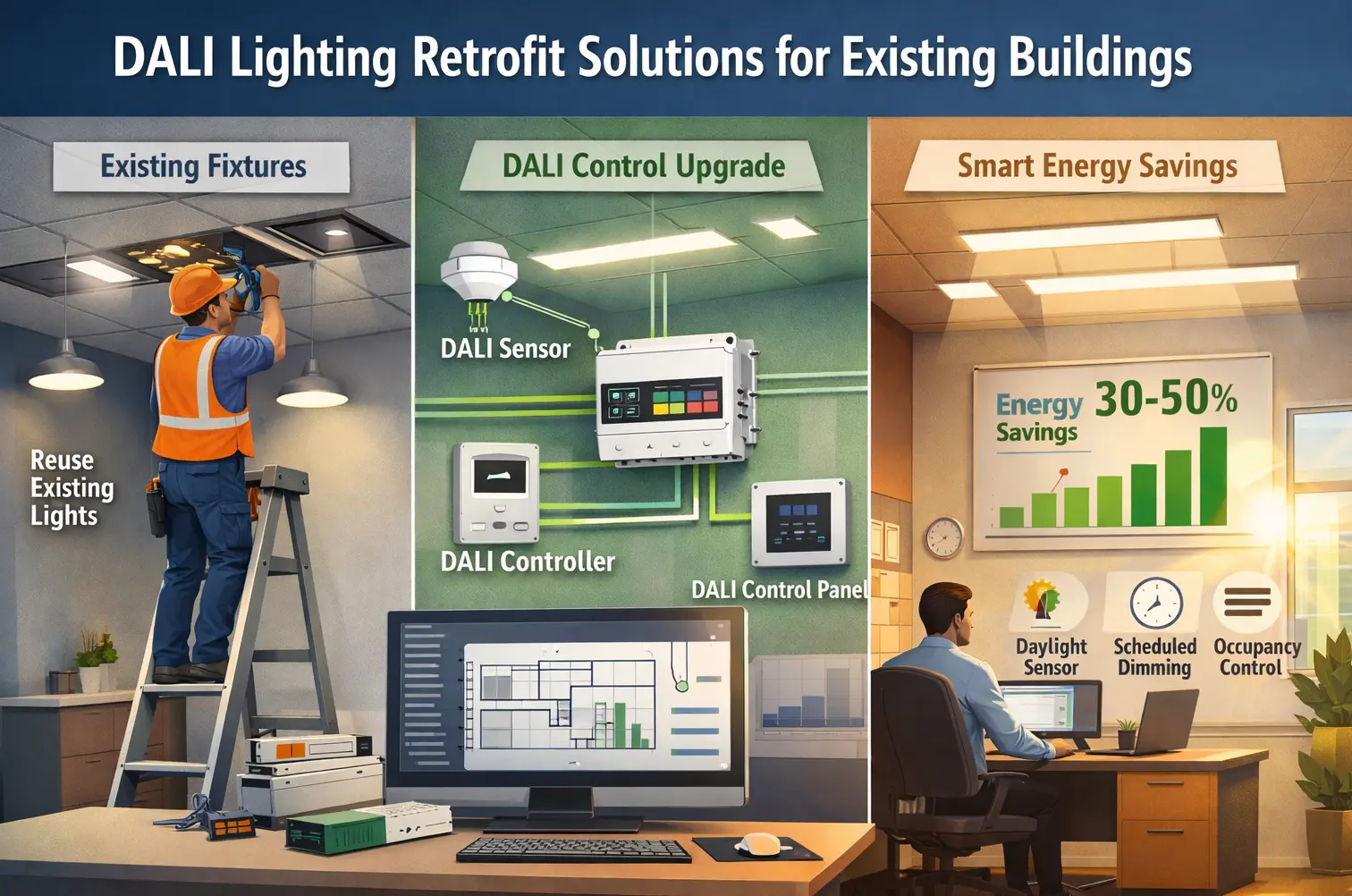
A key advantage of choosing to upgrade traditional lighting to DALI is the retrofit-friendly nature of the system. In most cases, the building structure, luminaires, and power distribution can remain unchanged.
A typical DALI retrofit includes:
- Replacing conventional drivers with DALI-compatible control gear
- Adding DALI controllers, sensors, or gateways
- Integrating the new DALI network alongside existing power lines
This targeted approach significantly reduces installation complexity compared to full lighting replacement projects.
Energy Saving Benefits When You Upgrade Traditional Lighting to DALI
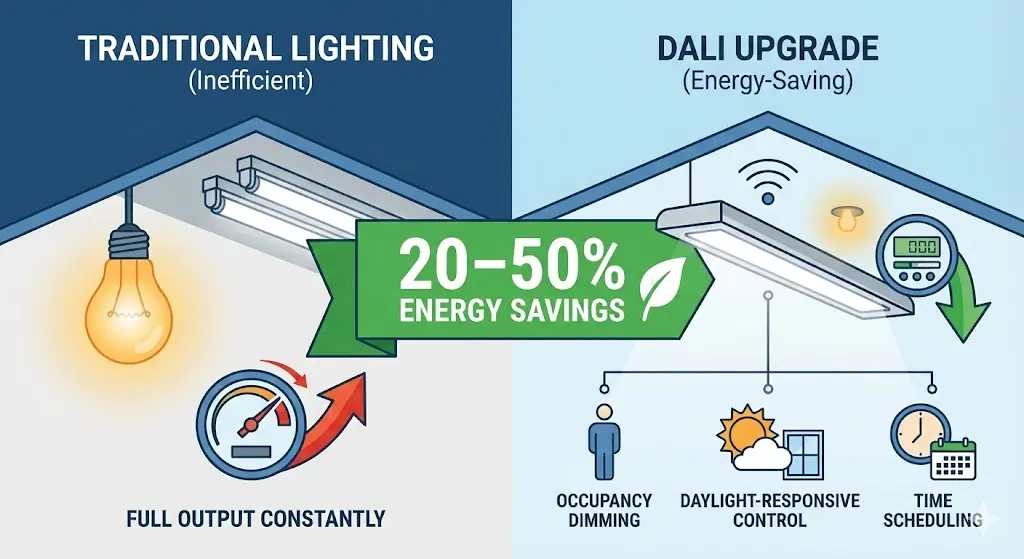
Energy efficiency is one of the strongest drivers behind DALI upgrades. Traditional lighting systems often operate at full output regardless of actual needs, resulting in unnecessary electricity consumption.
By upgrading traditional lighting to DALI dimming, commercial spaces can implement:
- Occupancy-based automatic dimming
- Daylight-responsive lighting control
- Time scheduling aligned with business hours
These strategies commonly deliver 20–50% lighting energy savings, depending on space usage and system configuration.
Compatibility of DALI Dimming with Existing Luminaires
A common concern when upgrading traditional lighting to DALI is whether existing luminaires can be reused. In most commercial retrofit scenarios, the answer is yes.
DALI upgrades typically require:
- Driver replacement rather than luminaire replacement
- Minimal modification to fixtures
- No changes to light distribution or appearance
This compatibility makes DALI dimming an efficient solution for upgrading lighting systems in occupied buildings or phased renovation projects.
Wiring Requirements for Upgrading Traditional Lighting to DALI
Unlike analog dimming systems, DALI uses a low-voltage digital control line that can be added without major rewiring.
Key wiring characteristics include:
- Polarity-free DALI control lines
- Flexible topology (line, star, or tree)
- Separation from mains wiring not strictly required
These features simplify installation and make it feasible to upgrade traditional lighting to DALI even in older commercial buildings.
Cost Comparison: Traditional Lighting vs DALI Dimming Upgrade
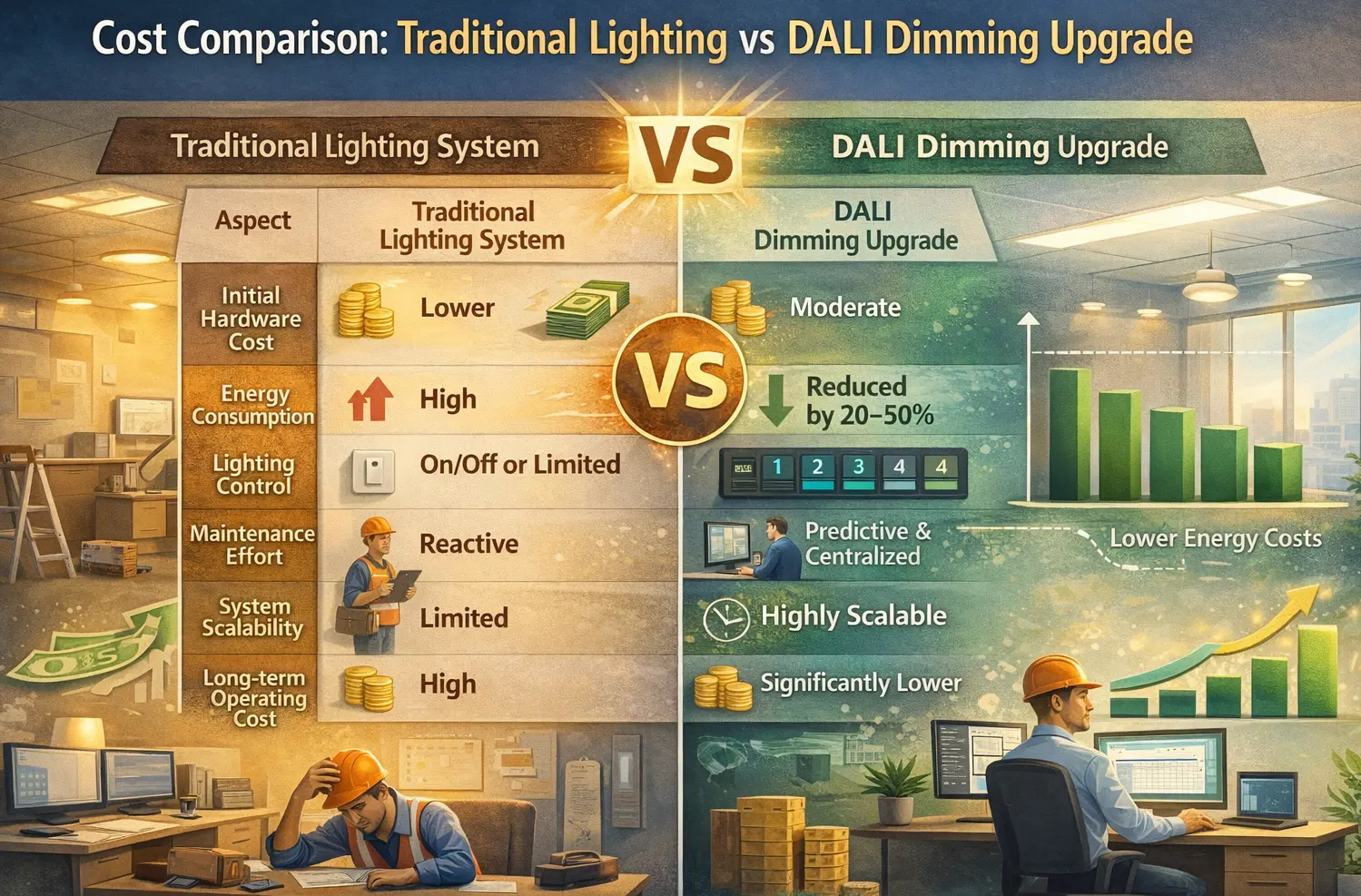
The financial aspect of a DALI upgrade is best evaluated through both initial investment and long-term savings.
| Aspect | Traditional Lighting System | DALI Dimming Upgrade |
|---|---|---|
| Initial hardware cost | Lower | Moderate |
| Energy consumption | High | Reduced by 20–50% |
| Lighting control | On/Off or limited | Individual, group, and scene control |
| Maintenance effort | Reactive | Predictive and centralized |
| System scalability | Limited | Highly scalable |
| Long-term operating cost | High | Significantly lower |
This comparison highlights why many commercial projects justify the upgrade traditional lighting to DALI decision based on lifecycle cost rather than upfront expense.
ROI Analysis of Upgrading Traditional Lighting to DALI
From a return-on-investment perspective, DALI upgrades consistently perform well in commercial environments with long operating hours.
Key ROI contributors include:
- Lower electricity bills
- Reduced maintenance interventions
- Extended driver and luminaire lifespan
In many office and retail projects, the payback period for upgrading traditional lighting to DALI typically ranges from 2 to 4 years, depending on energy prices and usage patterns.
Ideal Applications for Upgrading Traditional Lighting to DALI
Certain environments benefit more strongly from DALI upgrades due to variable occupancy and lighting demands.
Typical applications include:
- Office buildings with flexible workspaces
- Retail stores requiring frequent layout or scene changes
- Commercial spaces aiming to meet energy efficiency standards
In these scenarios, DALI dimming delivers both operational efficiency and improved lighting quality.
Step-by-Step Overview of a DALI Lighting Upgrade Project
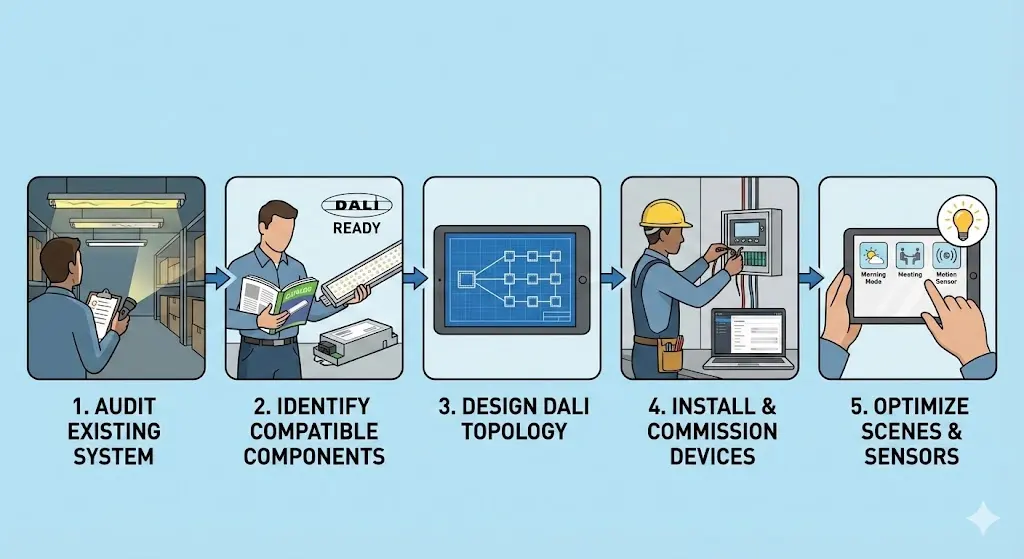
To upgrade traditional lighting to DALI effectively, a structured approach is recommended:
- Audit the existing lighting system
- Identify compatible luminaires and drivers
- Design the DALI control topology
- Install and commission control devices
- Optimize scenes, schedules, and sensors
This process ensures technical compatibility while maximizing energy-saving outcomes.
Conclusion: Why Upgrade Traditional Lighting to DALI Now
Upgrading traditional lighting to DALI is no longer a future-oriented option—it is a practical and proven solution for commercial buildings seeking better control, lower energy consumption, and long-term cost efficiency. With flexible retrofit options, strong ROI, and minimal disruption to existing infrastructure, DALI dimming upgrades offer a scalable pathway toward intelligent lighting systems.
For businesses planning lighting renovations or energy optimization projects, choosing to upgrade traditional lighting to DALI represents a balanced investment in performance, sustainability, and operational control.

