



What Is Anti Glare LED Lighting?A Professional Manufacturer’s Perspective
By Powerstar
Introduction: Light Should Be Bright — But Also Healthy
With LED technology now widely adopted across commercial and architectural lighting, the industry focus has clearly shifted from pure energy efficiency to light quality and visual comfort. In modern retail spaces, offices, and high-end residential projects, glare has become one of the most critical factors affecting user experience. From a manufacturer’s point of view, Anti Glare LED Lighting is no longer a premium feature, but a fundamental requirement for professional commercial lighting solutions. Many clients ask us the same question:
“Why do some luminaires feel more comfortable and refined, even when the specifications look similar?”
The answer lies in anti-glare design, which is deeply rooted in optical engineering rather than surface-level parameters. In this article, we share a manufacturer’s perspective on how anti-glare lighting works, why it matters, and how professional luminaires are designed to deliver long-term visual comfort.
Understanding Glare in LED Lighting Applications
In optical terms, glare refers to a visual condition caused by excessive brightness contrasts or poorly distributed luminance within the field of view, leading to discomfort or reduced visual performance.
Types of Glare in Commercial LED Lighting
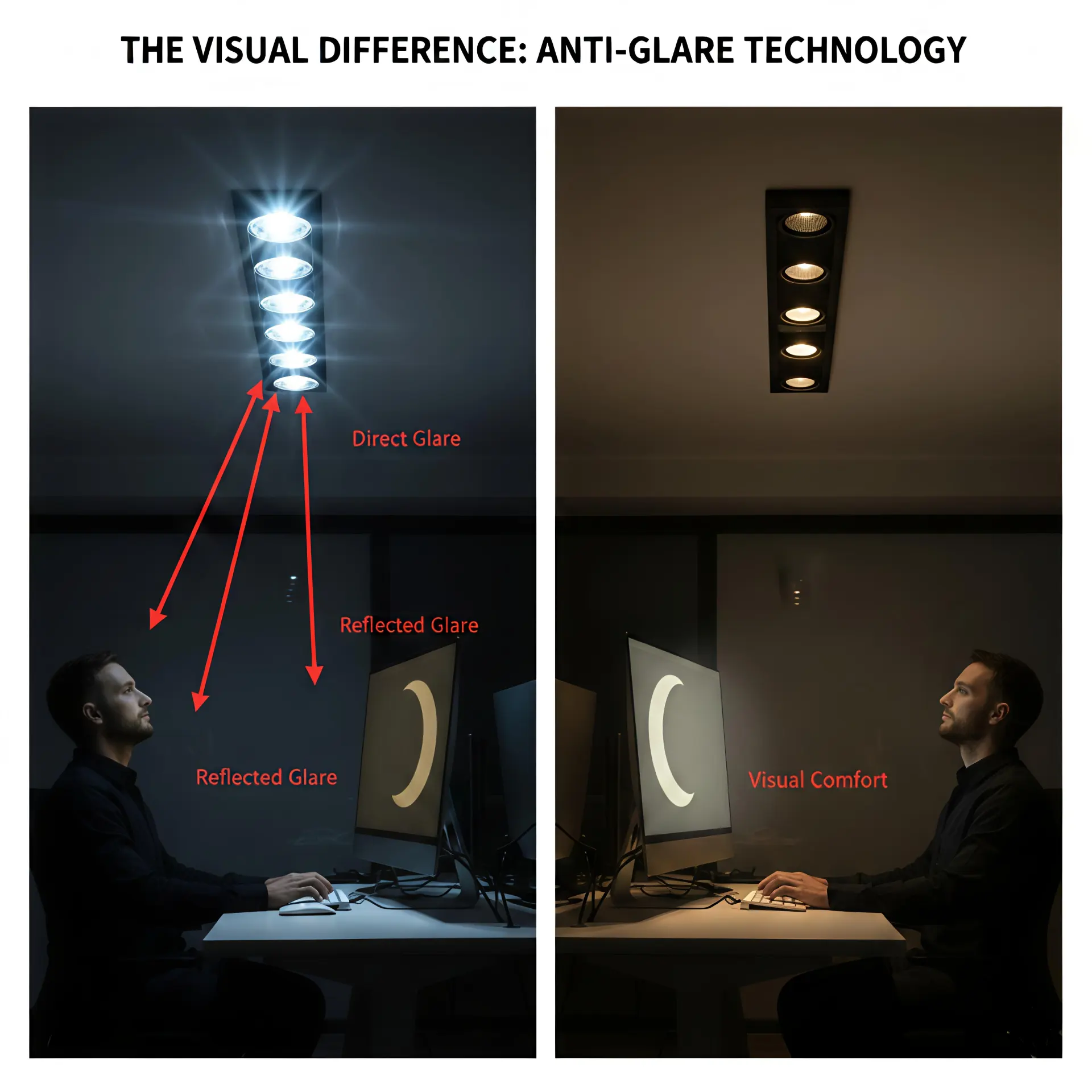
From real project experience, glare typically appears in two forms:
- Direct Glare
Occurs when high-luminance light sources, such as exposed LED chips or shallow recessed fixtures, are directly visible to the human eye. - Reflected Glare
Happens when light reflects off glossy surfaces like screens, glass displays, polished floors, or metal shelves—often referred to as veiling reflections.
Both types are common challenges in commercial LED lighting solutions, especially in retail stores and office environments.
UGR and Glare Control: The Global Standard for Anti Glare LED Lighting
What Is UGR?
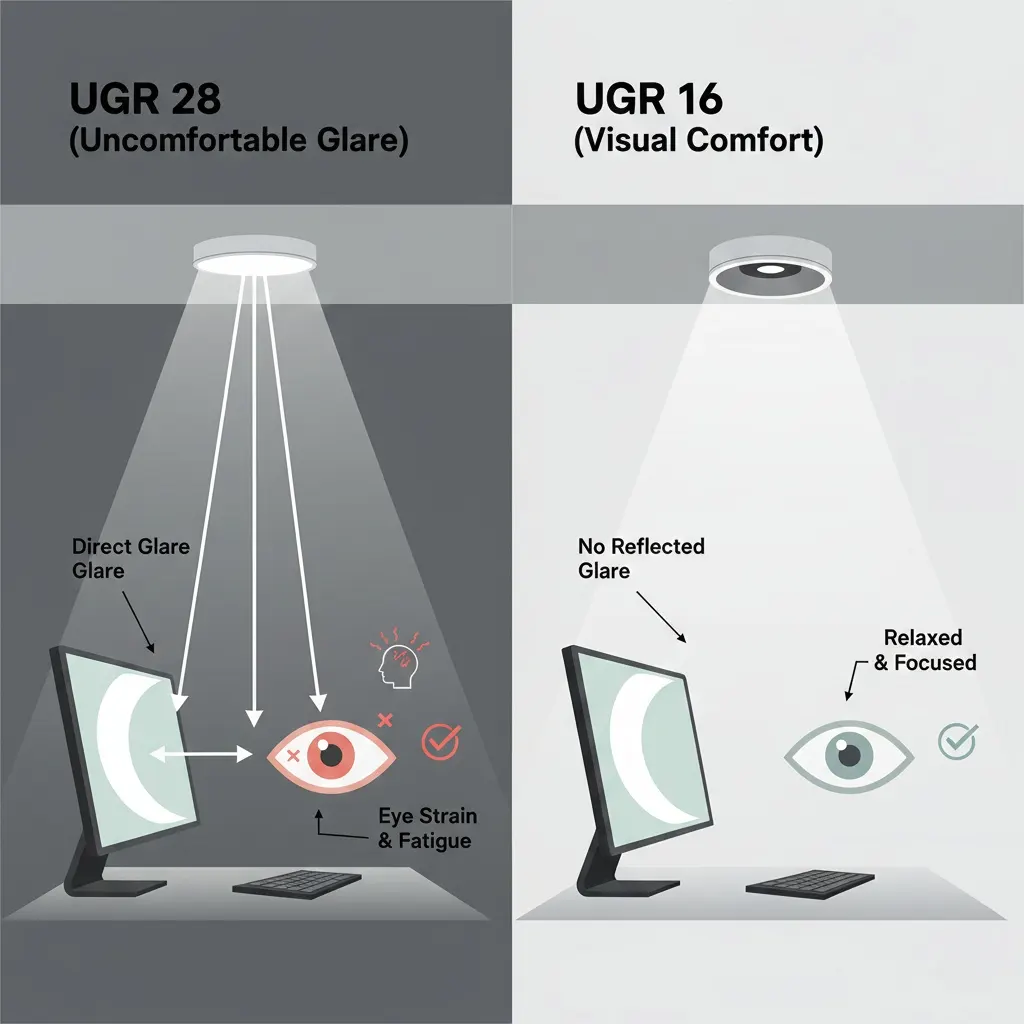
UGR (Unified Glare Rating) is the internationally recognized metric used to quantify discomfort glare in indoor lighting environments.
From a professional standpoint:
- UGR < 13
Extremely low glare, typically found in laboratories, museums, or premium exhibition spaces. - UGR < 19
The industry benchmark for offices, schools, and high-quality commercial lighting. - UGR > 25
Indicates poor glare control and often results in eye strain, fatigue, and user complaints.
It is important to note that UGR values depend not only on the luminaire itself, but also on installation height, beam angle, spacing, and room reflectance.
For a detailed definition of UGR, you can refer to the International Commission on Illumination (CIE).
How Manufacturers Achieve True Anti Glare LED Performance
Deep Recessed Design for Low Glare Lighting
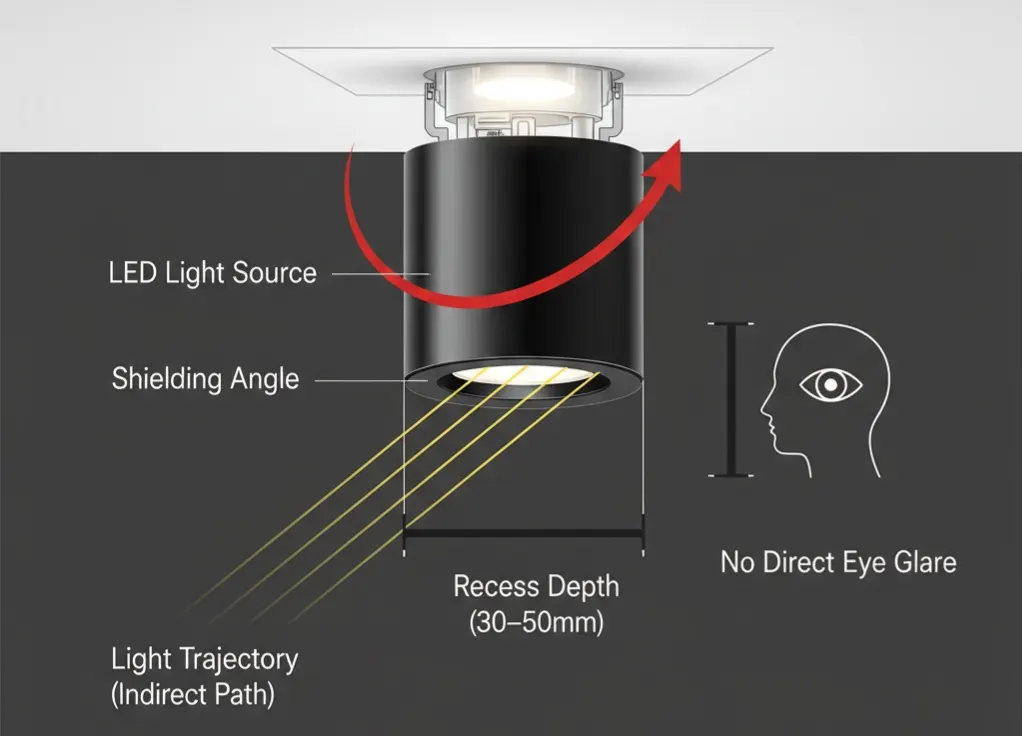
One of the most effective strategies in anti glare LED lighting design is the use of a deep recessed light source.
By setting the LED module back 30–50 mm inside the fixture housing, we increase the shielding angle and prevent direct view of the high-luminance source. This allows users to perceive the illuminated surface rather than the light source itself — a principle often described as “seeing the light, not the lamp.”
Secondary Optics: Lens and Reflector Engineering
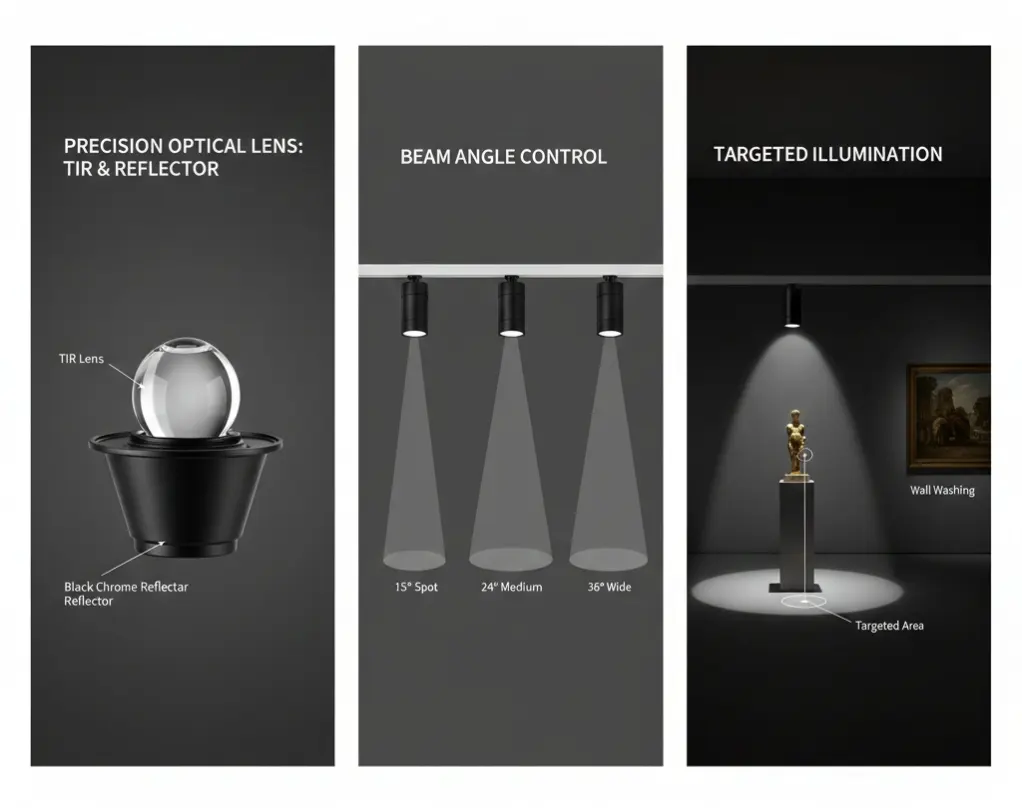
High-quality anti-glare luminaires rely on carefully engineered secondary optics:
- Reflectors
Manufactured using vacuum metallization and black chrome or matte finishes to absorb stray light and reduce unwanted reflections. - TIR Lenses (Total Internal Reflection)
Precisely control beam angles such as 15°, 24°, or 36°, minimizing light spill and side glare while maintaining high optical efficiency.
This level of optical control is essential for low UGR LED lighting systems used in professional projects.
Honeycomb Louvers and Micro-Prismatic Filters
In premium anti glare track lights and linear luminaires, honeycomb louvers or micro-prismatic filters are often applied.
These structures function like optical blinds, allowing vertical light output while blocking lateral high-angle glare. However, from a manufacturer’s perspective, such accessories should support the optical design—not compensate for poor core engineering.
Anti Glare LED Lighting Solutions by Luminaire Type
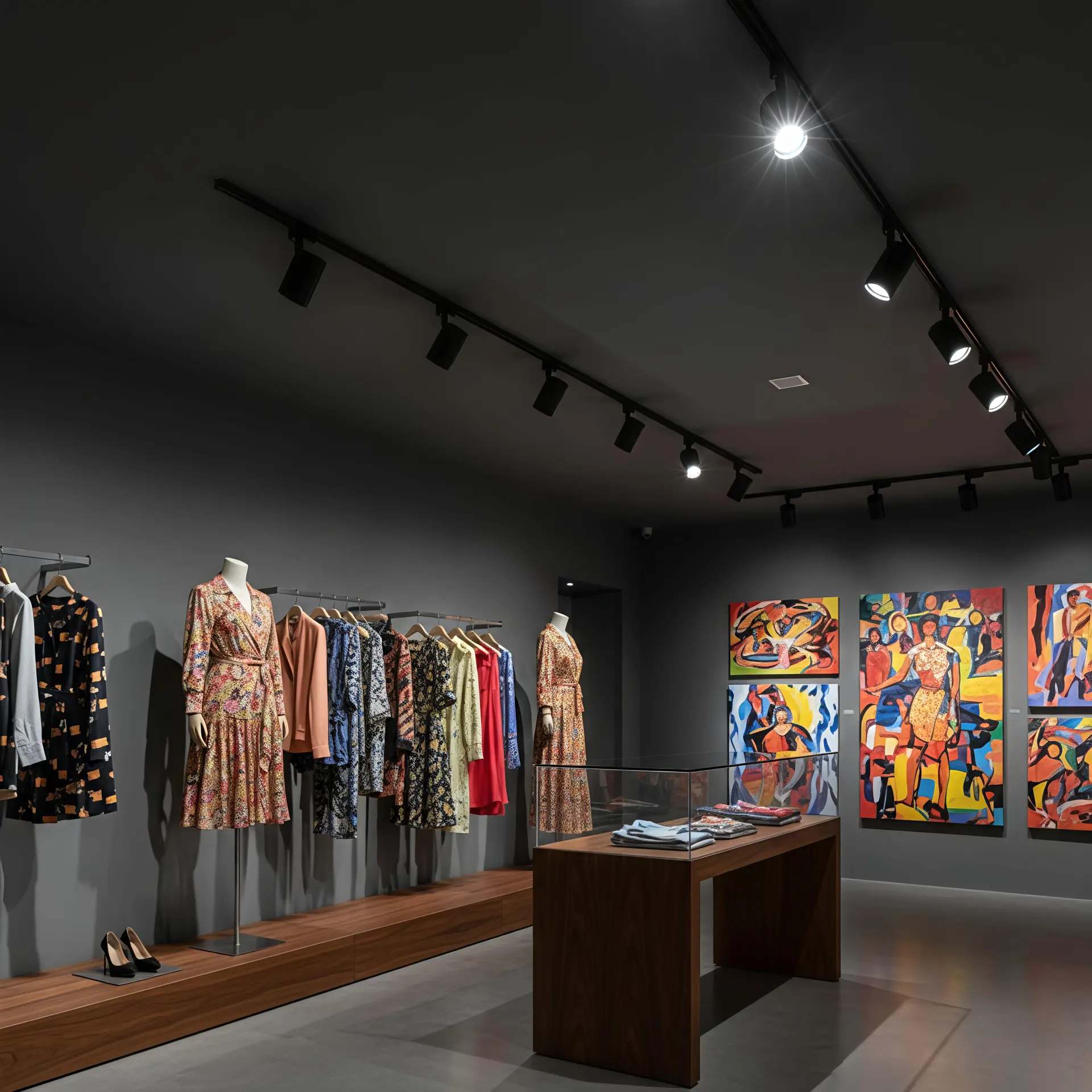
Anti Glare Track Lighting for Retail Spaces
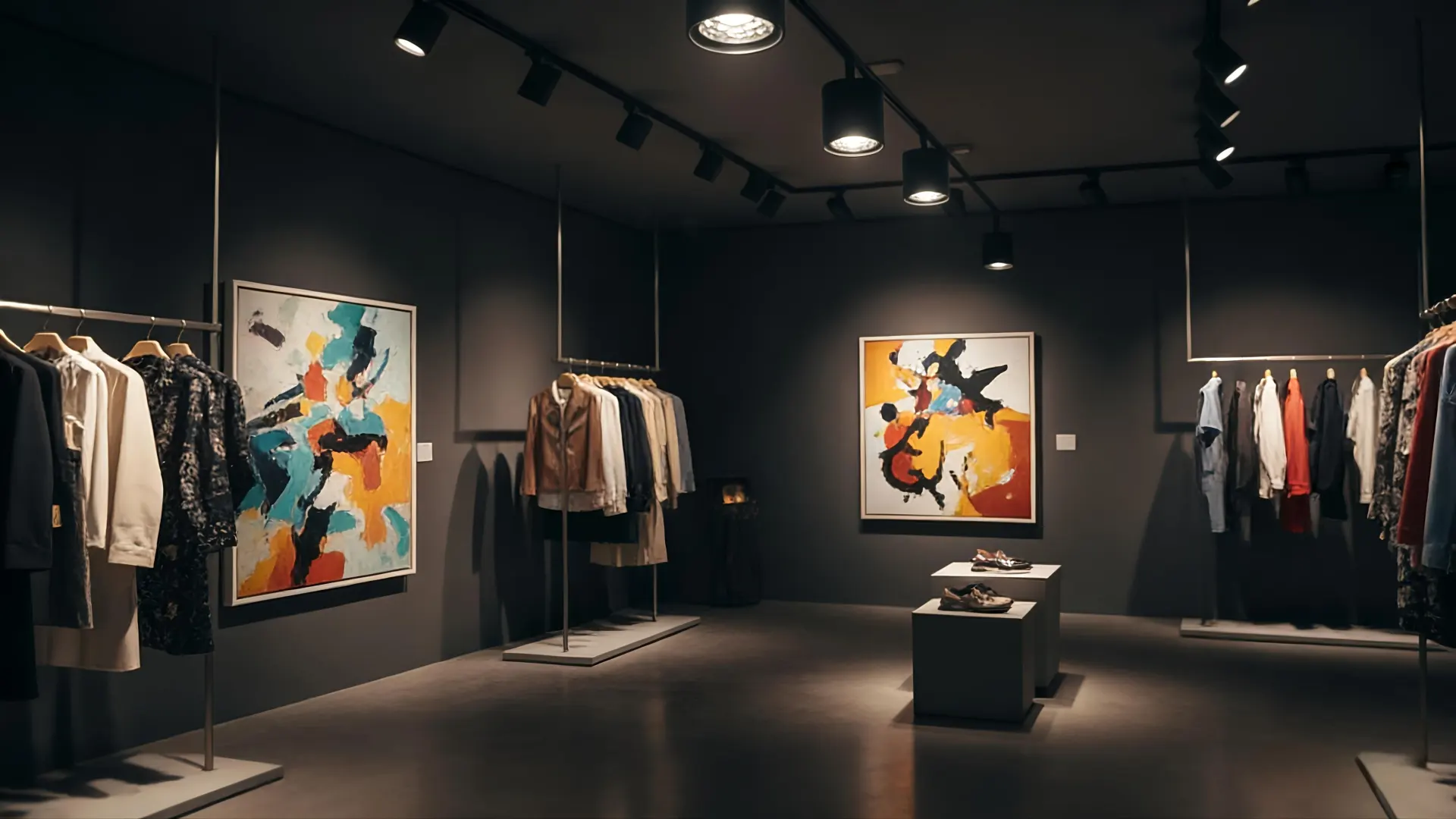
In galleries, fashion boutiques, and luxury retail environments, lighting must enhance products without causing visual discomfort.
Professional anti-glare track lights typically feature:
- CRI > 95 and high R9 values
- Interchangeable honeycomb or glare-control accessories
- Narrow and controlled beam distribution
The goal is simple: light the merchandise, not the customer’s eyes.
Recessed Downlights for Hotels and High-End Residences
In hospitality lighting, visual comfort often comes from what is not immediately visible.
Deep anti-glare recessed downlights with dual glare-control rings can create the illusion of “dark fixtures” even at higher lumen outputs. This low-luminance contrast is a key element in luxury architectural lighting design.
Linear Lighting for Offices and Workspaces
Traditional linear lights often cause screen reflections and uneven brightness. By integrating micro-prismatic diffusers, modern anti glare LED lighting systems can achieve G0 glare classification while maintaining uniform illumination—improving productivity and reducing eye fatigue.
Key Technical Parameters: Standard vs. Professional Anti Glare LED Lighting
| Parameter | Standard LED Fixtures | Professional Anti Glare LED Lighting |
|---|---|---|
| UGR | 22–28 (noticeable glare) | 13–19 (comfortable) |
| SDCM | < 5 (visible color shift) | < 3 (high color consistency) |
| Flicker | Noticeable | Flicker-free driver |
| Optical Materials | Standard plastic lenses | High-purity aluminum + tempered glass |
Lighting Simulation and Glare Control at the Design Stage
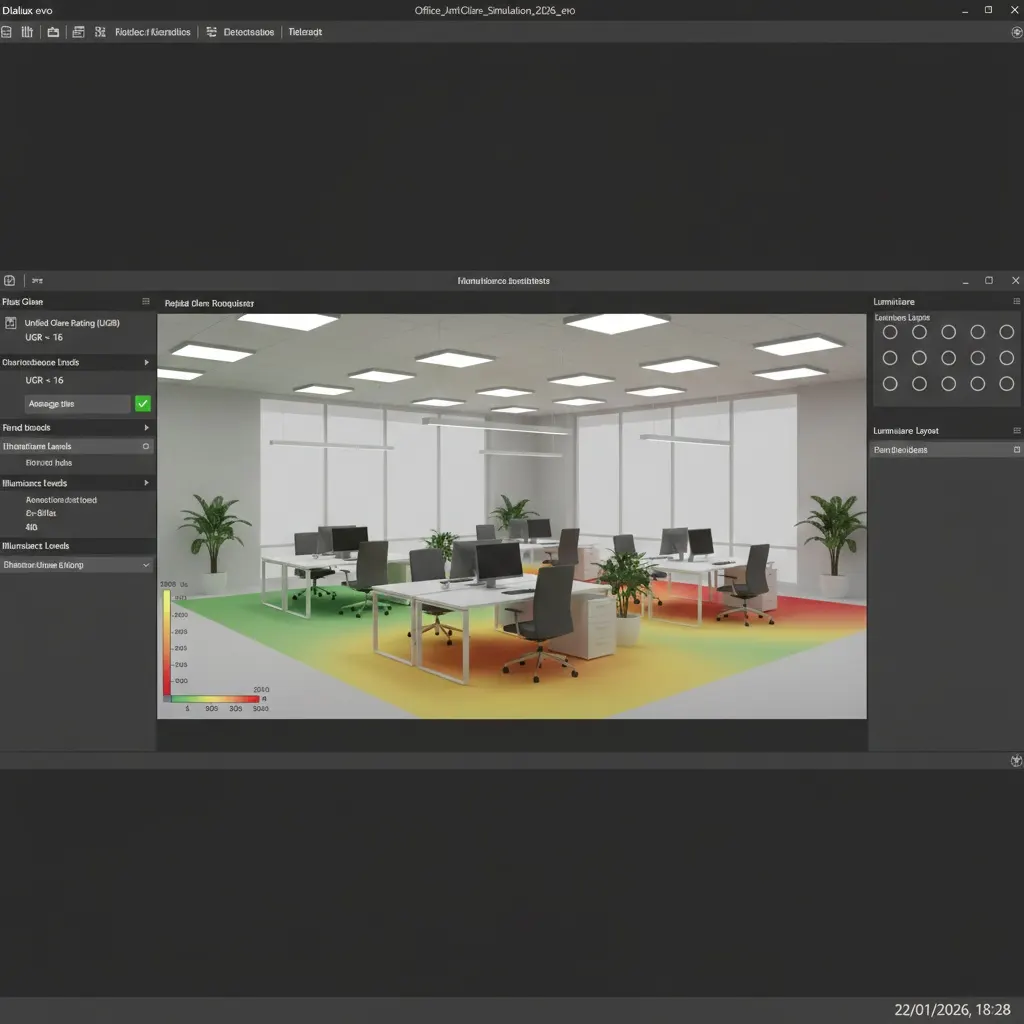
Before project execution, we strongly recommend requesting IES files from manufacturers and conducting lighting simulations using tools such as DIALux evo.
Key design considerations include:
- Task lighting levels around 500 lux with UGR < 19
- Avoiding direct placement above eye level
- Utilizing luminaire shielding angles to minimize glare exposure
International Compliance and Certifications
For export-oriented manufacturers, anti-glare performance is also tied to compliance and safety standards:
- CE & RoHS – Essential for the European market
- SAA – Mandatory for Australia, with strict safety and glare considerations
- LM-79 / LM-80 – Verifies lumen maintenance and LED lifespan
Conclusion: Anti Glare LED Lighting Is a Long-Term Value Choice
Anti Glare LED Lighting is not a marketing term—it is a reflection of how optical engineering respects human vision.
By reducing glare, improving color quality, and eliminating flicker, professional luminaires contribute to healthier, more comfortable environments. From a manufacturer’s perspective, true anti-glare capability defines how far a lighting product can go in real-world applications.
In the future of commercial lighting, glare control will no longer be optional—it will be expected.

