



Why Dali DT8 Smart Led Track Lighting Is the Most Cost-Effective Choice for Large-Scale Projects
By Powerstar
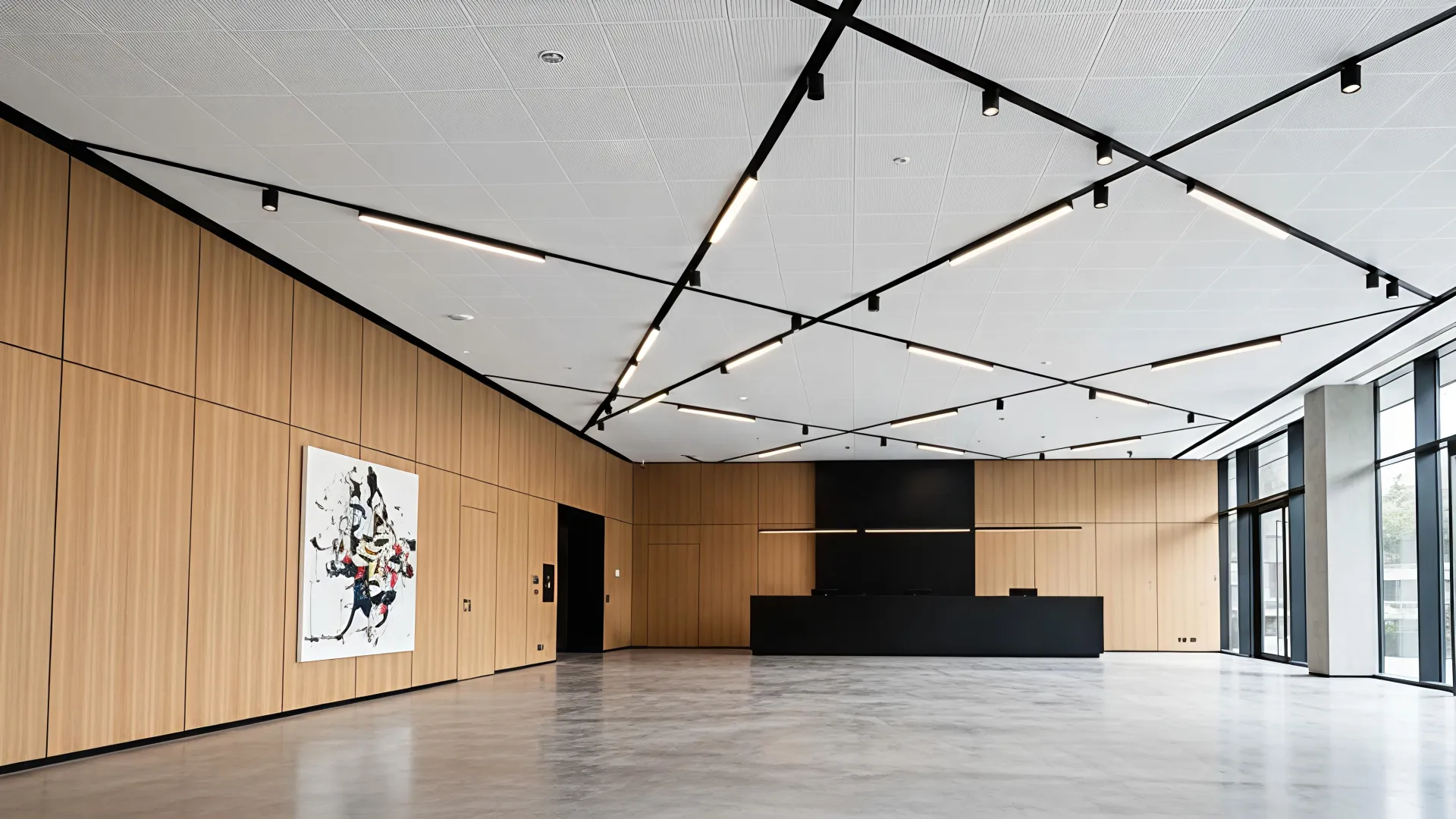
In 2026, as smart building standards such as LEED and WELL become the norm, DALI DT8 Smart LED Track Lighting is increasingly adopted in large-scale commercial and architectural projects. Lighting systems are no longer treated as simple luminaires, but as integrated digital infrastructure that affects visual quality, energy efficiency, and long-term operational cost. For shopping malls, Grade A office buildings, museums, and premium retail chains, the real challenge lies in balancing visual performance, system flexibility, and lifecycle cost control.
For large-scale projects—including shopping malls, Grade A office buildings, museums, and premium retail chains—the real challenge is no longer brightness alone. Developers and contractors must balance high-quality visual performance, system flexibility, and long-term operating budgets. This is where DALI DT8 smart LED track lighting demonstrates clear advantages.
From a project owner’s perspective, the real equation involves far more than upfront investment. Installation efficiency, long-term maintenance costs, and the ability to adapt to future space changes are equally critical. Many projects still focus heavily on luminaire unit price during the selection stage, only to discover later that the true cost drivers are complex commissioning, repeated on-site modifications, and unpredictable maintenance workloads.
Against this background, DALI DT8 smart LED track lighting has become the preferred solution for an increasing number of large-scale projects. While it may not be the lowest-priced option initially, it consistently delivers the lowest total cost of ownership and a much higher level of system reliability.
Lighting Costs in Large-Scale Projects Go Far Beyond Fixture Pricing
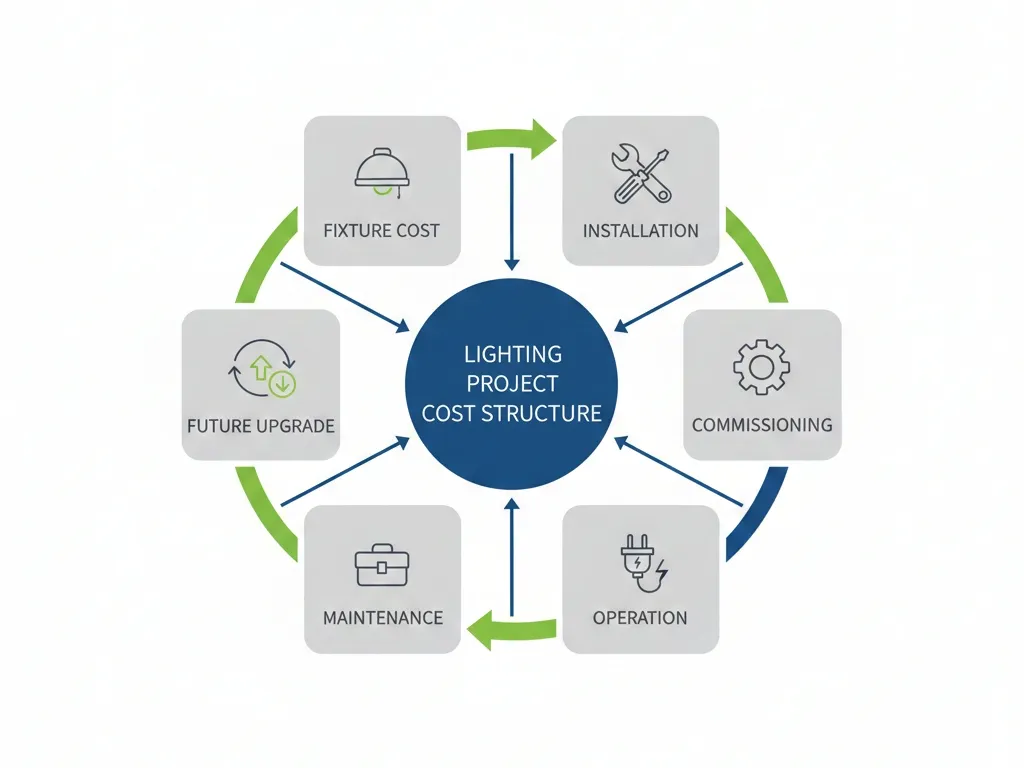
In commercial and public developments, the total cost of a lighting system typically includes:
- Initial procurement of luminaires and drivers
- On-site wiring and installation labor
- Commissioning and system configuration
- Energy consumption and routine maintenance
- Future renovations and functional upgrades
Traditional track lighting solutions often appear competitive in terms of luminaire price. However, as project scale increases, their limitations in commissioning efficiency, system stability, and future flexibility become increasingly apparent. Over time, these shortcomings are magnified and can result in significant cost overruns.
The value of DALI DT8 smart LED track lighting systems lies in their ability to control costs consistently—from early project planning through long-term operation.
What Is DALI DT8 and Why It Matters in Large Track Lighting Projects
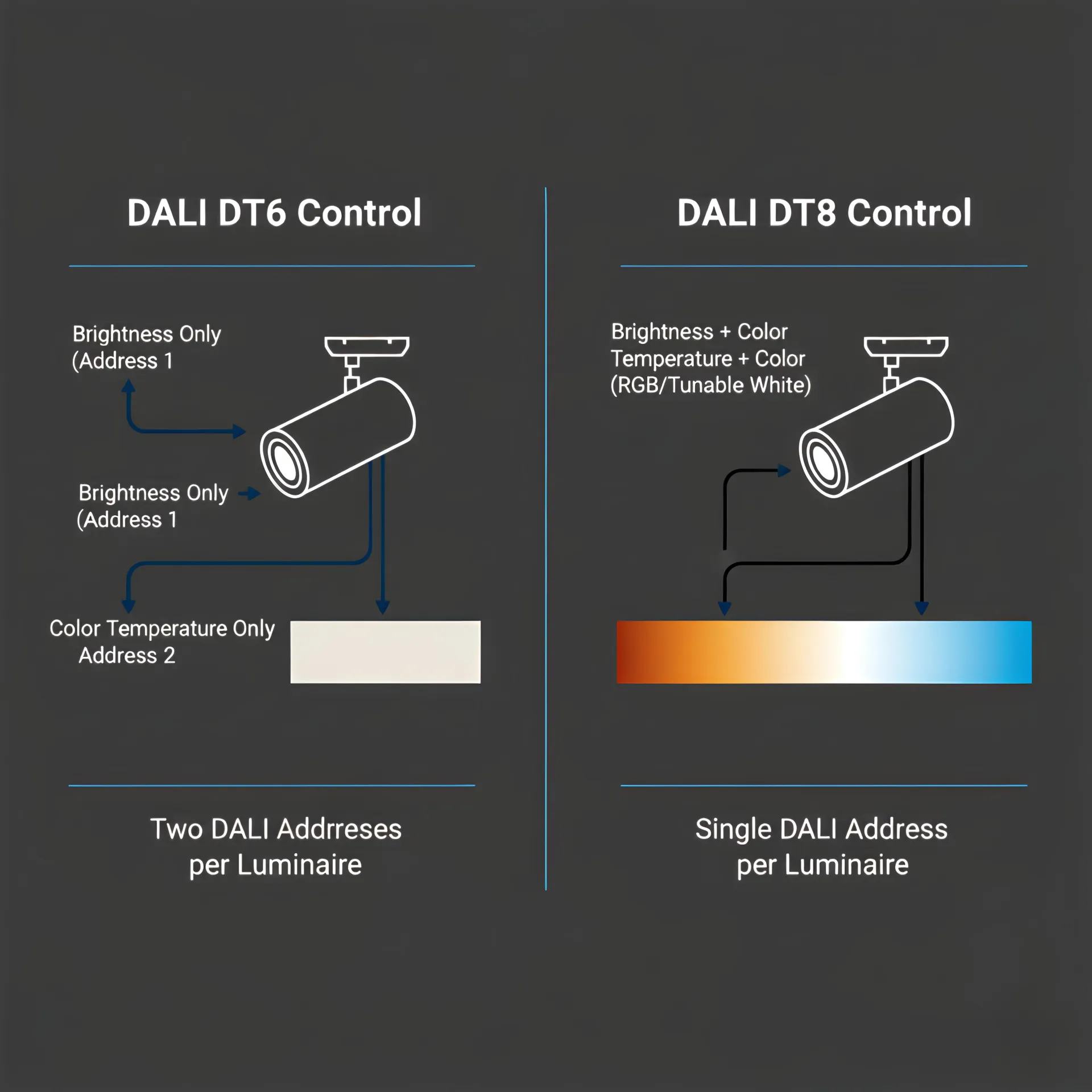
DT8 is a specific device type within the DALI (Digital Addressable Lighting Interface) protocol. It allows brightness and color temperature (or RGBW) to be controlled together under a single DALI address.
In conventional lighting systems, independent control of brightness and color temperature usually requires:
- Two separate DALI addresses
- Analog dimming methods
- Complex synchronization logic
While these approaches may be manageable in small installations, they quickly create challenges in large-scale track lighting projects, including:
- Inefficient use of DALI address resources
- More complex control logic
- Longer commissioning times
- Visible inconsistencies in brightness or color temperature between fixtures
By enabling multi-parameter control through a single address, DALI DT8 simplifies system architecture and significantly improves reliability, making it particularly suitable for large commercial and architectural applications.
Reduced Installation and Commissioning Costs with DALI DT8 Track Lighting
1. Simplified Wiring Lowers Labor Costs
DALI control lines are non-polarized and support star, tree, and daisy-chain topologies. When installing linear LED track lighting systems, electricians do not need to worry about polarity errors that could damage drivers or luminaires. This greatly reduces installation risks and rework rates.
For large projects, this means:
- Fewer wiring mistakes
- Faster installation schedules
- Lower labor and correction costs
In track lighting layouts with multiple luminaires and circuits, the centralized control structure of DALI becomes even more advantageous.
2. Digital Addressing Improves Commissioning Efficiency
In traditional lighting systems, fixture grouping is determined by physical wiring. When space functions change—such as converting an open-plan office into private offices—ceilings often need to be opened and wiring modified.
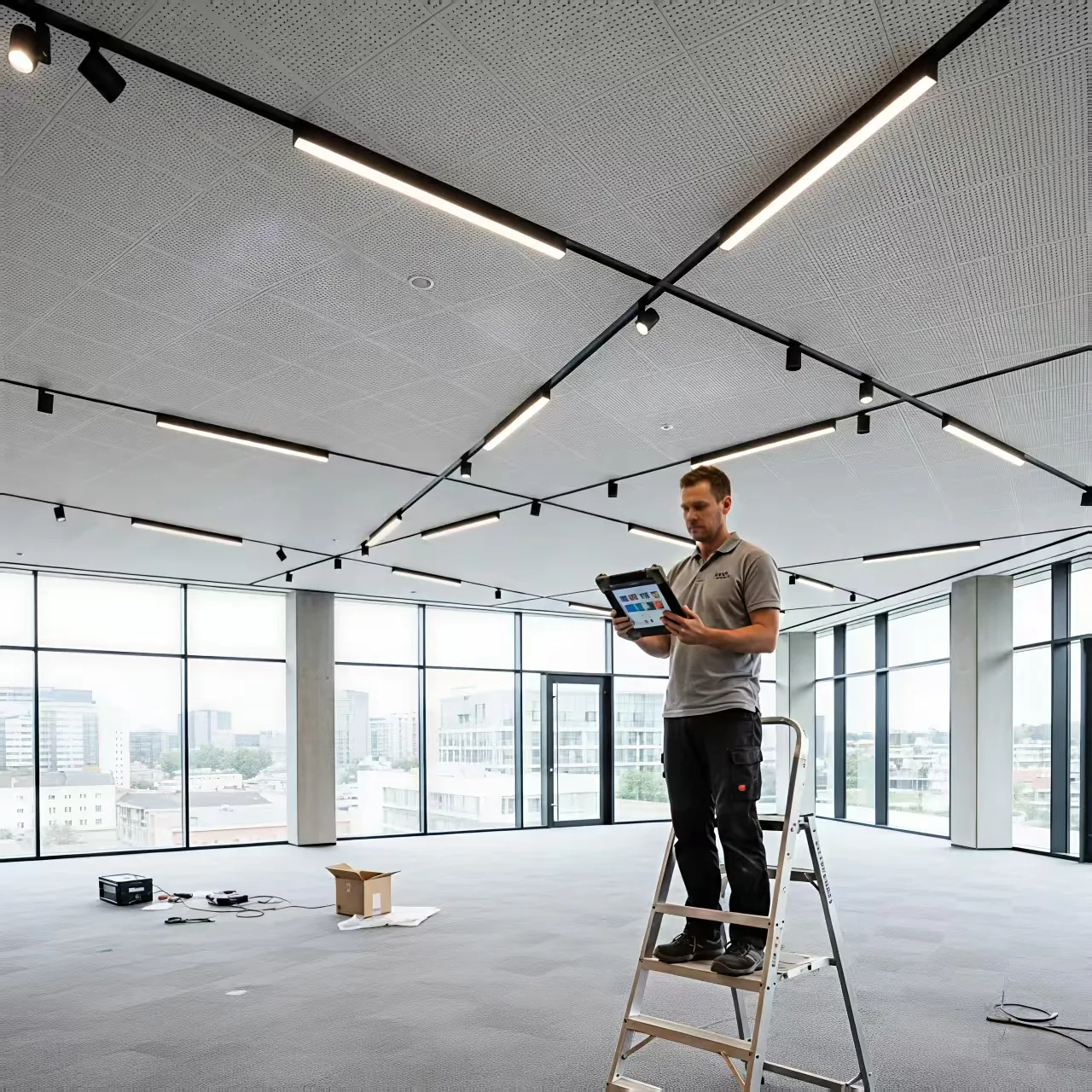
With DALI DT8 smart LED track lighting, every luminaire is identified digitally. No rewiring is required. Engineers can simply adjust groups and control logic through software, saving owners from costly secondary construction work.
From a computer interface, commissioning teams can complete:
- Luminaire addressing
- Group configuration
- Scene programming
- Fine-tuning of lighting parameters
All without repeated physical intervention on site. Since brightness and color temperature are controlled together in a DT8 architecture, commissioning steps are further reduced and project delivery timelines become far more predictable.
3. Fewer Human Errors, Higher System Stability
In non-DT8 systems, mismatched brightness and color temperature between fixtures is a common issue. The single-address control mechanism of DT8 eliminates this problem at its source, which is especially important for large projects that demand long-term stability.
Lower Long-Term Operating Costs Define True Cost Efficiency
In large facilities, locating and repairing a single lighting fault can consume hours of labor, often involving access equipment, work interruptions, and systematic inspection. DALI DT8’s two-way communication capability fundamentally changes this process.
1. Real-Time Fault Feedback via Two-Way Communication
DT8 drivers continuously monitor luminaire status. If an LED failure, driver overheating, or communication error occurs, the system immediately identifies the exact fixture location and fault type.
Operational benefit:
Maintenance teams no longer need to inspect fixtures one by one. Targeted interventions allow issues to be resolved in a single visit, significantly reducing maintenance OPEX.
2. D4i Compliance and Data-Driven Maintenance
As an important extension of the DALI-2 standard, many advanced DALI DT8 drivers now support D4i. This enables the collection of energy consumption data, operating hours, and asset information.
With these insights, facility managers can implement predictive maintenance strategies—replacing luminaires before end-of-life failures occur and avoiding large-scale disruptions to commercial operations.
Long-term advantages of DALI DT8 systems include:
- Continuous monitoring of luminaire and driver status
- Precise dimming and zoning for reduced energy consumption
- Less frequent manual inspections
- Clear system architecture that simplifies staff training
Together, these factors can generate substantial operational savings over the system’s lifetime.
Future-Proof Flexibility: Smart Savings Beyond Energy Reduction
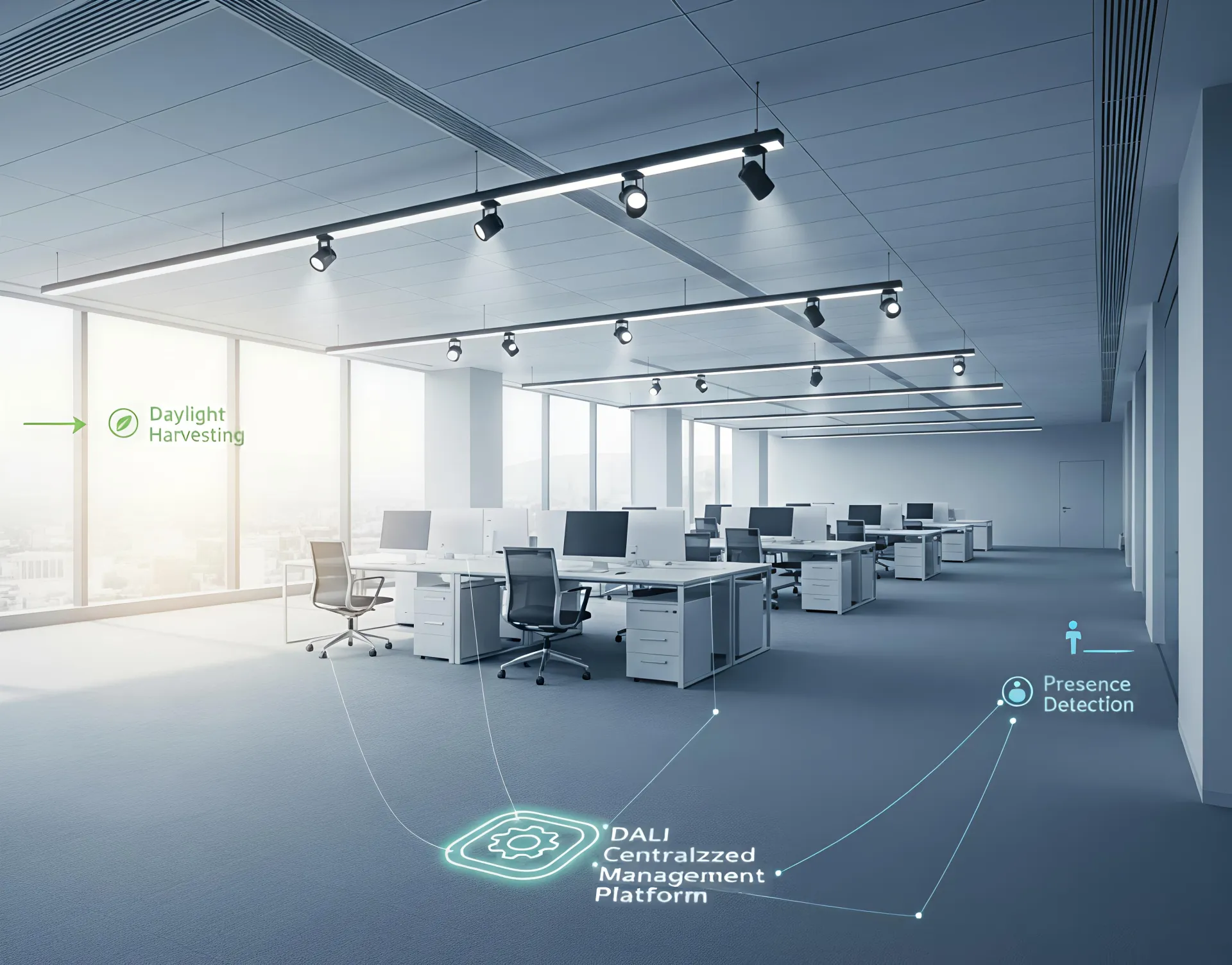
In large-scale projects, electricity costs represent a major portion of operating expenses. By integrating smart sensors, DALI DT8 smart LED track lighting transforms lighting from a passive system into a truly demand-driven solution.
1. Daylight Harvesting for Constant Light Output
By integrating light sensors into DALI track systems, the lighting can automatically respond to available daylight. When natural light is sufficient, luminaires dim smoothly; when daylight decreases, artificial lighting compensates seamlessly.
This constant light output strategy can reduce lighting energy consumption by more than 40% in many commercial environments.
2. Presence Detection for Intelligent Control
In large parking areas, corridors, and meeting rooms, DALI DT8 systems work with occupancy sensors to deliver “light when needed, dim or off when vacant.” Compared with traditional switching, digital dimming avoids frequent on/off cycles that shorten luminaire lifespan, while achieving maximum energy efficiency.
Visual Quality and Productivity: Creating Intangible Value
While cost savings are a major focus, the visual benefits of DALI DT8 smart LED track lighting play a key role in enhancing overall property value.
1. Dynamic Color Temperature and Human Centric Lighting
DT8 enables smooth color temperature transitions throughout the day—from warm morning tones to cooler midday light and back to warmer evening settings. Studies show that Human Centric Lighting can improve employee productivity by up to 15% in office environments and increase dwell time in retail spaces.
2. Premium Dimming Performance
Unlike basic dimming solutions, DALI DT8 supports logarithmic dimming from 0.1% to 100%. Light transitions remain smooth and flicker-free, delivering a refined visual experience essential for five-star hotels, museums, and high-end showrooms.
Scalable and Compatible: Designed for Large Lighting Systems
DALI DT8 is based on an open, internationally recognized standard rather than a proprietary system. This gives it clear advantages in large projects:
- Easy expansion from single zones to entire buildings
- Seamless integration with BMS and KNX systems
- Multi-brand compatibility, avoiding vendor lock-in
- Full compliance with DALI-2 standards for long-term maintenance
For consultants and project managers, this level of standardization translates directly into lower system risk.
Cost Comparison: DALI DT8 Smart LED Track Lighting vs Traditional Track Lighting
When evaluating lighting solutions for large-scale projects, the real difference between systems is not simply about “higher” or “lower” fixture prices. Instead, it lies in how costs are distributed throughout the entire project lifecycle—from installation and commissioning to long-term operation and future upgrades.
The table below provides a practical comparison between traditional track lighting solutions and DALI DT8 smart LED track lighting, focusing on the factors that most directly impact total project cost and operational risk.
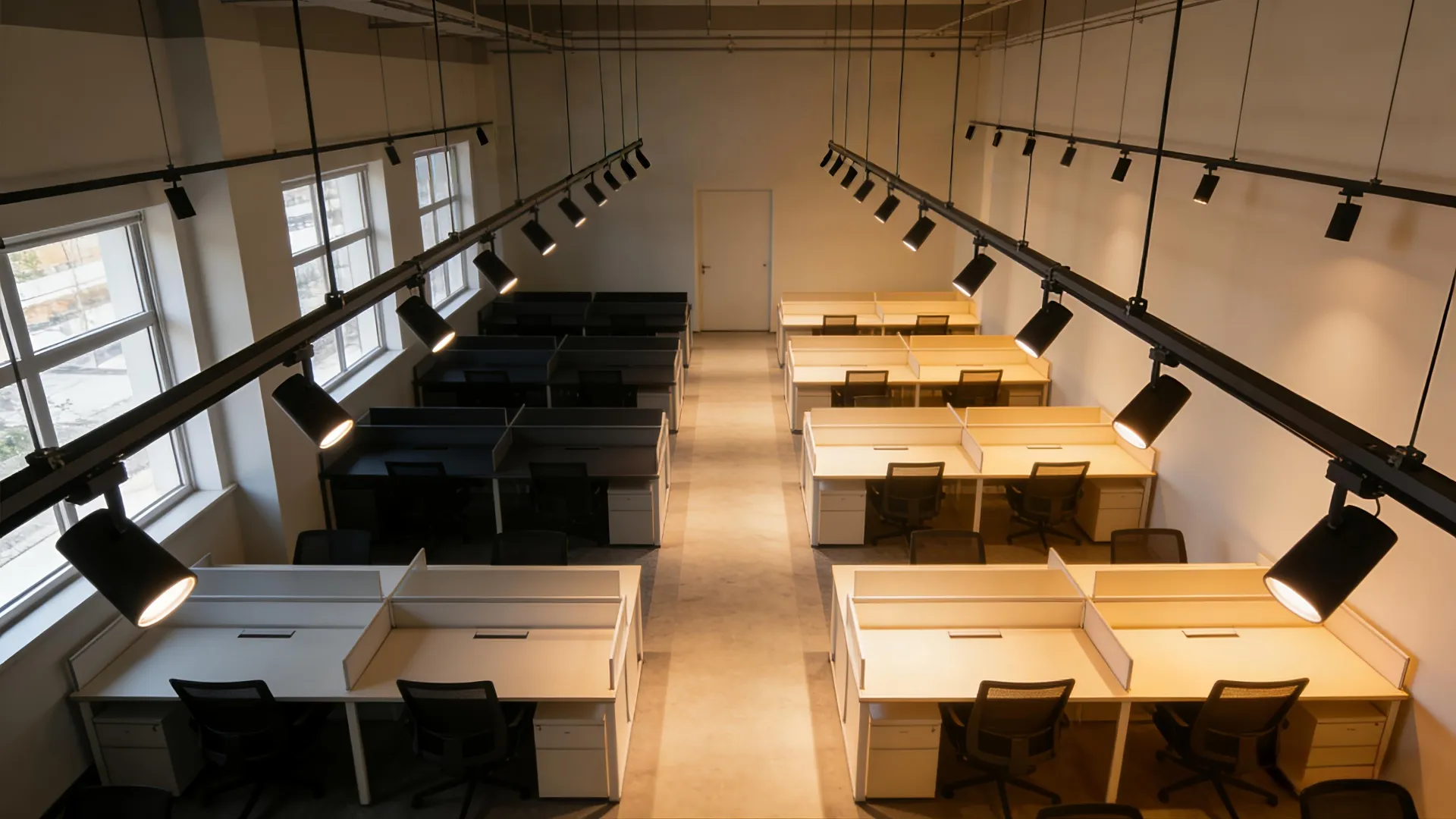
Lifecycle Cost Comparison for Large-Scale Projects
| Cost Factor | Traditional Track Lighting | DALI DT8 Smart LED Track Lighting |
|---|---|---|
| Initial Fixture Cost | Lower unit price, attractive at early bidding stage | Slightly higher upfront cost due to smart drivers and control capability |
| Wiring & Installation | More complex wiring, polarity-sensitive, higher risk of rework | Non-polarized DALI bus, simpler topology, faster installation |
| Commissioning Time | Manual grouping and adjustment, time-consuming for large systems | Digital addressing and software-based commissioning, significantly faster |
| Control Accuracy | Limited precision, brightness and CCT often controlled separately | Single-address control of brightness and color temperature (DT8) |
| System Stability | Higher risk of mismatched brightness or color temperature between fixtures | Consistent output across all luminaires, improved visual uniformity |
| Maintenance Approach | Reactive maintenance, faults located manually on site | Proactive maintenance with real-time fault feedback |
| Maintenance Labor Cost | High—requires on-site inspection and troubleshooting | Lower—fault location and status visible via system interface |
| Energy Efficiency | Basic dimming or switching, limited energy optimization | Advanced dimming, zoning, daylight harvesting, and presence detection |
| Operational Energy Cost | Relatively high and difficult to optimize | Significantly reduced through intelligent control strategies |
| Future Space Reconfiguration | Often requires rewiring and physical modification | Software-based reconfiguration, no rewiring required |
| Upgrade & Expansion Cost | High—limited scalability and flexibility | Low—easy expansion within the same DALI network |
| System Compatibility | Often proprietary or limited integration options | Open standard, compatible with BMS, KNX, and DALI-2 systems |
| Total Cost of Ownership (TCO) | Lower upfront, but higher and unpredictable long-term costs | Higher initial investment, but lower and more predictable lifecycle cost |
Key Takeaway for Project Owners and Consultants
While traditional track lighting may appear cost-effective at the purchasing stage, its limitations often lead to higher hidden costs during commissioning, operation, and future modifications.
In contrast, DALI DT8 smart LED track lighting shifts the cost structure toward long-term efficiency and predictability, making it a more rational choice for large-scale projects where reliability, flexibility, and lifecycle cost control are critical.
Conclusion: A Smarter Long-Term Investment for Large Projects
DALI DT8 smart LED track lighting is not designed for price-driven competition. Its value lies in helping project owners:
- Control total project costs
- Reduce technical and operational risks
- Improve system sustainability and scalability
- Adapt more confidently to future changes
For large projects focused on long-term value, DT8 is not an added expense—it is a strategic investment.
Our DALI DT8 Smart LED Track Lighting Solutions
We specialize in delivering high-performance linear track lighting systems fully compliant with DALI-2 standards. Whether you are planning a smart commercial building or upgrading a flagship retail space, our team provides end-to-end support—from optical design to system integration.
If you would like to understand how DALI DT8 smart LED track lighting can reduce costs in your specific project, we welcome you to contact our lighting consultants for a customized ROI analysis.

