



Why DALI High Efficiency Track Lighting Is the Future of Commercial Illumination
By Powerstar
Introduction | A Paradigm Shift in Commercial Lighting
Over the past decade, commercial illumination has moved beyond basic brightness and energy savings, shifting toward system-level efficiency, intelligent control, and long-term operational value. This transformation reflects a broader change in how lighting supports commercial spaces, not just visually, but economically and sustainably.
The first was the widespread adoption of LED technology, which replaced traditional light sources and marked the transition from energy-intensive lighting to basic energy efficiency. While this shift significantly reduced power consumption, lighting systems themselves largely remained static and passive.
The second transformation came with the introduction of digital lighting control, redefining how luminaires are managed and operated. Lighting was no longer limited to simple on/off functions but began to support dimming, grouping, and scene-based control.
As we look ahead from 2026, one trend has become unmistakably clear:
the deep integration of high-efficacy lighting hardware with the DALI (Digital Addressable Lighting Interface) protocol is no longer an optional upgrade reserved for premium projects. It is rapidly becoming a standard solution for commercial spaces seeking higher asset value, lower operational costs, and long-term sustainability.
DALI High Efficiency Track Lighting represents not just a product category, but a shift in lighting philosophy—one that defines the future of commercial illumination.
Why Efficiency Has Become Central to Commercial Lighting Design
Commercial lighting differs fundamentally from residential lighting in terms of operating hours and lifecycle expectations.
Retail spaces, museums, exhibition halls, and office buildings typically operate 12 to 16 hours per day, often throughout the entire year. Under such conditions, traditional approaches that rely on higher wattage to achieve brightness reveal clear limitations:
- Rising energy costs significantly impact operational budgets
- Continuous full-power operation accelerates lumen depreciation
- Excessive lighting during low-occupancy periods wastes energy
- Maintenance and replacement costs are frequently underestimated
As a result, commercial lighting design is shifting away from the question of whether a space is bright enough, toward whether lighting systems are efficient, controllable, and stable over the long term.
This is precisely where DALI High Efficiency Track Lighting demonstrates its value.
What Is DALI High Efficiency Track Lighting?
To fully understand this concept, it must be examined from two complementary perspectives: hardware efficiency and system intelligence.
High-Efficacy Track Lighting: Optimizing Physical Performance
High-efficacy track lighting is not defined by a single specification. Instead, it is the result of comprehensive system optimization. In well-designed systems, luminous efficacy typically reaches 130–150 lm/W or higher, achieved through:
- Advanced COB LED packaging
- High-transmittance, low-loss TIR or precision optics
- High-efficiency LED drivers
- Optimized thermal management and mechanical design
The objective is straightforward:
to convert electrical energy into usable, stable light with minimal loss.
In commercial lighting projects, higher efficacy allows designers to achieve required illuminance levels using lower installed power, fewer luminaires, or improved uniformity.
DALI Control Systems: Giving Lighting a Digital Brain
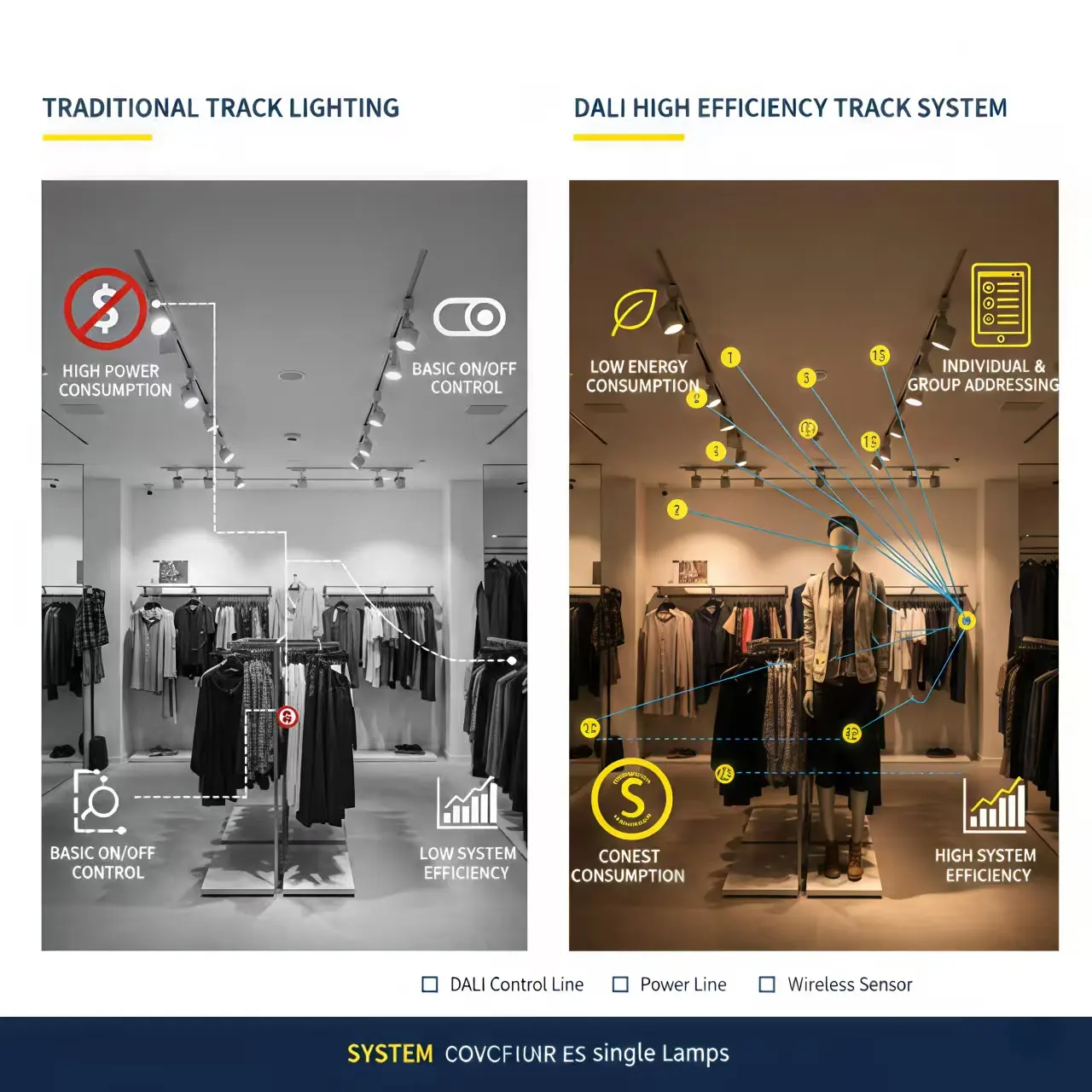
DALI, and especially DALI-2, is a globally recognized open protocol for digital lighting control. Unlike traditional analog dimming systems, DALI assigns each luminaire a unique digital address.
This enables:
- Individual control of each track luminaire
- Consistent dimming performance independent of cable length
- Software-based grouping and scene configuration
- Scalable and future-proof system expansion
When high-efficacy track lighting is integrated into a DALI system, lighting control evolves from zone-based management to point-level precision, laying the foundation for intelligent commercial lighting systems.
The Synergy Between High Efficacy and DALI Control
Why DALI High Efficiency Track Lighting Delivers More Than the Sum of Its Parts
In conventional commercial lighting, brightness and control are often treated as separate considerations. Even highly efficient luminaires can waste energy if they operate at full output during periods of low demand.
DALI High Efficiency Track Lighting resolves this disconnect by combining optimized hardware with intelligent control.
From Passive Illumination to Adaptive Lighting
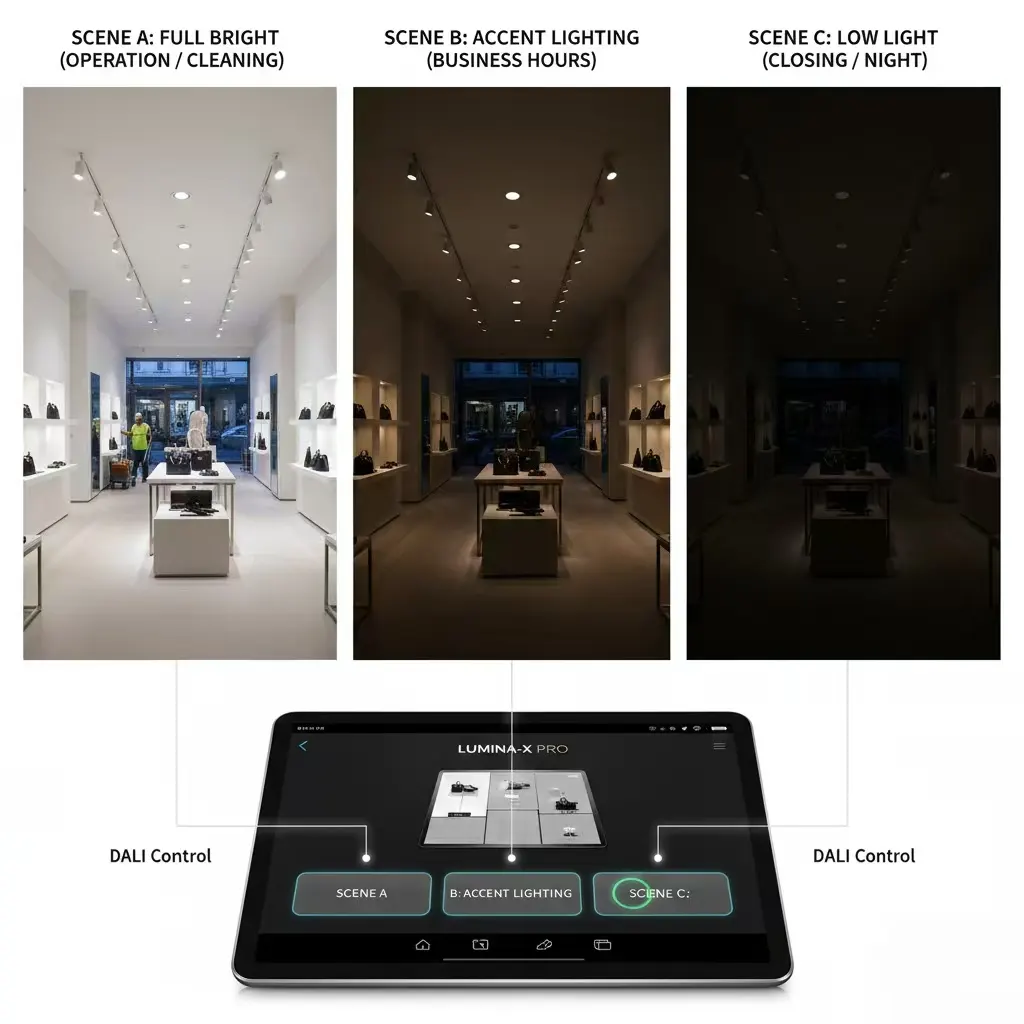
With DALI control, lighting systems gain the ability to respond dynamically to real-world conditions:
- Adjusting output based on operating hours
- Differentiating lighting levels by functional zones
- Compensating for variations in natural daylight
Lighting no longer simply produces light; it actively adapts to how spaces are used.
Maintaining Efficiency Across the Dimming Range
High-quality DALI drivers ensure stable performance across a wide dimming range. Whether operating at 30%, 50%, or 70% output, system efficiency remains consistent, avoiding the performance losses commonly seen in lower-grade solutions.
This makes DALI-controlled high efficacy track lighting especially suitable for commercial environments where luminaires rarely operate at full output.
Energy Performance and Sustainability
A Practical Path Toward Carbon Reduction
For commercial property owners, energy efficiency directly affects long-term financial performance.
Static Energy Savings Through High-Efficacy Hardware
Compared to standard LED track lighting, high-efficacy solutions can reduce installed power by 30% or more while maintaining equivalent illumination levels. This also leads to lower demands on electrical infrastructure.
Dynamic Energy Savings Through Intelligent Control
When combined with daylight sensors, DALI systems enable constant illuminance control. Luminaires near windows automatically dim when natural light is sufficient, delivering an additional 20–40% reduction in energy consumption in large commercial buildings.
Alignment With ESG and Green Building Standards
DALI High Efficiency Track Lighting supports compliance with international sustainability frameworks such as LEED and WELL, helping organizations meet ESG objectives and strengthen their corporate responsibility profile.
Scene-Based Precision
Where Lighting Quality Meets Commercial Value
In commercial environments, lighting shapes perception as much as it provides visibility.
Pixel-Level Flexibility for Changing Displays
Because control logic resides in software rather than wiring, DALI track lighting systems allow rapid reconfiguration. When layouts or displays change, lighting scenes can be updated digitally without physical intervention.
Smooth Visual Transitions and Premium Experience
DALI supports logarithmic dimming curves, ensuring smooth and natural transitions across the entire dimming range. This flicker-free, visually comfortable performance is essential for high-end retail, galleries, and brand-focused spaces.
Smarter Maintenance Through System Feedback
Traditional commercial lighting maintenance relies heavily on manual inspection and reactive repairs.
DALI introduces two-way communication between luminaires and control systems, enabling:
- Real-time monitoring of operating status
- Tracking of power consumption and driver health
- Predictive maintenance before failures occur
Combined with lower thermal stress from high-efficacy operation, system lifespan can be extended from typical 3–5 years to 8–10 years.
System Flexibility for Evolving Commercial Spaces
Modern commercial environments evolve rapidly, driven by seasonal changes, pop-up concepts, and new display strategies.
A key advantage of DALI track lighting systems is that control logic is software-based, not hardwired. This allows future modifications with minimal disruption, reducing renovation costs and downtime.
Conclusion | A Long-Term Investment in Lighting Performance
When discussing why DALI High Efficiency Track Lighting represents the future of commercial illumination, the core values are clear:
- Efficiency
- Intelligence
- Flexibility
Although initial investment costs may be higher than conventional solutions, reduced energy consumption, lower maintenance requirements, and enhanced lighting quality typically result in a return on investment within 18 to 24 months.
In an environment of volatile energy prices and tightening sustainability regulations, DALI High Efficiency Track Lighting is not merely a lighting upgrade—it is a strategic, future-oriented investment.

