



DALI vs 0–10V Dimming: Which Lighting Control System Is Right ?
By Powerstar
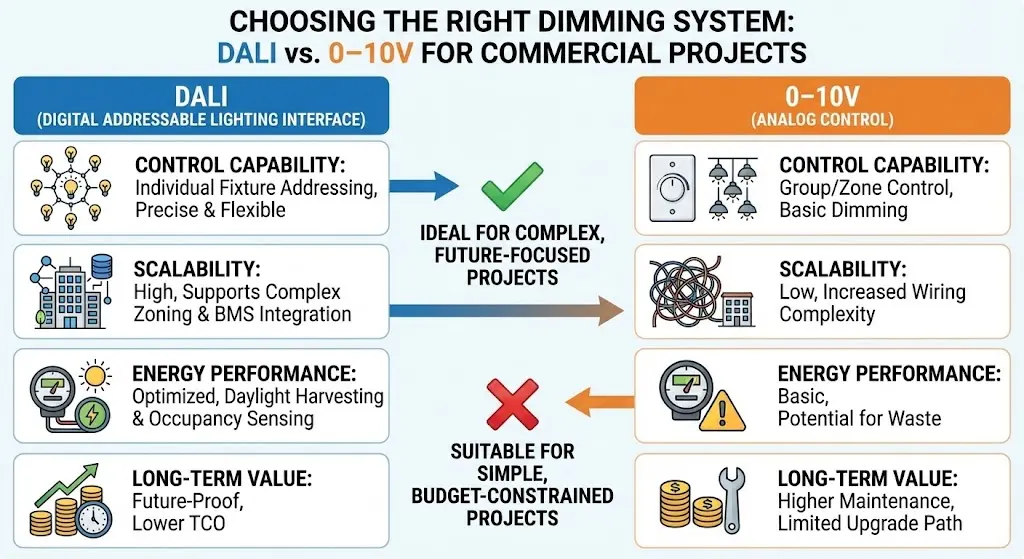
Choosing the right dimming system is a critical decision in any commercial lighting project. Among the available options, DALI and 0–10V remain the most commonly compared lighting control technologies. While both systems provide dimming functionality, their differences in control capability, scalability, energy performance, and long-term value can significantly impact project outcomes.
This article provides a practical comparison to help you determine whether DALI or 0–10V dimming is the right lighting control system for your commercial project.
DALI vs 0–10V dimming comparison for commercial lighting systems
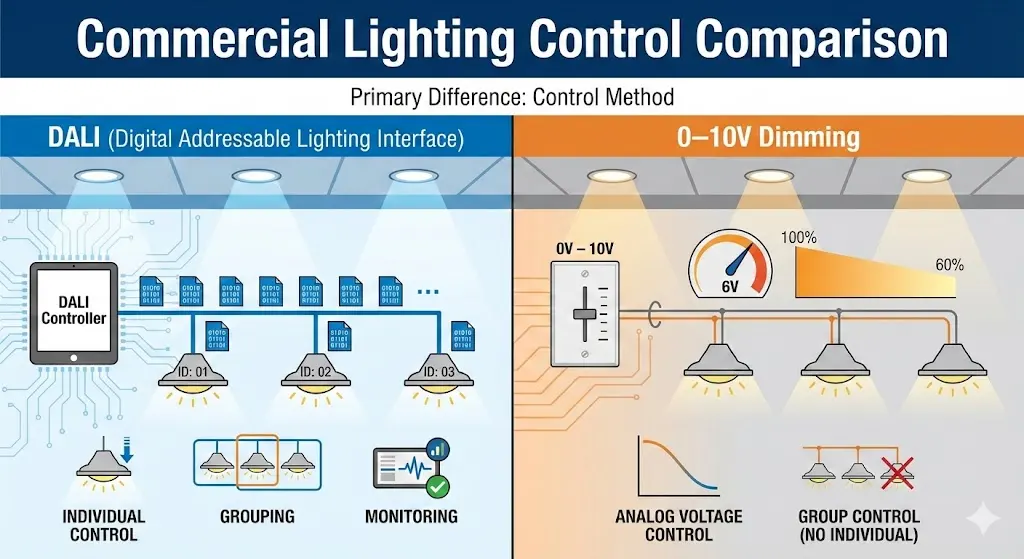
At a high level, the primary difference between DALI and 0–10V lies in how they control luminaires.
DALI is a digital, addressable lighting control system, allowing individual luminaires to be controlled, grouped, and monitored independently. In contrast, 0–10V is an analog dimming method that adjusts brightness by varying voltage levels, typically controlling fixtures in groups rather than individually.
This article provides a practical comparison to help you determine whether DALI or 0–10V dimming is the right lighting control system for your commercial project.
Core System Comparison
| Feature | DALI Dimming | 0–10V Dimming |
|---|---|---|
| Control type | Digital, addressable | Analog voltage-based |
| Individual luminaire control | Yes | No |
| Two-way communication | Yes | No |
| Group & scene flexibility | High | Limited |
| Typical project scale | Medium to large | Small to medium |
DALI vs 0–10V dimming installation and wiring differences
From an installation perspective, 0–10V dimming is often perceived as simpler due to its basic wiring requirements. However, this simplicity can become a limitation in larger projects.
DALI control wiring is polarity-free and supports flexible topologies, which simplifies system expansion and modification. While initial planning may be slightly more involved, DALI installations typically reduce complexity over the system’s lifecycle.
In retrofit or phased upgrade projects, this flexibility can significantly lower long-term installation costs.
Wiring and installation comparison
| Aspect | DALI | 0–10V |
|---|---|---|
| Control wiring | 2-wire, polarity-free | 2-wire, polarity-sensitive |
| Wiring topology | Flexible | Limited |
| Maximum control distance | Stable over long runs | Voltage drop risk |
| Installation skill level | Moderate | Basic |
DALI vs 0–10V energy saving and lighting efficiency
Energy efficiency is a key decision factor in commercial lighting projects.
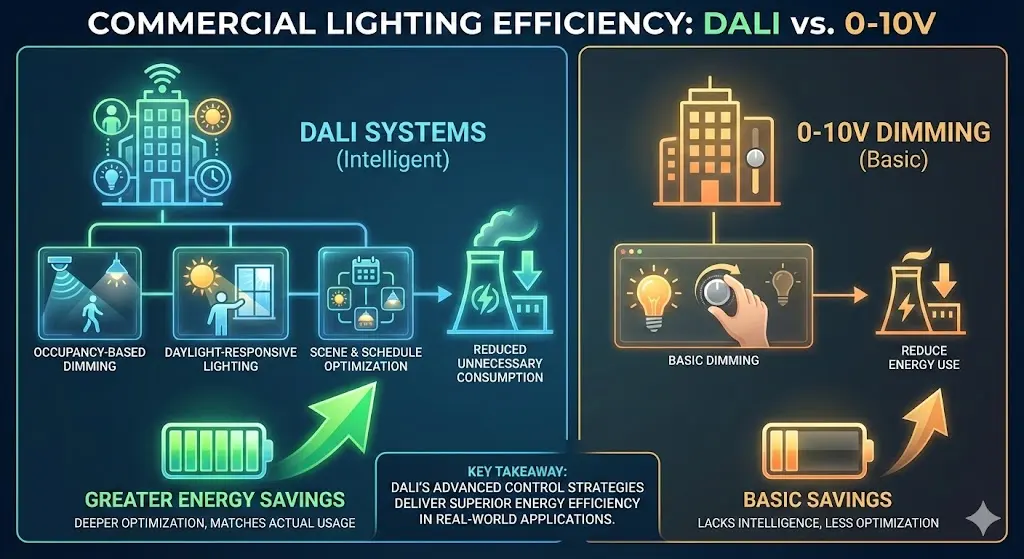
DALI systems support advanced control strategies such as:
- Occupancy-based dimming
- Daylight-responsive lighting
- Scene and schedule optimization
These features enable lighting output to closely match actual usage, reducing unnecessary energy consumption.
0–10V dimming can reduce energy use through basic dimming but lacks the intelligence required for deeper optimization. As a result, DALI systems typically deliver greater energy savings in real-world commercial applications.
Energy saving capability comparison
| Energy-saving function | DALI | 0–10V |
|---|---|---|
| Occupancy-based dimming | Yes | Limited |
| Daylight harvesting | Yes | Limited |
| Scheduled dimming | Yes | External controller required |
| Typical energy reduction | 20–50% | 10–25% |
DALI vs 0–10V lighting control flexibility and scalability
Commercial projects often evolve over time due to tenant changes, layout adjustments, or functional upgrades.
DALI systems are inherently scalable. New luminaires, sensors, or control devices can be added and reprogrammed without major rewiring. Grouping and scene logic can be modified through software rather than physical changes.
0–10V systems are far less flexible. Changes typically require rewiring, relay adjustments, or additional hardware, increasing labor costs and downtime.
DALI vs 0–10V scalability for large commercial lighting systems
Scalability is where the difference between the two systems becomes most evident.
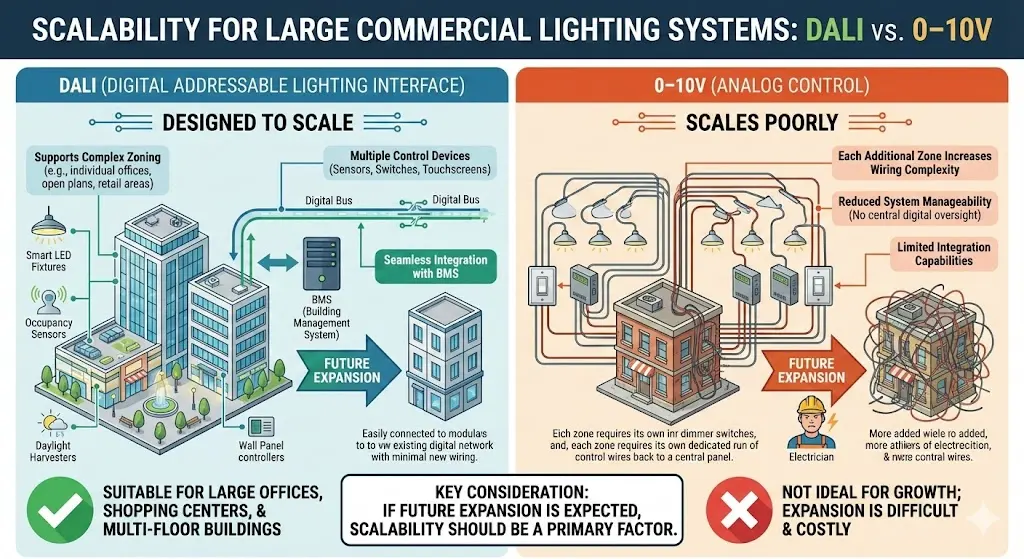
DALI systems are designed to scale, supporting complex zoning, multiple control devices, and integration with building management systems. This makes them suitable for large offices, shopping centers, and multi-floor commercial buildings.
0–10V systems scale poorly, as each additional zone increases wiring complexity and reduces system manageability.
If future expansion is expected, scalability should be a key consideration.
Scalability comparison
| Easy system expansion | Yes | No |
| Software-based reconfiguration | Yes | No |
| Support for complex scenes | Excellent | Basic |
| Long-term adaptability | High | Low |
DALI vs 0–10V maintenance and system monitoring comparison
Maintenance efficiency becomes increasingly important as project size grows.
DALI systems provide two-way communication, allowing facility managers to monitor luminaire status, detect faults, and plan maintenance proactively. This reduces downtime and maintenance labor.
0–10V systems offer no feedback mechanism. Fault detection relies on manual inspection, which increases maintenance effort and response time.
For large commercial projects, centralized monitoring is often a decisive factor in favor of DALI.
Maintenance comparison
| Maintenance aspect | DALI | 0–10V |
|---|---|---|
| Luminaire status feedback | Yes | No |
| Centralized monitoring | Yes | No |
| Fault identification speed | Fast | Slow |
| Maintenance efficiency | High | Low |
DALI vs 0–10V scalability for large commercial lighting systems
Scalability is where the difference between the two systems becomes most evident.
DALI systems are designed to scale, supporting complex zoning, multiple control devices, and integration with building management systems. This makes them suitable for large offices, shopping centers, and multi-floor commercial buildings.
0–10V systems scale poorly, as each additional zone increases wiring complexity and reduces system manageability.
If future expansion is expected, scalability should be a key consideration.
Cost and ROI comparison
| Cost factor | DALI | 0–10V |
|---|---|---|
| Initial investment | Medium | Low |
| Operating cost | Low | Medium |
| Maintenance cost | Low | High |
| Typical ROI period | 2–4 years | Longer |
Upgrading from 0–10V to DALI dimming in existing projects
When upgrading existing lighting systems, both technologies can be applied, but DALI offers greater long-term benefits.
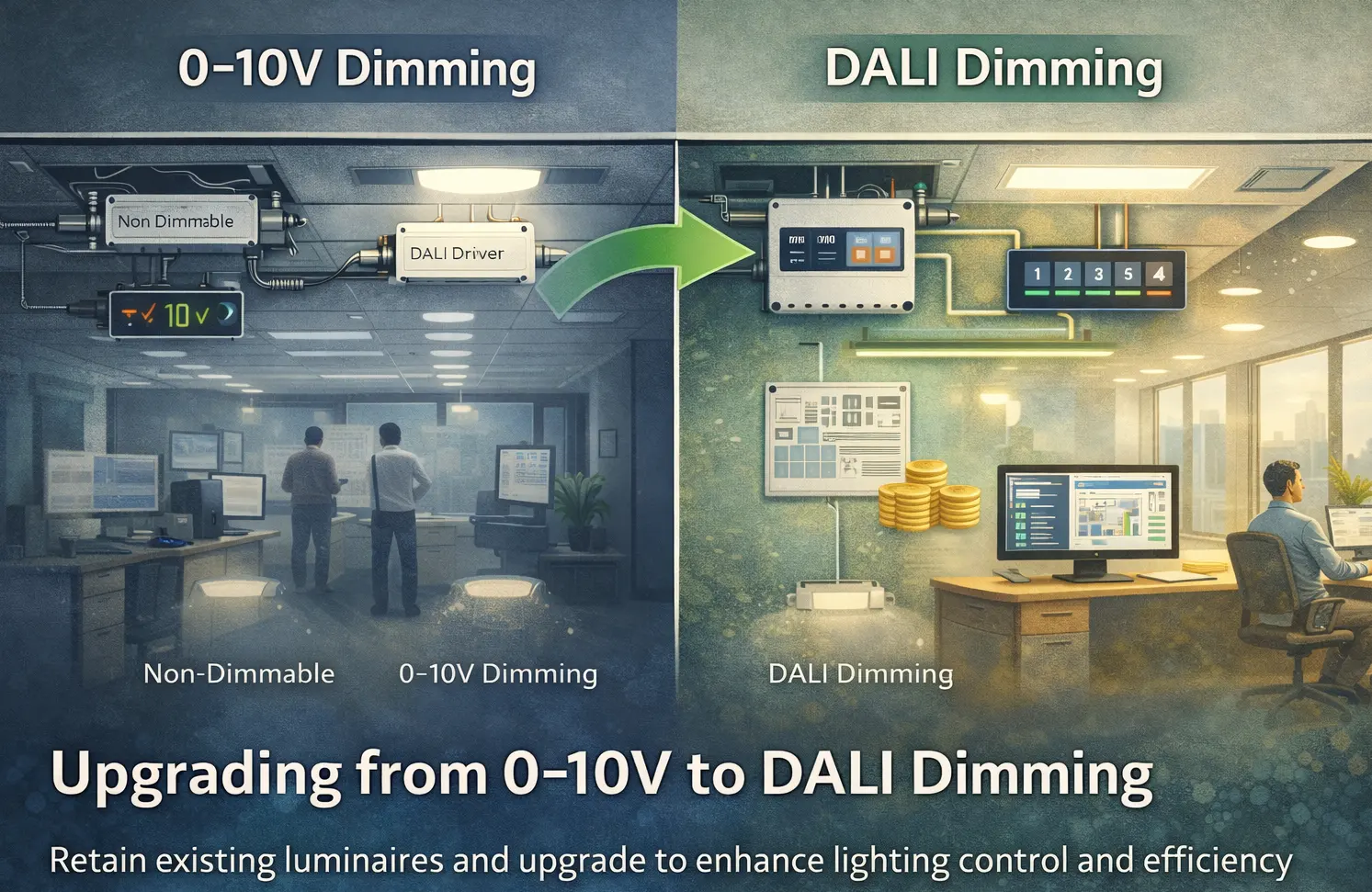
DALI retrofit projects typically focus on replacing drivers and adding control devices while retaining existing luminaires. This approach enables advanced control without structural changes.
Upgrading an existing 0–10V system often improves basic dimming performance but does not deliver the same level of intelligence or future readiness.
Many commercial buildings currently operate with 0–10V dimming systems and consider upgrading to DALI as part of an energy or control improvement initiative.
In most cases, existing luminaires can be retained, with upgrades focusing on drivers and control devices. This makes transitioning from 0–10V to DALI a practical retrofit strategy rather than a full system replacement.
For building owners seeking improved control without major disruption, this upgrade path is increasingly popular.
Which dimming system is right for your commercial project?
The choice between DALI and 0–10V depends on project goals, scale, and long-term strategy.
Choose 0–10V dimming if:
- The project is small and budget-driven
- Only basic dimming is required
- Long-term flexibility is not a priority
Choose DALI dimming if:
- The project involves offices, retail, or large commercial spaces
- Energy efficiency and intelligent control are key objectives
- Future expansion or system upgrades are expected
Conclusion
DALI and 0–10V dimming systems serve different purposes in commercial lighting projects. While 0–10V remains a viable option for simple applications, DALI stands out as the more advanced and future-proof lighting control solution.
For commercial projects seeking scalability, energy efficiency, and long-term operational value, DALI dimming is often the better choice.

