



The Silent Salesman: Why Track Panel Light for Retail Stores is the Preferred Upgrade
By Powerstar
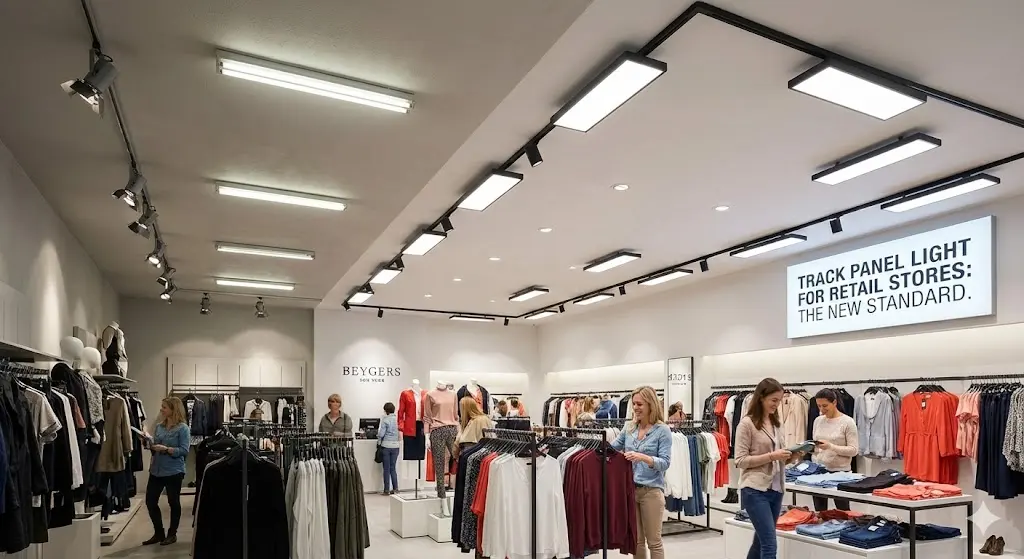
Track Panel Light for Retail Stores plays a crucial role in creating a bright, clean, and comfortable shopping atmosphere that enhances customer experience and product visibility. In the competitive world of brick-and-mortar retail, customer experience is everything. Store owners obsess over floor layouts, window displays, and background music. Yet, one of the most critical elements of sales psychology is often overlooked until the very end of the design process: Lighting.
Lighting does not just illuminate products; it defines the brand, guides the customer’s journey, and directly influences purchasing decisions.
For years, retailers have struggled with a common dilemma: the choice between the flexibility of track spotlights and the uniform coverage of linear fluorescent tubes. Today, a hybrid solution has emerged that offers the best of both worlds.
This article explores why the track panel light for retail stores is rapidly becoming the industry standard for modern commercial spaces, and how you can leverage this technology to transform your shop floor.
What Can Track Panel Light Bring to Us?
To understand the value of this fixture, we must first define it.
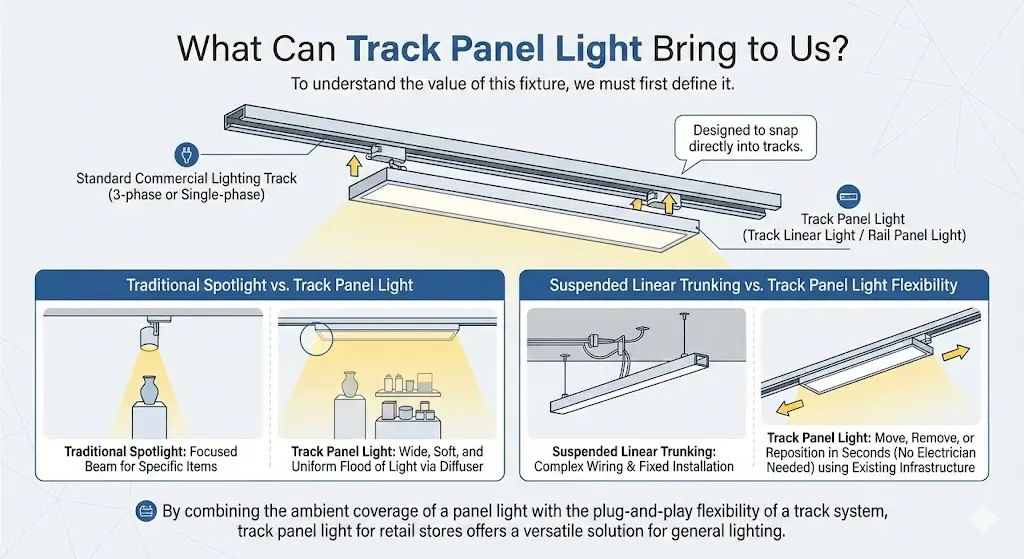
A Track Panel Light (often referred to as a track linear light or rail panel light) is a lighting fixture designed to snap directly into standard commercial lighting tracks (such as 3-phase or single-phase tracks).
Unlike a traditional spotlight, which emits a focused beam to highlight specific items, a track panel light utilizes a diffuser to emit a wide, soft, and uniform flood of light.
Unlike suspended linear trunking systems, which require complex wiring and fixed installation points, track panels use the existing track infrastructure. This means they can be moved, removed, or repositioned in seconds without an electrician.
By combining the ambient coverage of a panel light with the plug-and-play flexibility of a track system, track panel light for retail stores offers a versatile solution for general lighting.
The Core Benefits: Why Switch to Track Panel Lights?
Why are major supermarket chains, fashion boutiques, and showrooms making the switch? Here are the four competitive advantages.
1. Unmatched Flexibility for Changing Layouts
Retail is dynamic. Seasonal displays change, aisles are reconfigured, and promotional zones move. With traditional linear lighting (like tube lights hanging from chains), moving a shelf means your lighting is suddenly in the wrong place, casting shadows over your products.
With track panel lights, the lighting adapts to the store. If you move an aisle two feet to the left, you simply unclip the light from the track, slide it over, and clip it back in. This modularity makes it the ideal future-proof investment.
2. Elimination of Visual “Noise”
Modern retail design favors minimalism. A ceiling cluttered with different types of fixtures, messy wires, and hanging chains looks unprofessional. Track panel lights sit flush or semi-flush with the track rail. Because they share the same track as your accent spotlights, the ceiling looks clean, organized, and intentional. This “clean ceiling” aesthetic is crucial for high-end branding.
3. Superior Aisle Lighting (The “Library Effect”)
One of the biggest challenges in retail is lighting the vertical surfaces of high shelving (such as in supermarkets, pharmacies, or bookstores).
- Spotlights create “scalloping” (bright and dark spots) on shelves, making bottom shelves hard to see.
- Track Panel Lights utilize a wide beam angle (usually 90° to 120°) or double-asymmetric lenses. This floods the vertical face of the shelf with light from top to bottom.
When customers can see the price tags and labels clearly on the bottom shelf, sales in those zones increase.
4. Energy Efficiency and ROI
A track panel light for retail stores typically uses high-efficiency LEDs, delivering 130 to 160 Lumens per Watt. Compared to traditional fluorescent T5 or T8 tubes, these fixtures can reduce energy consumption by up to 50-60%. For a store operating 12 to 14 hours a day, the return on investment (ROI) is often realized within 12 to 18 months via electricity savings alone.
Technical Guide: How to Choose the Right Track Panel Light
Searching for “track panel light for retail stores” yields thousands of results. To ensure you are buying a commercial-grade fixture that enhances your merchandise, you must look at the following specifications.
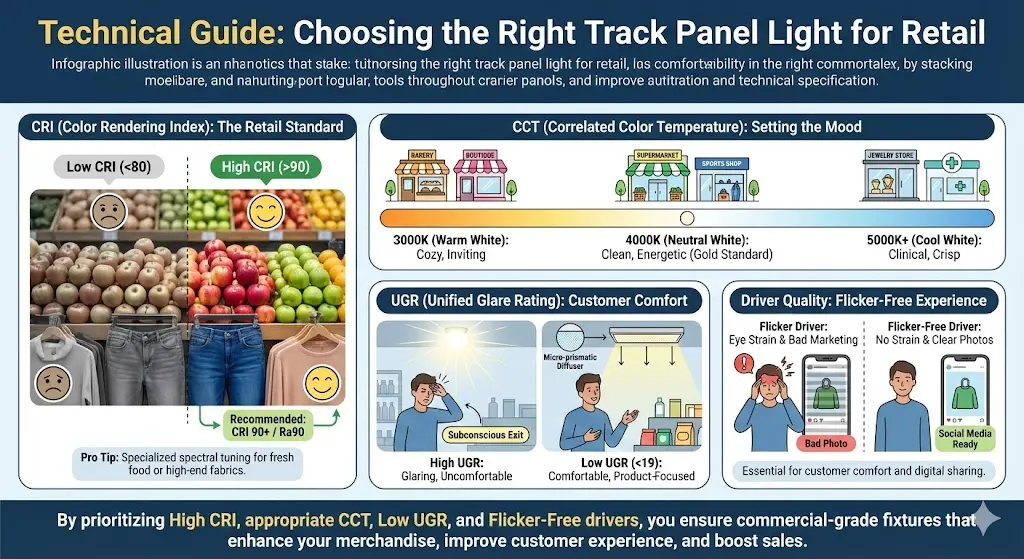
CRI (Color Rendering Index)
This is the most critical metric for retail. It measures how accurately the light reveals the true colors of an object compared to natural sunlight.
- Low CRI (<80): Makes red apples look brown, blue jeans look grey, and skin tones look sickly.
- High CRI (>90): This is the retail standard. It makes colors “pop.”
- Advice: Always specify CRI 90+ or Ra90. If you sell fresh food or high-end clothing, consider specialized spectral tuning (like “crisp white” for fabrics or “fresh meat” spectrums).
CCT (Correlated Color Temperature)
The “temperature” of the light sets the mood of the store.
- 3000K (Warm White): Best for bakeries, furniture stores, and high-end boutiques. It creates a cozy, inviting, and slow-paced atmosphere.
- 4000K (Neutral White): The gold standard for track panel light for retail stores (supermarkets, sport shops, electronics). It is clean, energetic, and modern without being sterile.
- 5000K+ (Cool White): generally avoided in general retail as it can feel clinical, though used occasionally in jewelry or pharmacies.
UGR (Unified Glare Rating)
Bright lights are good; glaring lights are bad. If a customer looks up and gets blinded, they will subconsciously want to leave the store. Look for track panels with UGR<19. These fixtures often use micro-prismatic diffusers or deep-recessed chips to control glare, ensuring the light lands on the product, not in the customer’s eyes.
Driver Quality (Flicker-Free)
Ensure the internal driver is “Flicker-Free.” While the human eye might not detect micro-flickering, it causes eye strain and headaches over time. Furthermore, if customers try to take photos of your products for social media (Instagram/TikTok) and the lights flicker, their phone screens will show banding lines. Bad photos mean bad free marketing.
Design Strategy: The “Layered” Lighting Approach
A common mistake is thinking you should use only track panels or only spotlights. The best retail environments use a hybrid approach.
The Golden Formula:
- General Lighting (Ambient): Use Track Panel Lights.
- Placement: Center of the aisles or general circulation areas.
- Goal: Raise the overall brightness of the store so customers feel safe and oriented.
- Accent Lighting (Focus): Use Track Spotlights.
- Placement: On the same track as the panels.
- Goal: Highlight mannequins, new arrivals, end-caps, or promotional signage.
Because both fixtures share the same track system (e.g., a standard 3-circuit Eurotrack), you can mix and match them.
- Example: In a 10-meter track run, you might install three 1.2m track panels for general light, interspersed with four spotlights pointing at specific displays.
Installation Considerations
Before purchasing track panel light for retail stores, check your infrastructure:
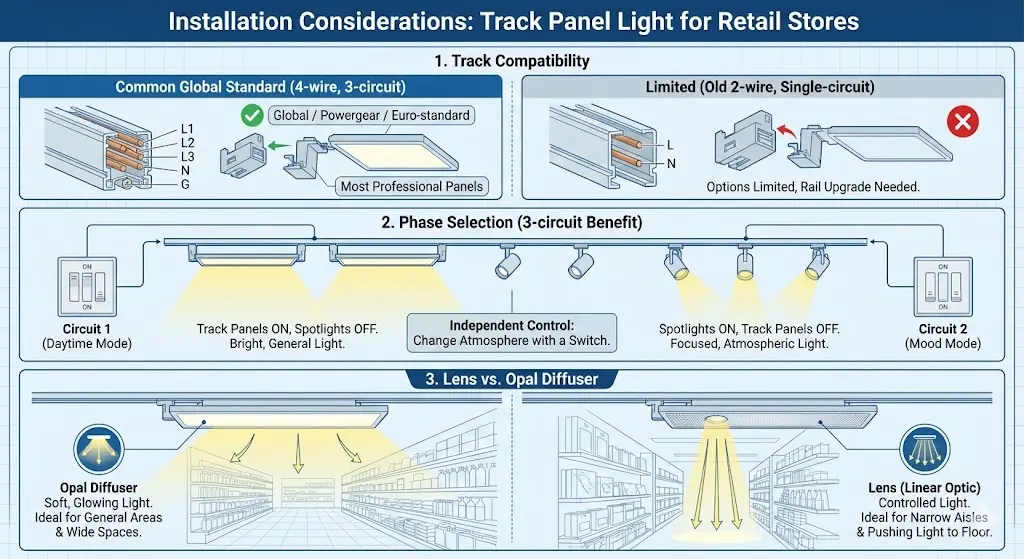
- Track Compatibility: The most common global standard is the 4-wire, 3-circuit track (often called Global, Powergear, or Euro-standard). Most professional track panels are built for this. If you have an old 2-wire single-circuit track, your options will be limited, and you may need to upgrade the rails.
- Phase Selection: A major benefit of 3-circuit tracks is that you can put different lights on different switches. You can set your Track Panels to “Circuit 1” (Daytime mode) and your Spotlights to “Circuit 2” (Mood mode), allowing you to change the store’s atmosphere by flipping a switch.
- Lens vs. Opal Diffuser:
- Opal Diffuser: Soft, glowing light. Good for general areas.
- Lens (Linear Optic): More controlled light. Good for narrow aisles to push light down to the floor rather than lighting up the top of the shelving units.
Conclusion: Lighting as an Investment
In the era of e-commerce, the physical store must offer an experience. Dark corners, flickering tubes, and flat lighting are silent killers of conversion rates.
Upgrading to track panel light for retail stores is not just a maintenance decision; it is a strategic business move. It provides the clean aesthetic of high-end design, the flexibility to adapt to changing merchandising needs, and the energy efficiency to lower overheads.
Whether you are fitting out a new flagship store or retrofitting a local boutique, the track panel represents the future of retail illumination—flexible, efficient, and undeniably effective.

