



Smart Lighting for Chain Stores: How to Keep Every Location Efficient, Consistent, and Easy to Manage
By JC
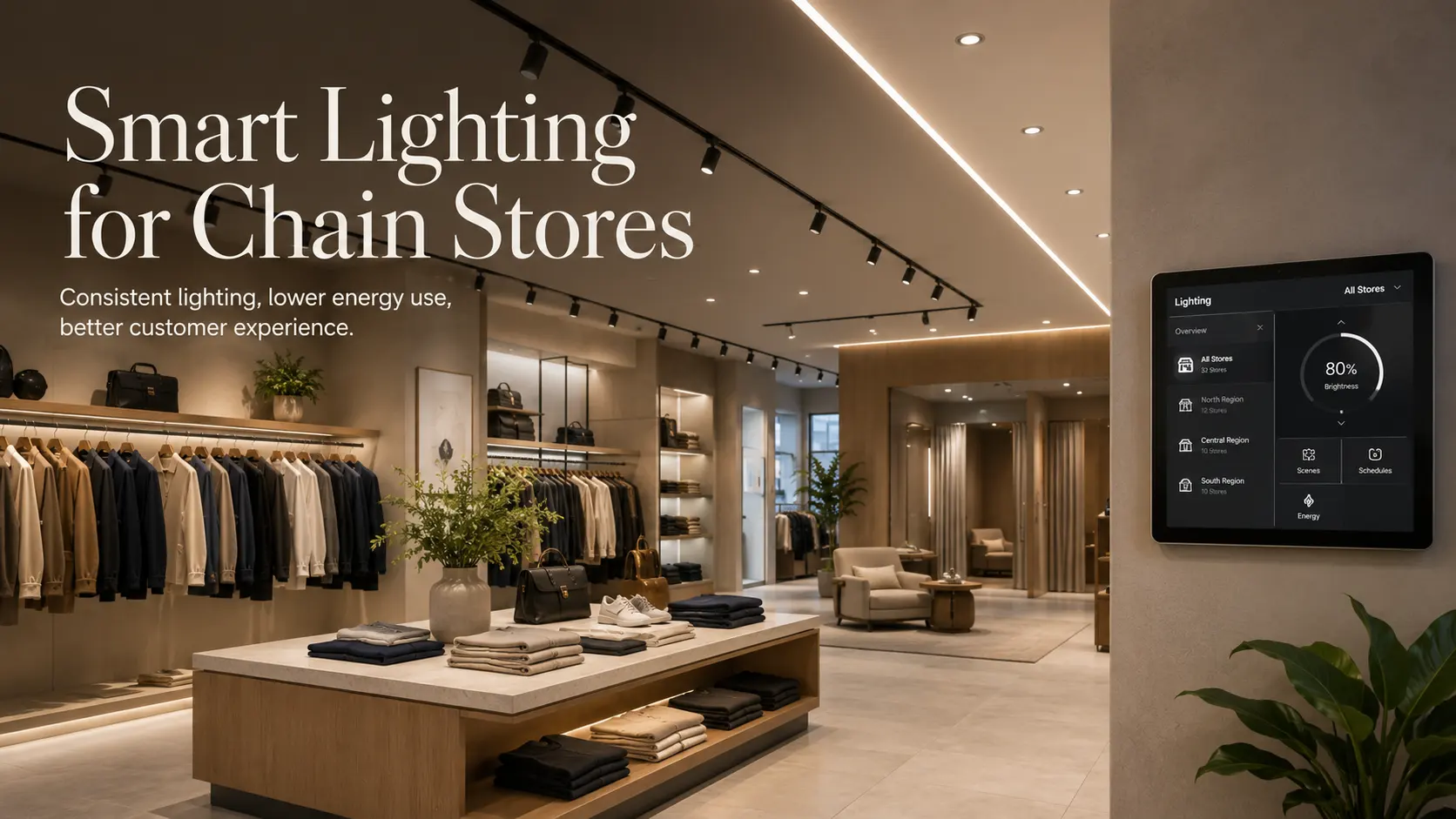
In chain store projects, lighting is not only about brightness. It affects brand image, product presentation, customer experience, energy cost, and daily operation. When a retail brand has only one store, lighting can be adjusted manually based on the local situation. But when the brand has ten, fifty, or even hundreds of stores, lighting management becomes more complicated.This is where smart lighting for chain stores becomes valuable.
Instead of relying only on manual switches or fixed lighting settings, smart lighting systems allow retail brands to control, adjust, and standardize lighting across different locations. From fashion stores and supermarkets to convenience stores, showrooms, and shopping mall tenants, intelligent lighting control can help every store maintain a more consistent visual effect while reducing unnecessary energy waste.
For contractors, lighting designers, and retail operators, smart lighting is becoming an important part of modern commercial lighting projects.
Why Chain Stores Need Smarter Lighting Control
Chain stores usually follow a clear brand standard. The store layout, product display, color style, signage, and customer experience are often designed to look similar in every location. Lighting should also support this consistency.
However, different stores may have different ceiling heights, window positions, daylight conditions, business hours, and display layouts. If each store adjusts lighting manually, the final lighting effect may vary from location to location. One store may look bright and clean, while another may feel dim, uneven, or visually uncomfortable.
Smart lighting for chain stores helps solve this problem by making lighting more controllable. Store managers can use preset lighting scenes, time schedules, dimming settings, motion sensors, and daylight sensors to make the lighting system easier to manage. Instead of adjusting every fixture one by one, the lighting can work according to a planned control strategy.
For retail brands, this means better consistency. For store operators, it means easier daily management. For project contractors, it means a more professional lighting solution that goes beyond basic installation.
Keeping Brand Image Consistent Across Multiple Stores
For chain stores, lighting is part of the brand identity. A fashion store may need a clean, premium, and high-contrast lighting atmosphere. A supermarket may need bright and uniform lighting to make products look fresh and easy to find. A cosmetic store may need high color rendering and accurate facial lighting. A showroom may need flexible lighting for different product displays.
If lighting is not consistent, the brand image can become weaker. Customers may feel that one store looks more premium than another, even if the products are the same.
With smart lighting control, retail brands can create standard lighting scenes for different areas, such as:
- Entrance area
- Product display area
- Promotional zone
- Checkout counter
- Shelf area
- Window display
- Back office or storage area
Each scene can be designed with suitable brightness levels, dimming settings, and operating schedules. This allows different stores to follow a similar lighting strategy while still allowing local adjustment when needed.
For example, a chain fashion store can use brighter accent lighting for new arrivals, softer general lighting for fitting areas, and higher brightness near display walls. Once the lighting scene is defined, the same concept can be applied across different branches.
Reducing Energy Costs in Long-Hour Retail Operation
Many chain stores operate for long hours every day. Convenience stores, supermarkets, shopping mall tenants, and retail chains may keep lights on for 10 to 16 hours per day, sometimes even longer. In this situation, even small energy savings can become valuable over time.
Smart lighting for chain stores can reduce energy consumption in several practical ways.
First, dimming control allows lighting to run at the required brightness instead of always operating at full power. Some areas may not need 100% brightness all day. During low-traffic hours, lighting can be slightly dimmed without affecting customer experience.
Second, daylight harvesting can adjust artificial lighting based on natural daylight. Stores with large windows or glass façades may receive enough daylight during certain periods. Smart sensors can reduce the output of indoor lighting automatically, helping save electricity.
Third, motion sensors can be used in low-traffic areas such as storage rooms, staff areas, corridors, or back-of-house zones. Lights can turn on when people enter and dim down when the space is empty.
Fourth, time-based scheduling can match lighting operation with business hours. For example, a store may use full lighting during opening hours, lower brightness during cleaning time, and only security lighting after closing.
These functions help retail chains control operating costs without sacrificing the visual quality of the store.
Better Lighting Scenes for Different Retail Zones
A chain store is not one single lighting area. Different zones need different lighting effects. Smart lighting makes it easier to separate these zones and manage them more precisely.
In a retail store, general lighting provides basic brightness for the whole space. Accent lighting highlights key products, promotional displays, or brand walls. Shelf lighting improves product visibility. Window display lighting attracts people from outside. Checkout lighting supports staff operation and customer interaction.
If all lights are controlled by one switch, the lighting effect becomes limited. But with smart lighting control, each area can have its own lighting scene.
For example, in a supermarket, the fresh food area may need bright and clear lighting to make products look clean and appealing. The bakery area may use warmer lighting to create a more comfortable feeling. The aisle area may need uniform lighting for easy shopping. Promotional zones may need stronger focus lighting to attract attention.
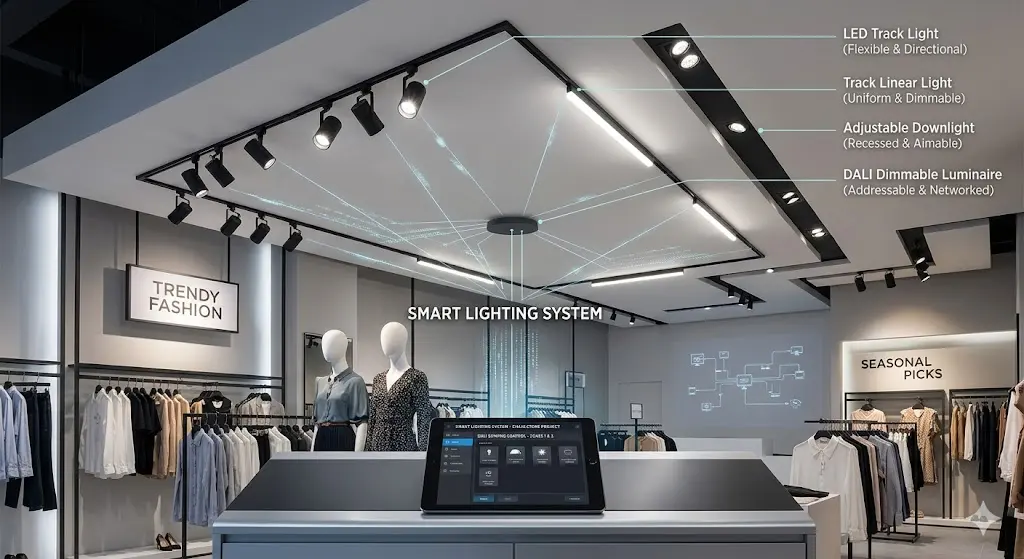
In a fashion store, track lights can highlight mannequins, wall displays, and seasonal collections. Linear lighting can create a clean ceiling style. Downlights can provide comfortable general lighting. With smart control, these fixtures can work together instead of functioning separately.
This helps the store create a more layered and professional lighting environment.
Easier Management for Store Managers and Maintenance Teams
One major advantage of smart lighting for chain stores is easier management. Traditional lighting systems often depend on manual operation. Staff may forget to turn off lights, use the wrong switch, or keep unnecessary areas fully lit.
Smart lighting can reduce this problem by using preset scenes and automated schedules. Store staff do not need to understand every lighting circuit. They can simply select a scene such as “Opening,” “Business Hours,” “Promotion,” “Cleaning,” or “Closed.”
For maintenance teams, smart lighting can also make system management easier. In some advanced systems, lighting status can be monitored from a central platform. If a fixture fails or a certain area is not working correctly, the maintenance team can respond more quickly.
For chain store operators, this is especially useful. Managing lighting across many branches manually can be time-consuming. A centralized or semi-centralized lighting control system can reduce labor pressure and improve operational efficiency.
This is why smart commercial lighting is not only a design upgrade. It is also an operational tool.
How DALI Lighting Control Supports Chain Store Projects
DALI lighting control is commonly used in commercial lighting projects because it allows more flexible and precise control. For chain stores, DALI can support dimming, grouping, scene setting, sensor connection, and individual fixture control.
Compared with simple switch control, DALI gives project teams more freedom to design how the lighting system should work. Fixtures can be grouped by area, such as display wall, shelf area, entrance, checkout counter, or corridor. Each group can have different brightness levels and scene settings.
DALI is also useful when store layouts change. Retail stores often update displays, move shelves, or adjust promotional zones. With a flexible lighting control system, the lighting can be adapted more easily without changing the entire electrical layout.
For example, a chain store may want to highlight a new seasonal display near the entrance. Instead of installing a completely new lighting circuit, the existing DALI-controlled fixtures can be regrouped or adjusted to create a stronger focus in that area.
For contractors and lighting suppliers, DALI lighting for retail chains can be positioned as a practical solution for flexibility, energy saving, and long-term store management.
Smart Lighting Works Better with Flexible Fixtures
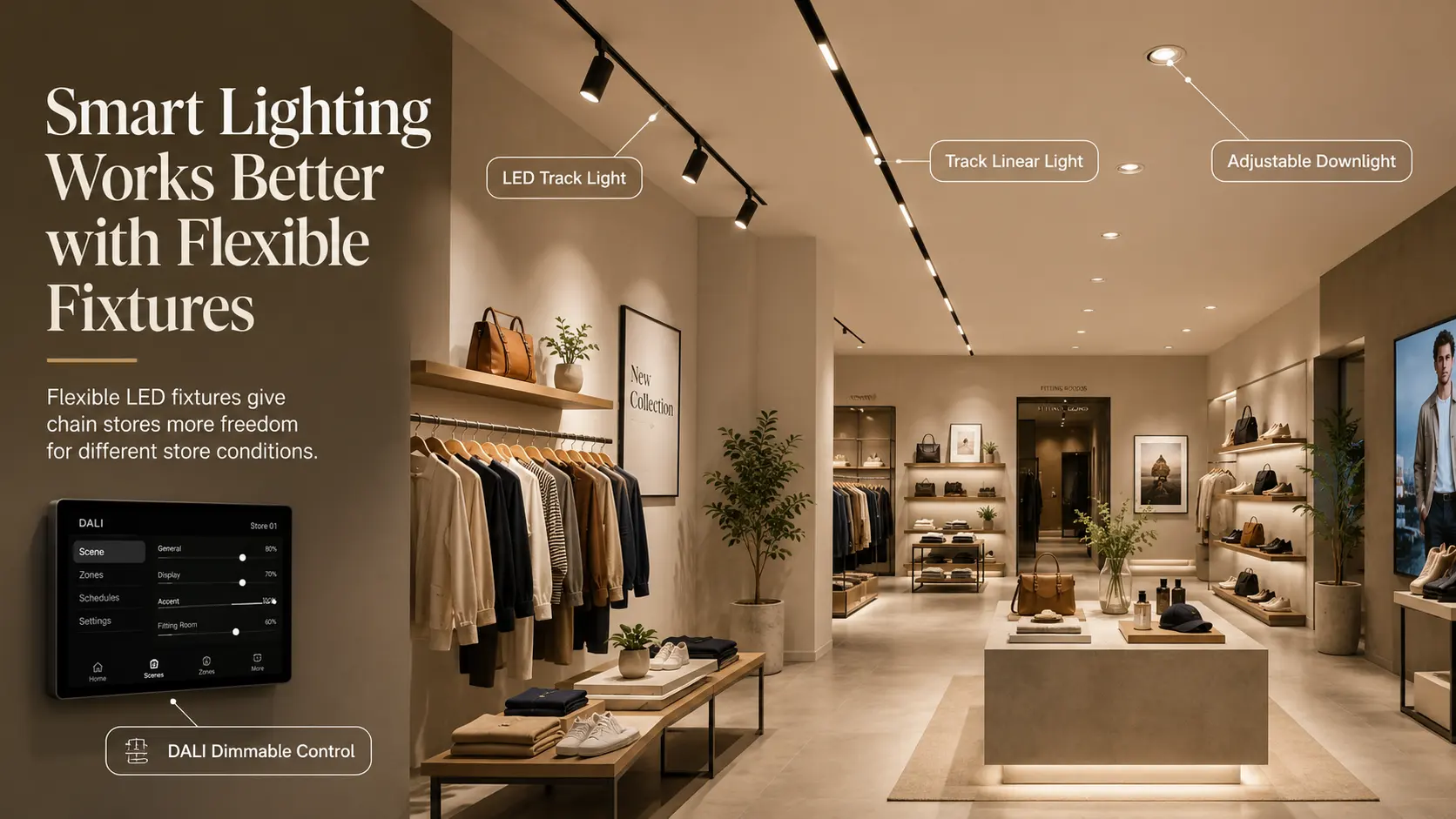
A smart lighting system becomes more useful when it works with flexible LED fixtures. In chain store projects, fixtures such as LED track lights, track linear lights, adjustable downlights, and DALI dimmable luminaires can provide more freedom for different store conditions.
Track lighting is especially suitable for retail spaces because the fixture position can be adjusted according to product displays. Adjustable beam angle track lights can help focus light on different display sizes. Zoomable track lights can provide narrow or wide beams depending on the application.
LED track linear lights are useful for supermarkets, retail aisles, and larger display areas. They can provide continuous and uniform lighting while keeping the ceiling layout clean. High-efficiency versions, such as 160 lm/W track linear lights, can also support energy-saving goals in long-hour retail projects.
Commercial LED downlights are suitable for general lighting in corridors, checkout areas, offices, and public zones. Low-glare downlights can improve visual comfort, especially in spaces where customers and staff stay for a longer time.
When these fixtures are combined with smart lighting control, the whole system becomes more adaptable. The store can adjust not only where the light goes, but also how bright it is, when it operates, and which scene it supports.
Improving Customer Experience Through Better Lighting
Lighting has a direct influence on how customers feel inside a store. Poor lighting can make products look dull, reduce visual comfort, and weaken the shopping atmosphere. Good lighting can guide attention, improve product visibility, and create a more pleasant retail experience.
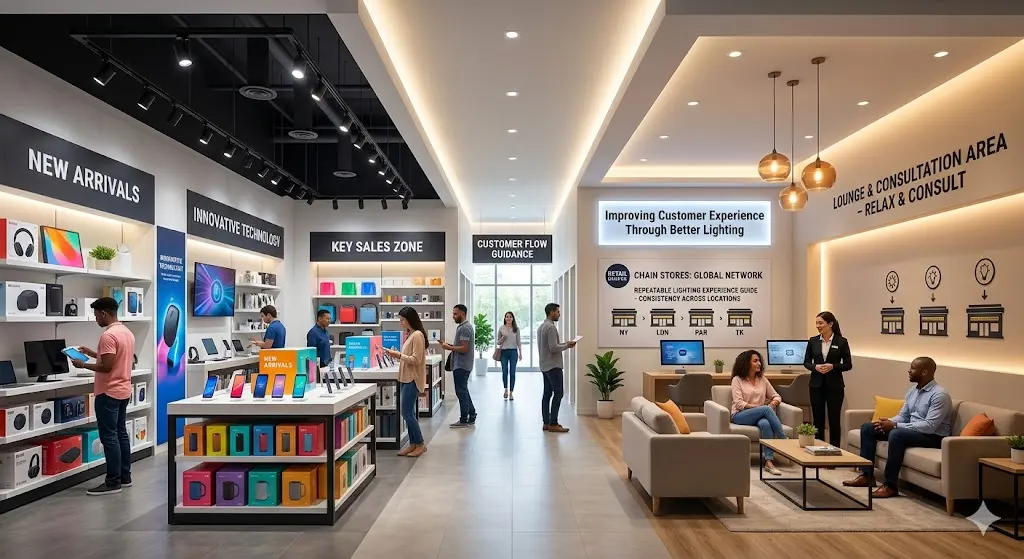
Smart lighting for chain stores allows brands to adjust the store atmosphere based on time, season, or promotion.
For example, a fashion store may use brighter lighting during busy daytime hours and a softer atmosphere in the evening. A supermarket may use strong lighting in fresh food areas and more balanced lighting in aisles. A jewelry or cosmetic store may use carefully controlled accent lighting to make products look more attractive.
Lighting can also support customer flow. Brighter areas can guide people toward new products, promotional displays, or key sales zones. Softer lighting can create a more relaxed feeling in fitting rooms, consultation areas, or lounge zones.
For chain stores, the goal is not just to make the space bright. The goal is to create a repeatable lighting experience that supports the brand and helps customers feel comfortable in every location.
Supporting Store Renovation and Future Layout Changes
Retail stores change frequently. New product lines, seasonal campaigns, display updates, and renovation projects all require lighting flexibility. Fixed lighting systems may become a problem when the store layout changes.
Smart lighting helps future-proof chain store projects. Instead of being locked into one fixed lighting effect, the store can adjust scenes, groups, schedules, and brightness levels over time.
This is especially useful for brands that often update visual merchandising. A promotional wall may change position. A display table may be moved. A new product category may need stronger accent lighting. With flexible fixtures and smart control, the lighting system can respond faster.
For contractors, this is also a strong selling point. A smart lighting system can reduce the need for repeated electrical changes and make future store updates easier. This creates long-term value for the retail brand, not just a one-time installation benefit.
Key Benefits of Smart Lighting for Chain Stores
Smart lighting for chain stores offers several clear benefits for commercial projects:
- More consistent brand image across different locations
- Lower energy consumption through dimming, sensors, and scheduling
- Easier lighting management for store staff
- Better product display and customer experience
- Flexible lighting scenes for different retail zones
- Easier adaptation for future store layout changes
- Better support for centralized or multi-store operation
For retail chains, these benefits are practical. They help reduce operating costs, improve store appearance, and make daily lighting control more efficient.
For lighting suppliers and project contractors, smart lighting is also a strong value-added solution. Instead of only selling fixtures, they can provide a complete commercial lighting strategy that supports long-term operation.
Conclusion
Smart lighting for chain stores is becoming an important part of modern retail lighting design. It helps chain brands keep their lighting consistent, reduce energy waste, simplify daily management, and improve the customer experience across multiple locations.
By combining intelligent lighting control with flexible LED fixtures such as track lights, track linear lights, downlights, and DALI dimmable luminaires, chain stores can build a lighting system that is not only bright, but also efficient, adaptable, and easier to manage.
For retail brands, smart lighting means better control over every store. For contractors and lighting designers, it provides a more professional solution for commercial projects. For customers, it creates a more comfortable and visually attractive shopping environment.
In a competitive retail market, lighting should not be treated as a basic installation only. A well-designed smart lighting system can become a practical tool for brand consistency, energy saving, and better commercial performance.

