



Professional Museum Track Lighting Solution: A Smarter Way to Illuminate Art and Exhibition Spaces
By JC
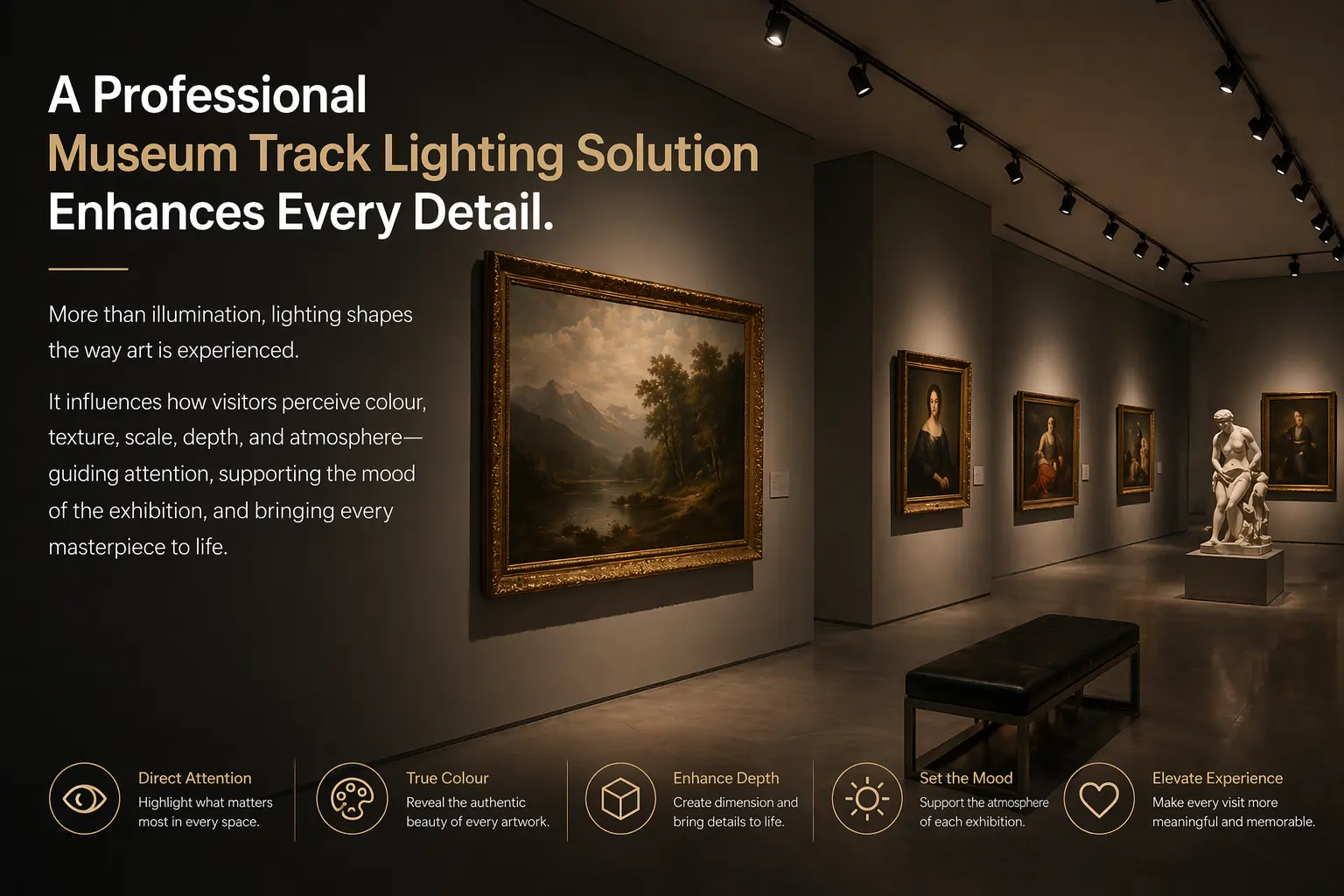
A professional museum track lighting solution is no longer just a technical tool for illuminating artwork. In modern museums and galleries, lighting has become an essential part of the visitor experience. It affects how people perceive colour, texture, scale, depth, and atmosphere. It can quietly direct attention toward a masterpiece, support the mood of an exhibition, and help every display feel more intentional and refined.
Unlike standard commercial spaces, museums require lighting that is both visually precise and highly adaptable. A single exhibition may include framed paintings, sculptures, historical artifacts, multimedia works, and feature walls, all of which respond differently to light. This means a fixed lighting layout is often too limited. Curators and designers need a system that can change with the exhibition while maintaining professional presentation quality.
That is why track lighting has become such a valuable choice in cultural and artistic spaces. A professional museum track lighting solution offers flexibility, directional control, and clean architectural integration, making it easier to shape light exactly where it is needed. More importantly, it allows museums and galleries to build a lighting system that supports both current exhibitions and future changes without compromising quality.
Product Solution: Precision Lighting Tailored for Art Spaces
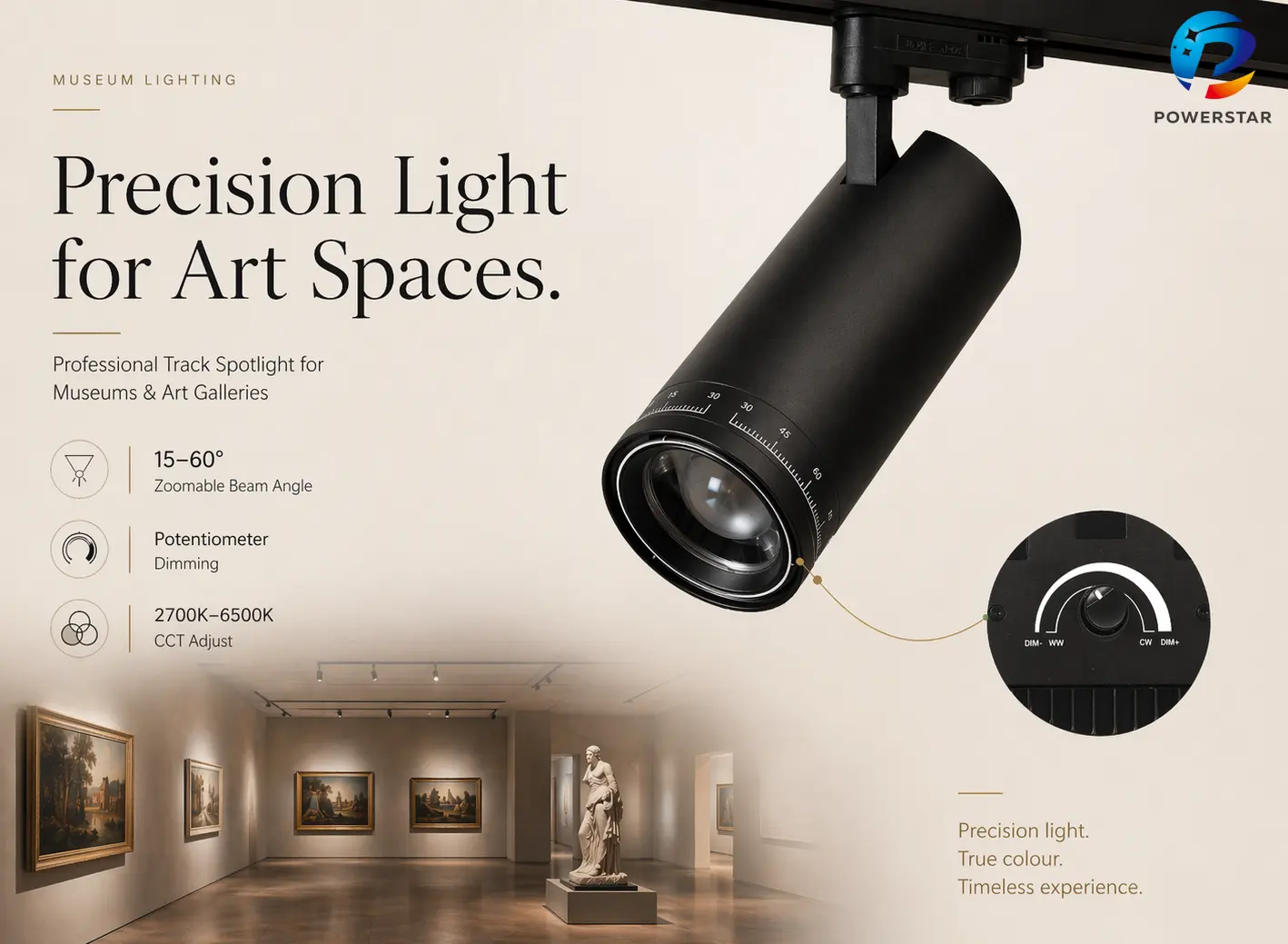
For projects that demand both flexibility and precision, this track spotlight is designed as a professional museum track lighting solution for art galleries and exhibition environments. It combines multiple adjustable features into one fixture, allowing lighting designers and curators to create more tailored lighting effects without increasing system complexity.
A key feature is the 15–60° zoomable beam angle, which allows the light distribution to be adjusted according to the size and placement of each artwork. Narrow beams can be used to create strong visual focus on smaller pieces, while wider beams provide more even coverage for larger paintings or display areas. This adaptability helps reduce the need for multiple fixture types and supports a cleaner, more efficient lighting design.
The fixture is also equipped with integrated potentiometer dimming, enabling on-site brightness adjustment without requiring changes to the existing control system. This is particularly useful in museum and gallery environments where different artworks may require different light intensities to achieve the right balance between emphasis and visual comfort.
In addition, the 2700K–6500K adjustable CCT allows lighting designers to fine-tune the colour temperature based on the exhibition concept and material characteristics of the artwork. Warmer tones can enhance classical paintings and create a more intimate atmosphere, while cooler tones can support contemporary displays with a clearer and more neutral presentation.
By combining beam flexibility, dimming control, and colour temperature adjustment in a single luminaire, this track spotlight helps create a more adaptable and refined lighting system.
It is especially suitable for museums and galleries where exhibition layouts change frequently and lighting needs to remain both precise and responsive.
Why Museum and Gallery Spaces Need More Than General Lighting
In a museum, lighting is never just about brightness. General illumination may make a room visible, but it does not automatically make artwork meaningful. Art needs carefully controlled light to reveal the details that matter most, whether that is the texture of a painting, the form of a sculpture, or the subtle material contrast in a mixed-media installation.
When lighting is too flat, the artwork can lose depth and emotional impact. When it is too harsh, reflections, glare, or excessive contrast can distract visitors from what they are supposed to see. A museum environment requires balance. The room must feel calm and comfortable, while individual works still receive enough emphasis to stand out.
This is where a professional museum track lighting solution becomes especially useful. Instead of relying on fixed ceiling fixtures with limited flexibility, track systems allow each luminaire to be positioned, aimed, and adjusted according to the needs of the display. The result is not only better visual focus, but also a more curated and professional atmosphere throughout the exhibition space.
Track lighting also supports a cleaner ceiling design. Rather than filling the ceiling with many different fixture types, museums can create a more organized visual structure that remains adaptable over time. This combination of visual simplicity and technical flexibility is one of the key reasons track systems are so effective in art-focused environments.
The Importance of Flexibility in Exhibition Design
Museum and gallery layouts are rarely permanent. Walls may be reconfigured, displays may be rotated, and featured works may change according to season, theme, or curatorial direction. Because of this, lighting must remain flexible enough to support constant evolution.
A professional museum track lighting solution gives designers the freedom to respond to those changes without starting over each time. Luminaires can be moved along the track, re-aimed, regrouped, or replaced with different optics depending on the needs of the next exhibition. This saves time, reduces installation complexity, and supports a more efficient exhibition workflow.
Flexibility also improves creative freedom. Curators can rethink how they want visitors to move through a room, which artwork should become the focal point, and how different sections of an exhibition should feel. With a flexible lighting system, those curatorial ideas become much easier to execute. Instead of forcing the exhibition to fit the lighting plan, the lighting plan can adapt to the exhibition.
That ability is especially valuable in institutions that host diverse content. A museum may present classical paintings one month and contemporary installations the next. In both cases, the space needs lighting that can shift with purpose while still maintaining a consistent level of professionalism.
Supporting Gallery Lighting for Temporary Exhibitions
One of the biggest strengths of a track-based system is how well it supports gallery lighting for temporary exhibitions. Temporary exhibitions often move quickly from concept to installation. They may involve new wall arrangements, changing object positions, and different storytelling approaches from one show to the next. In that context, flexibility is not just useful. It is necessary.
A fixed lighting solution may work well for a permanent display, but temporary exhibitions demand something more responsive. Curators need to highlight new works, create fresh focal points, and sometimes completely change the rhythm of a room. A track system makes those adjustments much easier because the lighting can be repositioned without major structural changes.
This also improves operational efficiency. Exhibition teams can spend less time working around inflexible fixtures and more time refining the final presentation. That can be especially important when installation periods are short and every detail needs to be completed quickly.
More importantly, gallery lighting for temporary exhibitions should still feel intentional, not improvised. Even when displays change often, the visitor experience must remain polished and coherent. A well-designed track lighting system helps achieve that by giving curators the control needed to create tailored lighting effects for each new exhibition concept.
Why an Adjustable Beam Angle Track Light for Gallery Projects Matters
Another major advantage of modern museum lighting is the use of an adjustable beam angle track light for gallery applications. Not every artwork needs the same distribution of light. A small framed piece may require a tighter beam to create focus, while a larger painting or display surface may need broader, more even coverage.
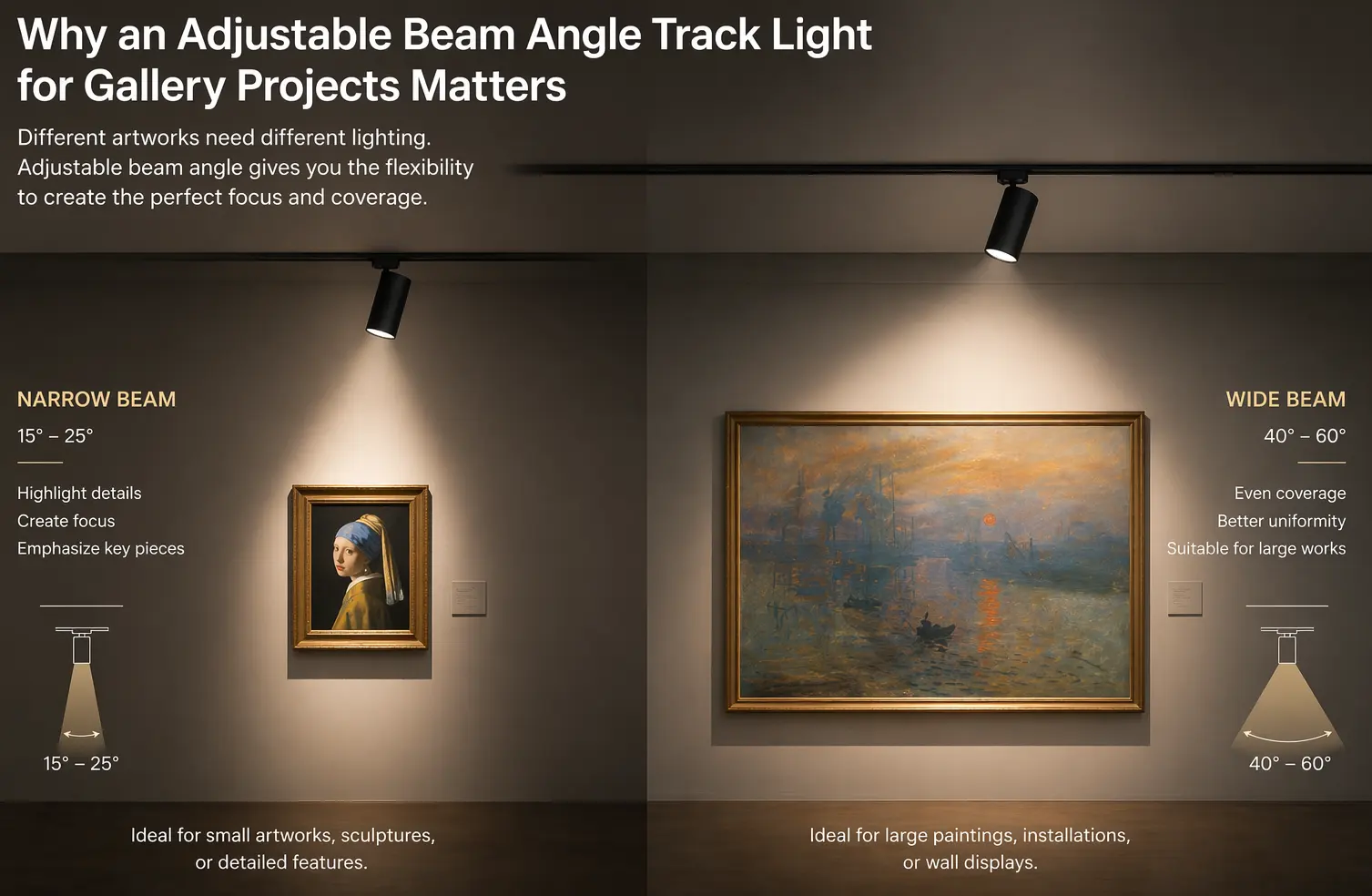
If a gallery uses only fixed beam fixtures, it may need several luminaire types to handle different display conditions. That can make the lighting system more complex and less efficient. An adjustable beam solution simplifies this process by giving one fixture the ability to perform in different ways.
An adjustable beam angle track light for gallery use allows designers to fine-tune the beam according to the artwork’s size, position, and visual importance. A narrow beam can create dramatic emphasis on a specific piece, while a wider beam can deliver more balanced illumination across a larger surface. This helps achieve better visual precision while reducing unnecessary spill light on surrounding walls or adjacent works.
That control is particularly important in curated environments where visual hierarchy matters. Every exhibition has focal points, supporting pieces, and transitions between areas. Adjustable beam lighting helps reinforce that structure. It allows light to become part of the storytelling rather than just background illumination.
For museums and galleries, this means better presentation quality and greater freedom in how art is staged. It also means fewer compromises when exhibitions change, because the beam can be adapted without changing the entire fixture.
Why a High CRI Museum Track Light Is Essential for Artwork Presentation
In art spaces, colour accuracy is one of the most important performance requirements. This is why a high CRI museum track light is essential for serious exhibition lighting. CRI, or Color Rendering Index, refers to how faithfully a light source reveals the colours of an object. In museums and galleries, that matters immensely.
Artworks are often created with subtle colour relationships, delicate tonal transitions, and surface details that depend on accurate lighting to be fully appreciated. If the light source has poor colour rendering, those qualities may appear dull, distorted, or less expressive than intended. Visitors may still see the artwork, but they will not experience it at its best.
A high CRI museum track light helps reveal colours more naturally and more convincingly. Reds appear richer, blues feel deeper, neutrals become more balanced, and textures stand out with greater clarity. This is especially important for paintings, textiles, prints, and mixed-media works where material character and colour nuance are central to the artistic impact.
High colour rendering also supports curatorial credibility. Museums and galleries aim to present artwork in a way that respects the artist’s original intent. Lighting that improves colour fidelity contributes directly to that goal. It allows the audience to see more of what makes each piece unique, from fine pigment differences to subtle surface depth.
When combined with good beam control and low glare, high CRI lighting becomes one of the strongest tools for elevating the overall quality of an exhibition.
Creating a More Refined Visitor Experience
The best museum lighting often goes unnoticed by visitors, not because it is unimportant, but because it feels natural. It supports the artwork without competing with it. It helps visitors move through the space comfortably, understand where to look, and connect more deeply with what they are seeing.
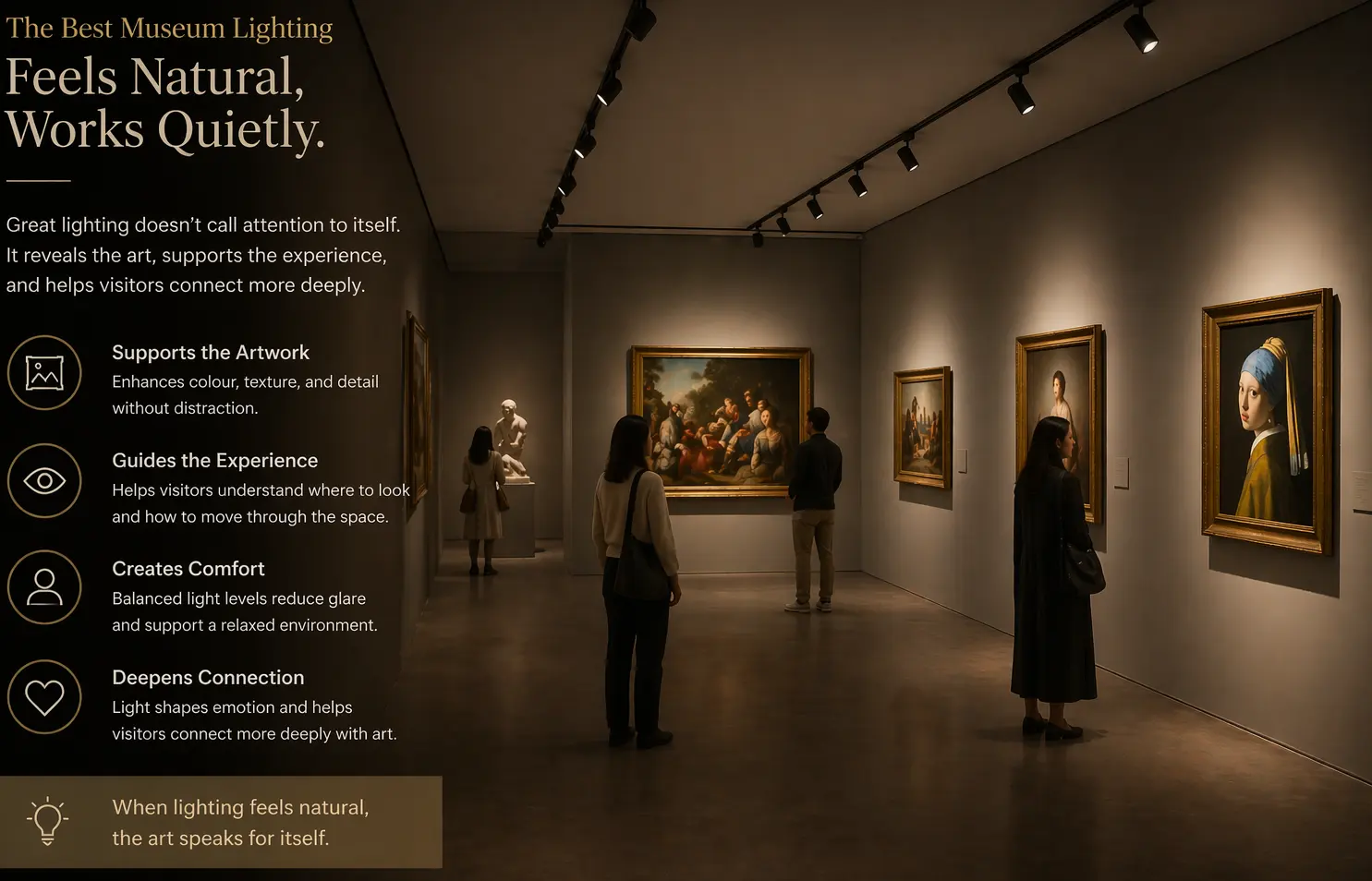
A professional museum track lighting solution contributes to that refined experience in several ways. It improves focus, reduces visual clutter, and creates smoother transitions between ambient and accent lighting. It also helps maintain a calm exhibition atmosphere by limiting glare and keeping light where it belongs.
For institutions, this creates long-term value. A flexible, precise lighting system improves not only the appearance of current exhibitions, but also the ability to adapt to future ones. It supports curatorial goals, enhances visitor engagement, and strengthens the overall visual identity of the space.
In the end, museum lighting is not just about illuminating objects. It is about shaping perception. A professional museum track lighting solution gives galleries and museums the tools to do that with greater control, greater flexibility, and greater respect for the art itself.

