



RGBW vs RGBCW LED Lighting: Which Is Right for Track Light Projects?
By Vincent
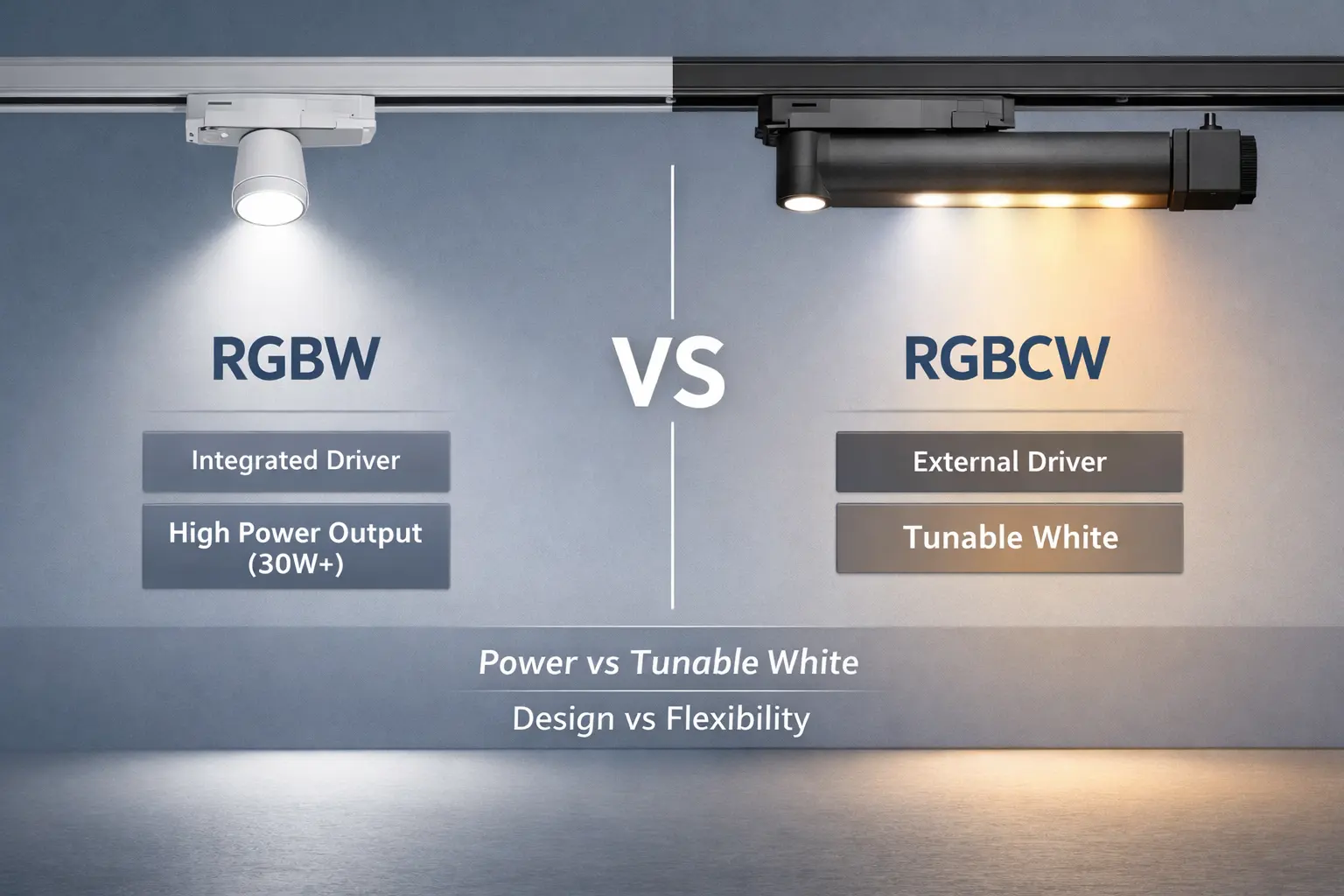
In modern lighting design, particularly in high-end commercial and architectural projects, choosing the right color system is critical. RGBW vs RGBCW LED Lighting represents a key decision for track light projects, as each system offers distinct benefits in terms of brightness, color flexibility, and fixture design. Client requirements today often go beyond simple illumination, seeking precise color control and seamless integration into minimalistic spaces.
In track light projects, this tension is particularly evident. RGBW vs RGBCW LED Lighting has become a recurring topic during the early design stage, as both systems are widely used but often misunderstood. Many clients instinctively assume that a five-channel RGBCW system must be superior to a four-channel RGBW solution. In real-world applications, however, physical constraints and driver architecture often force designers to make practical trade-offs.
This article analyzes the differences between RGBW and RGBCW in track lighting, supported by a real 30W integrated track light case, and provides a clear selection logic for professional projects.
Understanding RGBW and RGBCW LED Systems
Hardware Structure: Four Channels vs Five Channels
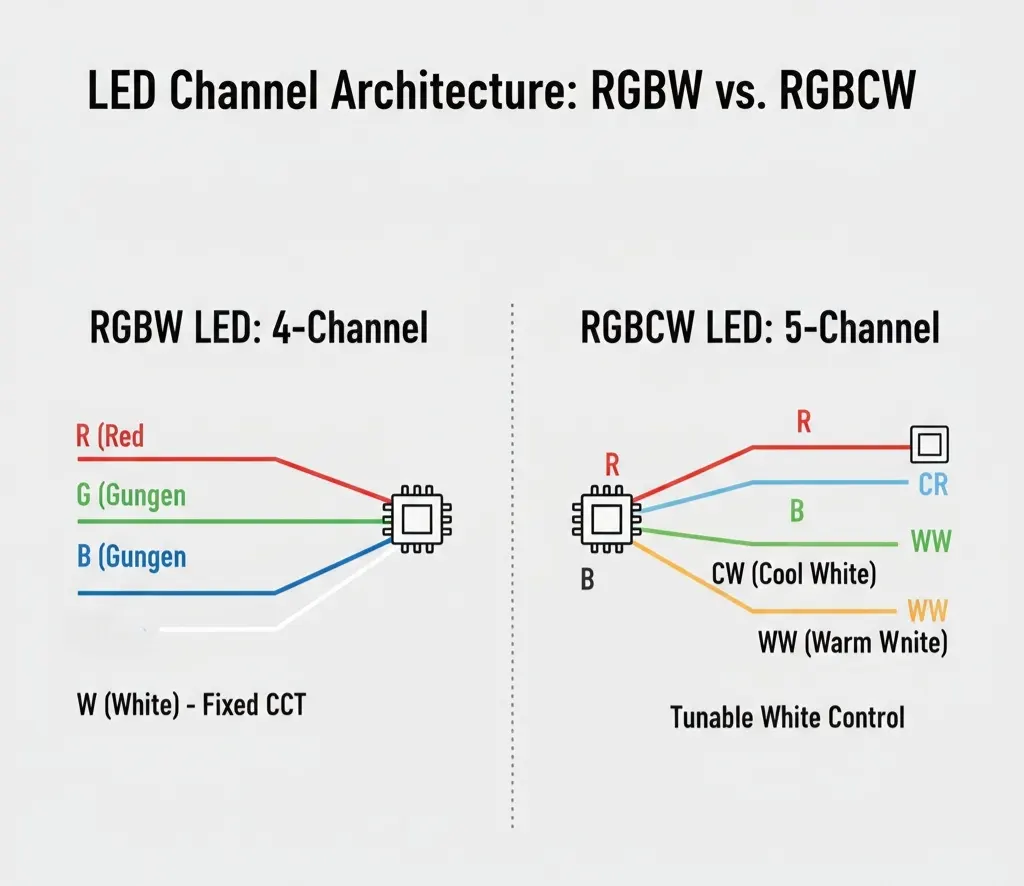
RGBW LED lighting combines red, green, and blue LEDs with a single white LED, usually at a fixed color temperature such as 3000K or 6000K. The system operates with four independent control channels.
RGBCW LED lighting, on the other hand, adds two separate white LEDs—cool white and warm white—to the RGB configuration. This results in five independent channels and enables flexible white light control.
This structural difference directly impacts white light quality, driver complexity, thermal management, and achievable output power.
White Light Performance: Fixed White or Tunable White?
In RGBW systems, the white light channel is fixed by design. While RGB channels can be mixed with white to create various visual effects, this approach cannot deliver true tunable white lighting. Color consistency and visual comfort are limited, especially in functional lighting scenarios.
RGBCW systems enable smooth CCT adjustment by blending warm white and cool white channels. This allows lighting designers to simulate natural daylight changes and create more comfortable environments. For applications focused on human-centric lighting or hospitality spaces, tunable white is often a key requirement.
For a technical reference on tunable white principles, you may consult resources from the Illuminating Engineering Society (IES):
https://www.ies.org
Track Light Design Reality: Integrated Driver Limitations
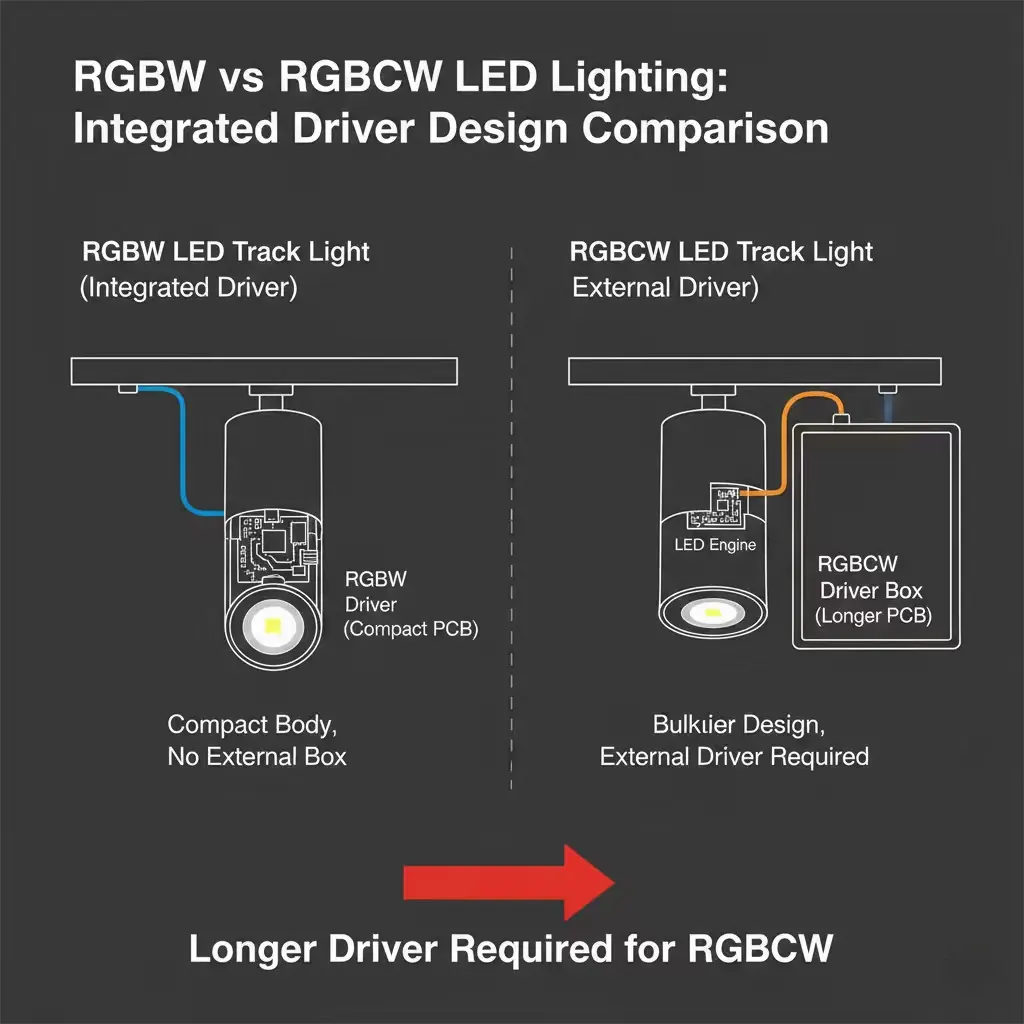
Track lights are compact by nature. Designers often require a clean appearance with the driver fully integrated into the luminaire body. This design preference introduces strict limitations on driver size, heat dissipation, and long-term reliability.
RGBCW drivers require five independent constant-current outputs. Compared with RGBW drivers, this significantly increases PCB length, component density, and thermal load. In many compact track light housings, such drivers cannot be safely integrated without compromising lifespan or performance.
As a result, RGBCW track light solutions frequently rely on external driver boxes, especially when stability and certification compliance are critical.
Power Output vs Functional Flexibility
One of the most common misconceptions in multi-channel LED systems is that total wattage can be freely scaled. In reality, more channels mean stricter current limits per channel and higher thermal pressure.
The practical differences are summarized below:
| Aspect | RGBW Track Light | RGBCW Track Light |
|---|---|---|
| Control channels | 4 | 5 |
| Driver complexity | Lower | Higher |
| Integrated driver feasibility | High | Limited |
| Typical total output | 30W and above | Often restricted |
| White light behavior | Fixed CCT | Tunable CCT |
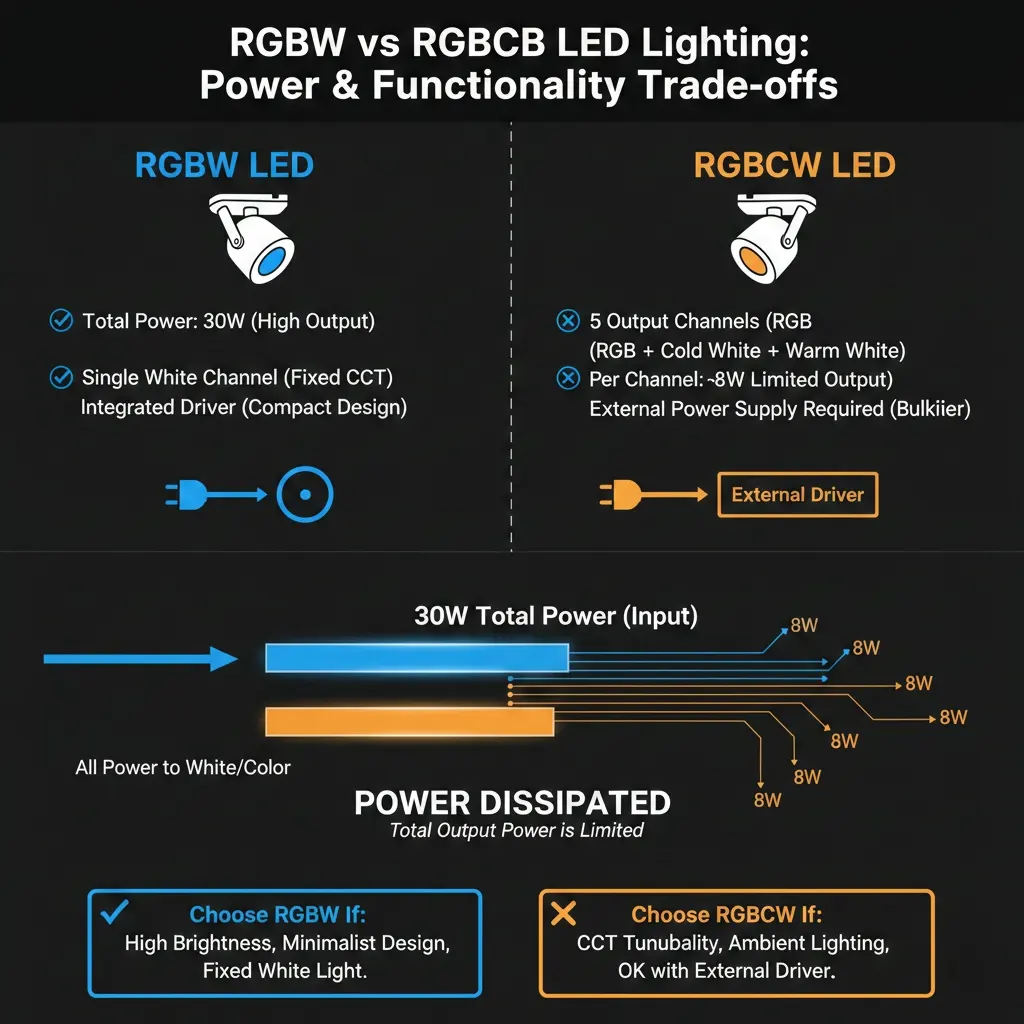
This trade-off is not a product limitation but a result of physical and thermal constraints inherent to compact luminaires.
Case Study: A 30W Integrated Track Light Project
In a recent commercial project, the client requested a track lighting solution with the following specifications:
- Integrated driver design with no external power box
- Total output of at least 30W
- Full-color lighting with tunable white capability
During technical evaluation, it became clear that true tunable white required an RGBCW configuration. However, within the limited space of an integrated track light housing, the RGBCW driver could only support approximately 8W per channel. When operating in white light mode, current had to be split between warm and cool white channels, resulting in insufficient brightness for accent lighting.
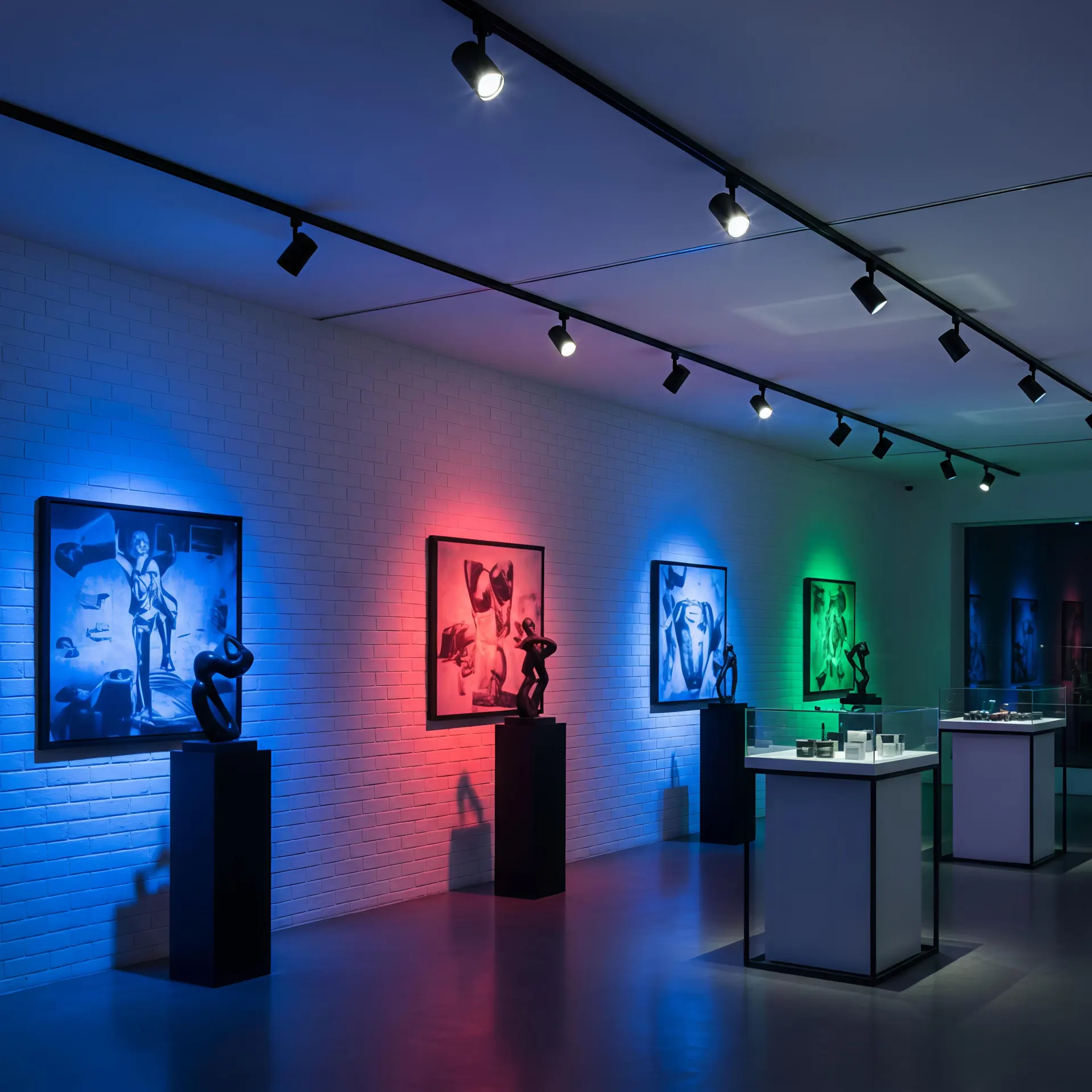
After reviewing both options, the client chose an RGBW track light solution. This approach ensured high luminous output, a fully integrated driver, and a clean fixture appearance, while accepting a fixed white color temperature that met most exhibition lighting requirements.
How to Choose Between RGBW and RGBCW for Track Lighting
The following table provides a quick reference for common project scenarios:
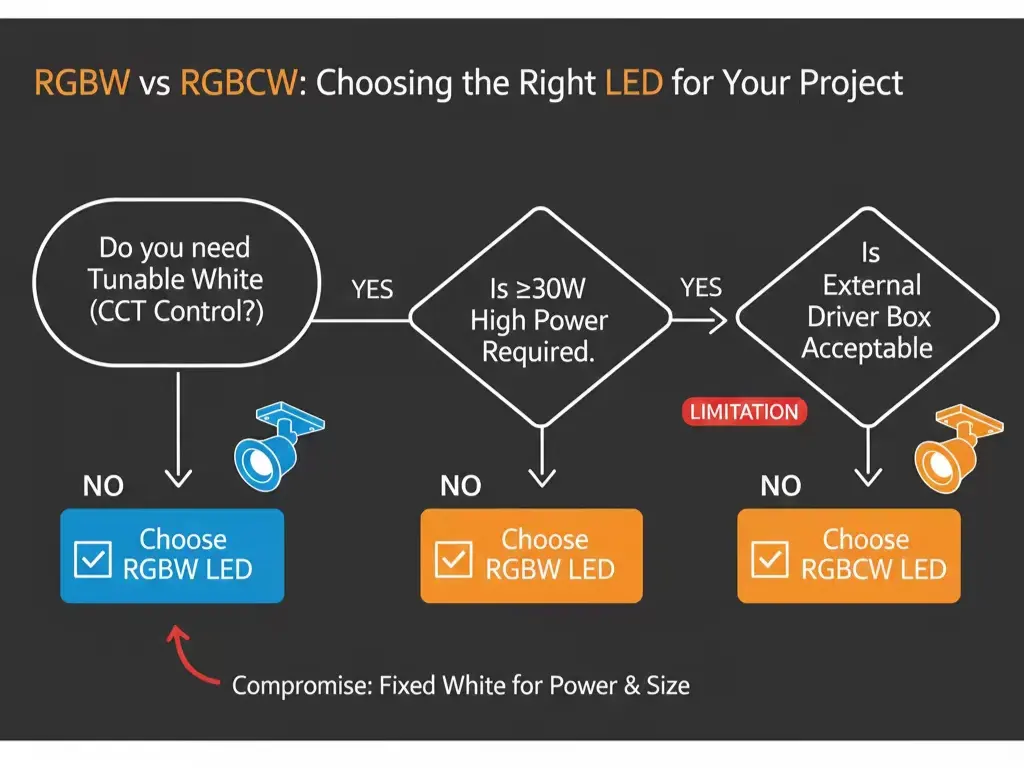
| Project Requirement | Recommended Solution |
|---|---|
| Extremely compact fixture design | RGBW |
| High output accent lighting (30W+) | RGBW |
| Tunable white as a core function | RGBCW |
| External driver acceptable | RGBCW |
| Budget and long-term reliability focus | RGBW |
For additional guidance on LED driver design and thermal management, industry insights from LED professional can be helpful:
https://www.led-professional.com
Why More Channels Are Not Always Better
In the LED industry, higher channel count is often associated with higher-end systems. From an engineering perspective, however, reliability is closely linked to simplicity.
Each additional driver channel increases heat generation and control complexity. In densely packed track lights, excessive thermal stress is a primary cause of LED degradation and driver failure. Moreover, five-channel systems require more advanced control protocols, increasing commissioning effort and system cost.
For large-scale track lighting installations, RGBW systems often provide better consistency across fixtures and batches, making them easier to manage in commercial environments.
Conclusion: Practical Balance Over Specification Stacking
Choosing between RGBW and RGBCW LED lighting is not about selecting the most feature-rich option. It is about aligning lighting goals with physical constraints, driver architecture, and long-term reliability.
For commercial projects that prioritize brightness, compact design, and stable performance, RGBW remains a proven and practical choice. For projects focused on ambiance, human-centric lighting, and flexible scenes—and where external drivers are acceptable—RGBCW offers unmatched versatility.
Early-stage evaluation of driver size, thermal conditions, and spatial constraints is essential. Avoiding functional overdesign often leads to cleaner aesthetics and more reliable lighting solutions.

