



The Rise of Suspended Geometric Lighting for Commercial Spaces: A Complete Design Guide
By Powerstar
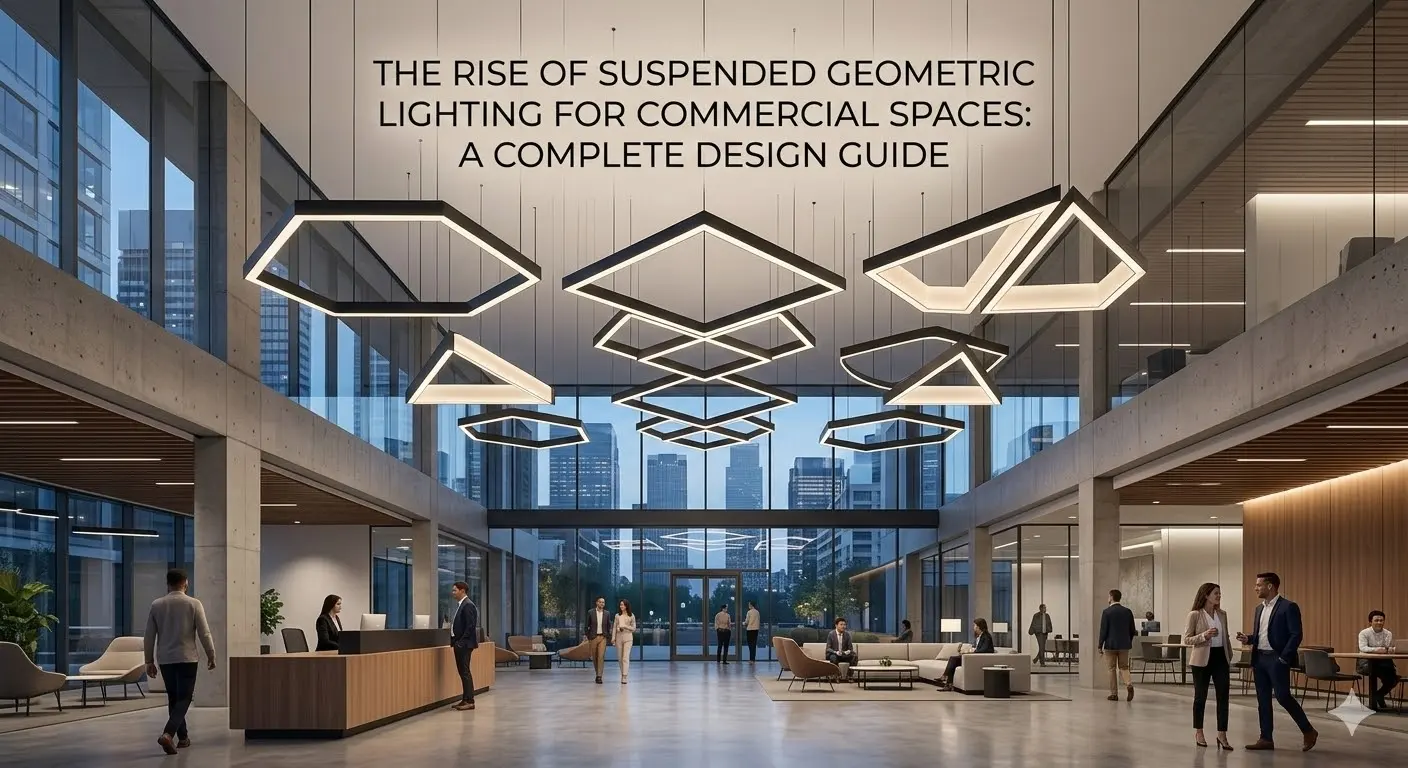
The era of uninspiring, grid-style drop ceilings and harsh fluorescent lighting in commercial environments is officially over. Today, architects, interior designers, and business owners are treating lighting not just as a functional necessity, but as a core architectural element that defines the identity of a space. At the forefront of this design revolution is the increasing use of suspended geometric lighting for commercial spaces.
From interlocking hexagons in tech startups to sweeping, curved linear pendants in luxury hotel lobbies, shaped linear lighting has become the ultimate tool for creating visual impact. As we move deeper into 2026, the demand for customized, bespoke lighting solutions continues to surge. This comprehensive guide explores why commercial environments are embracing geometric lighting, the key benefits it offers, and how to effectively integrate these fixtures into your next project.
What is Suspended Geometric Lighting?
Before diving into its applications, it is essential to define what this lighting category entails. Suspended geometric lighting refers to LED lighting fixtures that are hung from the ceiling via aircraft cables, rods, or wires, and are constructed into specific, non-linear shapes.
Unlike traditional straight linear lights, these fixtures are engineered using precision-cut aluminum extrusions and seamless connectors to form distinct shapes. Common configurations include:
- Circular and Ring Lights: Offering a soft, continuous halo of light that breaks up the rigid straight lines of modern architecture.
- Hexagons and Honeycombs: Highly popular in collaborative workspaces and tech environments, allowing for modular, scalable grids.
- Triangles and Polygons: Providing an edgy, dynamic, and highly modern aesthetic.
- Intersecting Lines (X, Y, and V shapes): Used to create custom, sprawling webs of light that guide the eye across a large ceiling plane.
- Bespoke Curved Forms: Serpentine or wave-like continuous lines that flow fluidly through a corridor or open-plan area.
Because they are suspended, these fixtures bring the light source closer to the work plane while highlighting the vertical volume of a room. This is particularly effective in spaces with exposed ductwork, open-plenum ceilings, or industrial-style architecture.
Why Commercial Spaces are Moving Away from Standard Lighting
The shift toward suspended geometric lighting for commercial spaces is driven by several significant changes in how we view the modern workplace and retail environment.
Historically, commercial lighting was purely utilitarian. The goal was to achieve a specific foot-candle (illuminance) level as cheaply and uniformly as possible. This led to the dominance of the 2×4 recessed troffer. However, as corporate culture and retail strategies have evolved, the physical environment has become a critical asset for brand expression and human well-being.
Modern commercial interior design prioritizes “experiential spaces.” Employers want offices that make employees excited to leave their home offices. Retailers need brick-and-mortar stores that offer an immersive atmosphere that online shopping cannot replicate. Standard flat-panel lighting fails to deliver this emotional and aesthetic connection. Geometric lighting, on the other hand, acts as a suspended sculpture, filling the void of high ceilings and transforming empty overhead space into a captivating design feature.
Key Benefits of Suspended Geometric Lighting for Commercial Spaces
Investing in custom or shaped linear lighting offers a multitude of advantages that go far beyond basic illumination. Here are the primary reasons designers are specifying these fixtures:
1. Unmatched Visual Impact and Brand Identity
First impressions matter. When a client walks into a corporate lobby or a customer enters a flagship retail store, the lighting immediately sets the tone. Geometric fixtures can be tailored to mirror a company’s branding. For instance, a cutting-edge software company might utilize aggressive, intersecting triangular pendants, while a wellness spa might opt for soothing, continuous circular halos. The lighting becomes an integral part of the brand’s physical identity.
2. Wayfinding and Spatial Definition
In large, open-plan commercial spaces, it can be difficult to delineate different zones without building physical walls. Suspended geometric lighting excels at spatial definition. A massive hexagonal cluster suspended directly over a collaborative lounge area instantly defines that zone as a gathering space. Similarly, continuous curved lighting can act as a visual guide, subtly directing foot traffic down corridors or toward specific retail displays.
3. Direct and Indirect Lighting Capabilities
One of the major technical advantages of suspended fixtures is the ability to incorporate both direct (downward) and indirect (upward) lighting.
- Direct lighting provides the necessary task illumination for desks, tables, or product displays.
- Indirect lighting washes the ceiling above with light, reducing glare, softening shadows, and making the space feel significantly larger and more open.
4. Acoustic Management Integration
One of the biggest challenges in modern commercial spaces—especially those with trendy exposed concrete floors and open ceilings—is noise control. A major trend in 2026 is the integration of acoustic dampening materials directly into the lighting fixtures. Many manufacturers now offer suspended geometric lighting clad in sound-absorbing PET felt. This allows designers to solve both lighting and acoustic challenges with a single, visually stunning architectural element.
5. Energy Efficiency and Smart Controls
Despite their elaborate shapes, modern geometric lights are powered by highly efficient LED technology. They offer exceptional lumen output per watt, helping commercial buildings meet strict energy codes and green building certifications (such as LEED or WELL standards). Furthermore, these fixtures are easily integrated with advanced control systems (like DALI or 0-10V dimming), allowing for daylight harvesting, occupancy sensing, and tunable white light that supports human circadian rhythms.
Top Applications by Industry
The versatility of suspended geometric lighting for commercial spaces means it can be adapted to almost any industry. Here is how different sectors are utilizing this design trend:
Corporate Offices and Workspaces
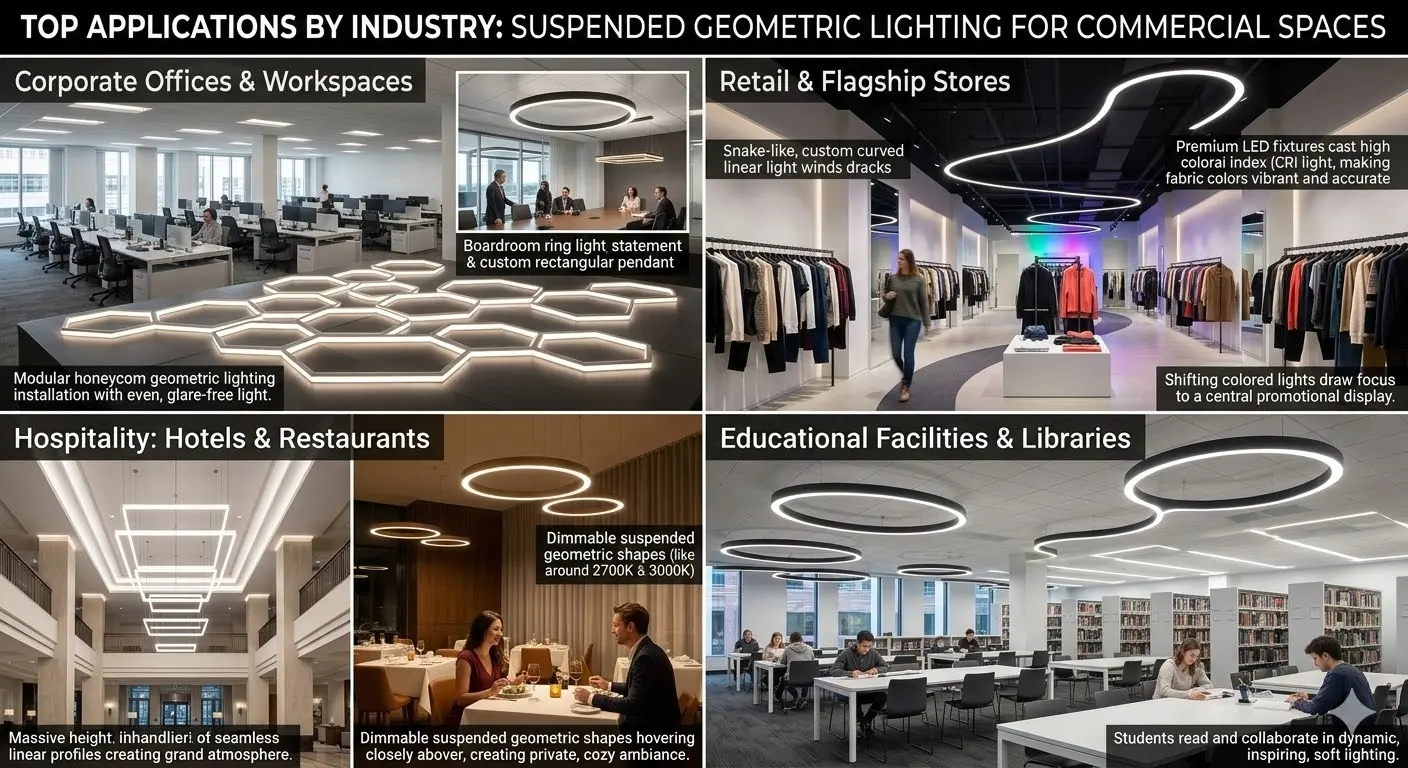
In the corporate sector, lighting must balance productivity with comfort. Open-plan offices frequently use modular geometric shapes, like honeycomb patterns, to provide even, glare-free illumination across large banks of desks. Boardrooms often feature statement ring lights or custom rectangular pendants suspended directly over the conference table, ensuring participants’ faces are evenly lit for video conferencing while adding a touch of executive prestige.
Retail and Flagship Stores
Retail lighting is all about drama and focus. Stores use shaped linear lights to draw attention to high-margin product zones or central promotional displays. A custom curved linear light winding through a clothing store encourages shoppers to explore the entire floor plan. The high Color Rendering Index (CRI) of these premium LED fixtures ensures that merchandise colors appear vibrant and accurate.
Hospitality: Hotels and Restaurants
Atmosphere is the core product of the hospitality industry. Hotel lobbies with double-height ceilings utilize massive, multi-tiered geometric chandeliers made of seamless linear profiles to create a sense of grandeur. In restaurants, warmer color temperatures (such as 2700K or 3000K) are paired with dimmable suspended shapes to create an intimate, cozy dining experience, hovering just above the tables to lower the visual ceiling and create a private ambiance.
Educational Facilities and Libraries
Modern universities and high-tech learning centers are moving away from institutional lighting. Libraries and student unions use geometric lighting to create dynamic, inspiring environments that foster creativity and focus. Circular and curved fixtures are particularly popular in these spaces to soften the academic environment and make it more inviting.
Crucial Design Considerations for Specification
When integrating these complex fixtures into a commercial project, careful planning is required. Architects and lighting designers must consider several technical specifications to ensure the final installation is both beautiful and functional.
Scale and Proportion
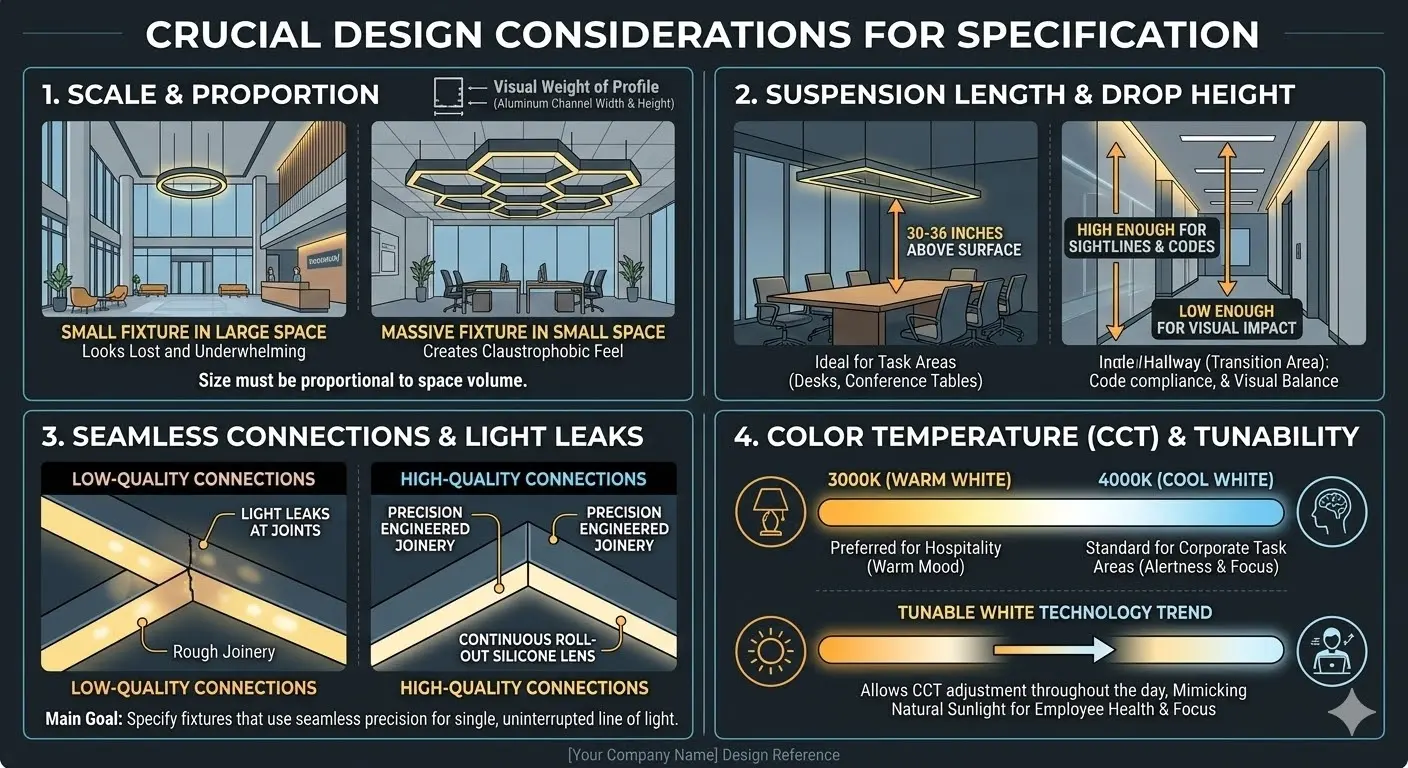
The size of the fixture must be proportional to the volume of the space. A small geometric ring will look lost in a sprawling, double-height lobby, while a massive, heavy-looking hexagonal grid can make a room with a standard 9-foot ceiling feel claustrophobic. Understanding the scale of the room and the visual weight of the fixture’s profile (the width and height of the aluminum channel) is paramount.
Suspension Length and Drop Height
Because these lights are suspended, determining the correct drop height is critical. For task lighting over desks or conference tables, the bottom of the fixture typically hovers between 30 to 36 inches above the surface. In open transition areas, they must be hung high enough to clear sightlines and adhere to building codes, while still low enough to be visually impactful.
Seamless Connections and Light Leaks
The hallmark of high-quality geometric lighting is the seamlessness of the shape. Lower-quality fixtures often suffer from “light leaks” at the joints where two straight sections meet to form an angle. It is crucial to specify fixtures that use precision-engineered joinery and continuous roll-out silicone lenses to ensure the light appears as a single, uninterrupted line of illumination.
Color Temperature (CCT) and Tunability
The color of the light dramatically alters the mood of the space. While 4000K (cool white) is standard for corporate task areas to promote alertness, 3000K (warm white) is preferred for hospitality. A growing trend is the use of Tunable White technology within geometric fixtures, allowing the commercial space to adjust the color temperature throughout the day—mimicking natural sunlight and promoting better employee health and focus.
The Future of Commercial Lighting
As we look toward the future of commercial interior design, the demand for customization will only grow. Advances in flexible LED strips, bendable aluminum profiles, and 3D printing are making it easier and more cost-effective for manufacturers to produce highly complex, bespoke shapes without prohibitive lead times.
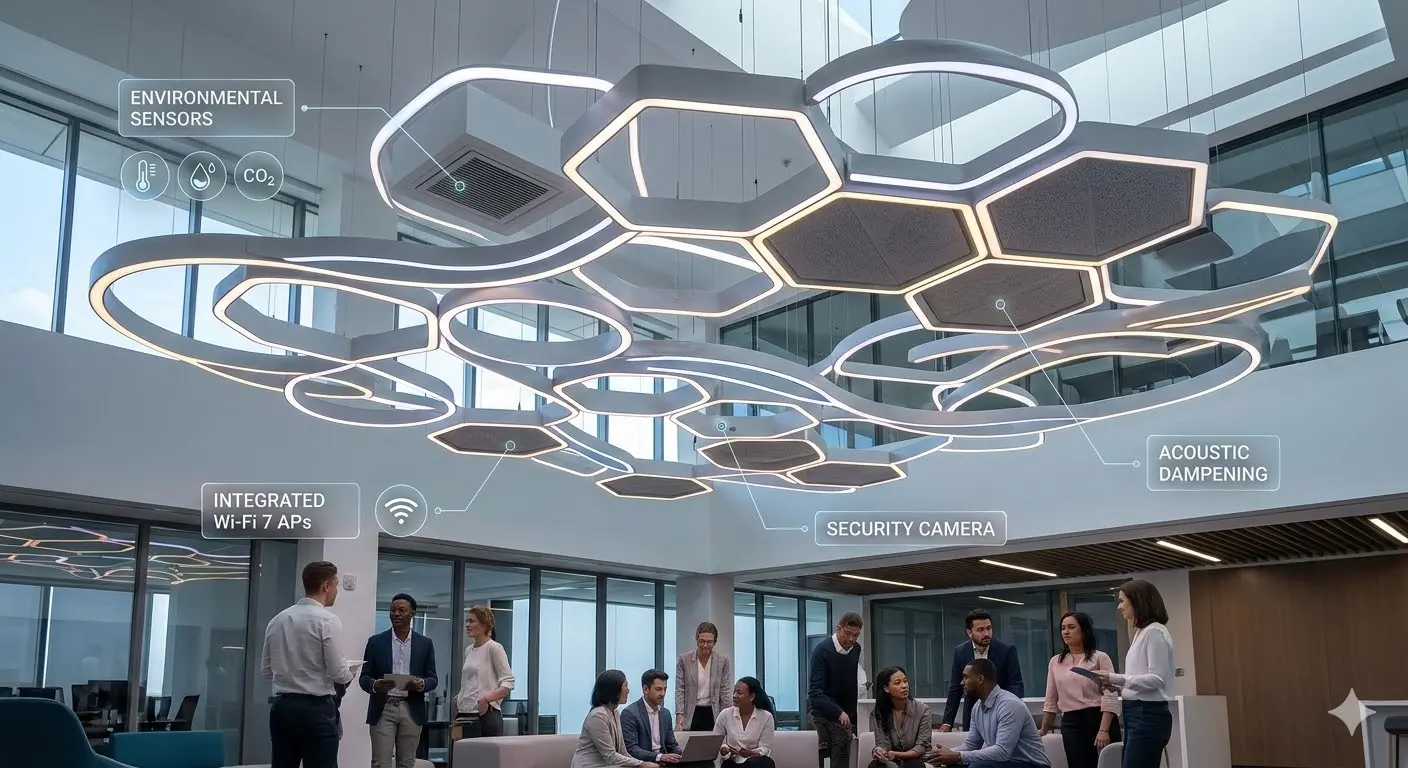
We will also see a tighter integration between geometric lighting and smart building ecosystems. Soon, these suspended structures will not only provide light and absorb sound but will also house environmental sensors, Wi-Fi access points, and security cameras—all hidden within the sleek, architectural profile of the fixture itself.
Conclusion
The transition from basic illumination to architectural integration marks a new era in commercial design. Suspended geometric lighting for commercial spaces offers an unparalleled combination of aesthetic brilliance, energy efficiency, and functional versatility. Whether you are aiming to inspire a workforce, attract retail customers, or create a welcoming hospitality environment, these fixtures provide the creative freedom to sculpt spaces with light. By moving beyond straight lines and embracing curves, angles, and custom shapes, businesses can create truly unforgettable environments.

