



What Is the Best Lumen Per Watt for Supermarkets? How 160 lm/W Lighting Can Cut Energy Costs by 25%
By Vincent
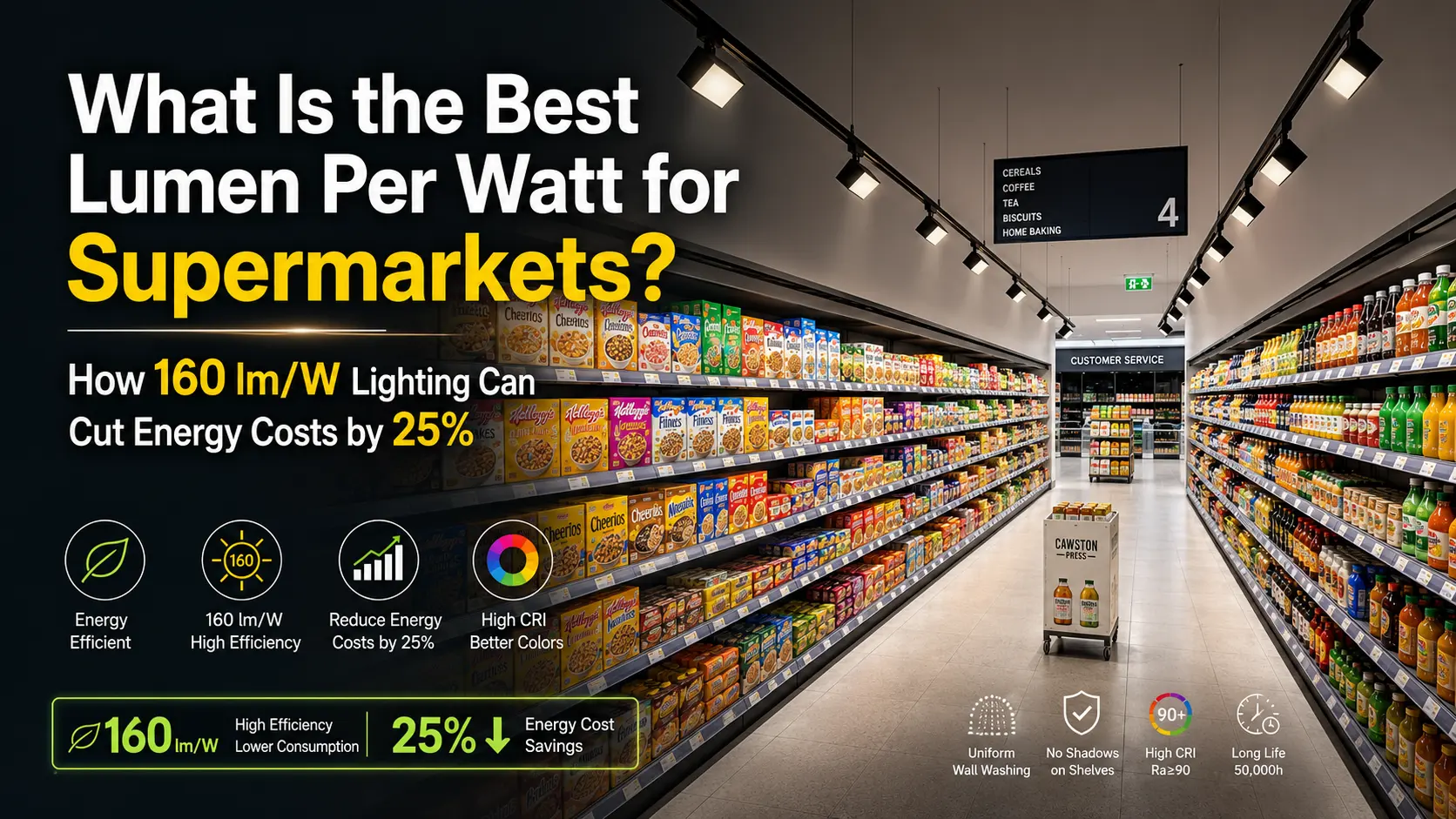
Running a supermarket is a constant balancing act between customer experience and operating costs. For large hypermarkets and grocery chains, lighting is one of the biggest ongoing expenses, often ranking just behind refrigeration systems in total energy consumption. That is why facility managers, lighting designers, and retail operators frequently ask the same question: What is the best lumen per watt for supermarkets?
A decade ago, fixtures delivering 100–120 lm/W were considered highly efficient for commercial applications. Today, rising energy prices and stricter sustainability targets have pushed expectations much higher. Many modern retail projects now target 160 lm/W supermarket lighting because it offers a compelling combination of energy savings, lower operating costs, and excellent merchandising performance.
The challenge, however, is not simply choosing the highest efficacy number. The real goal is finding a lighting solution that delivers both efficiency and high-quality shelf illumination.
Understanding Supermarket Lighting Efficiency: Why lm/W Matters
Before discussing the ideal efficacy level, it is important to understand what lumen per watt (lm/W) actually means.
Lumens measure the amount of visible light produced by a fixture, while watts measure the electricity consumed. The higher the lm/W rating, the more light you get for every watt of energy used.
For supermarkets, this metric has a direct impact on profitability because retail lighting systems operate for long hours every day.
Supermarket environments typically have three characteristics:
- Operating hours of 12–18 hours per day, with some stores running 24/7.
- Hundreds or even thousands of fixtures throughout the facility.
- A strong focus on vertical shelf illumination rather than floor lighting.
When lighting operates at this scale, even small efficiency improvements can produce substantial annual savings.
For additional guidance on commercial lighting efficiency, the U.S. Department of Energy provides useful resources through Better Buildings Lighting Program.
What Is the Ideal Lighting Efficacy for Modern Supermarkets?
Retail lighting technology has improved significantly over the last decade.
| Lighting Technology | Typical Efficacy |
|---|---|
| Fluorescent Lighting | 60–90 lm/W |
| Standard LED Fixtures | 90–120 lm/W |
| High-Efficiency LEDs | 130–150 lm/W |
| Premium Retail Lighting | 150–160 lm/W |
For most new supermarket projects, the recommended range is now: 140–160 lm/W
This range delivers a strong balance between:
- Energy efficiency
- Lighting quality
- Installation costs
- Maintenance savings
- Return on investment
Many lighting consultants now consider 160 lm/W supermarket lighting the practical benchmark for high-performance retail environments.
Why the Best Supermarket Lighting Efficiency Is Not Just About Higher Numbers
A common misconception is that a higher lm/W rating automatically means better lighting.
In reality, some manufacturers achieve extremely high efficacy by reducing optical control, removing glare-reduction components, or compromising light distribution quality.
The result can include:
- Harsh glare
- Uneven shelf brightness
- Multiple shadows
- Hotspots on product packaging
- Dark lower shelves
These problems can negatively affect product presentation and reduce the overall shopping experience.
The best supermarket lighting solution should combine:
- High efficacy
- Uniform illumination
- Low glare
- High color rendering
- Long-term reliability
This is why many lighting professionals view 160 lm/W as the sweet spot between efficiency and visual performance.
How 160 lm/W Supermarket Lighting Delivers 25% Energy Savings
Let’s look at a simple example.
Assume a supermarket shelf requires 4,800 lumens of light output.
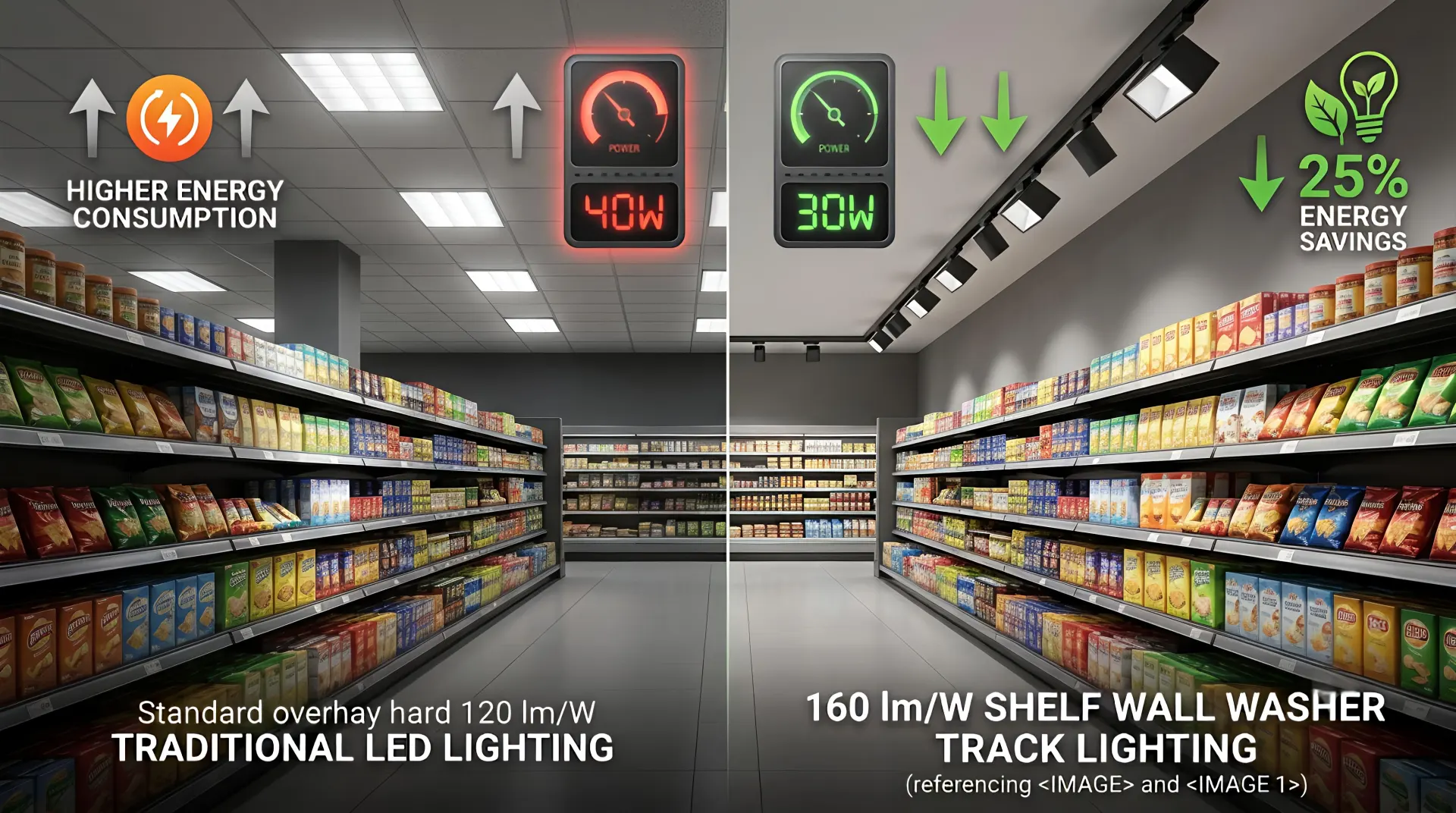
Power Consumption Comparison
| Fixture Type | Efficacy | Power Required for 4,800 Lumens |
|---|---|---|
| Conventional LED Fixture | 120 lm/W | 40W |
| High-Efficiency Shelf Wall Washer | 160 lm/W | 30W |
The reduction in power consumption is straightforward:
- 40W → 30W
- Energy reduction: 25%
Now imagine a supermarket using 1,000 fixtures for 15 hours per day.
| Scenario | Daily Consumption |
|---|---|
| 120 lm/W Fixtures | 600 kWh |
| 160 lm/W Fixtures | 450 kWh |
| Daily Savings | 150 kWh |
Over a year, the energy savings become significant, often resulting in a payback period of less than one year.
This is one reason why supermarket shelf lighting energy savings have become a major focus for retail chains worldwide.
Why Shelf Wall Washer Track Lights Are Changing Supermarket Lighting Design
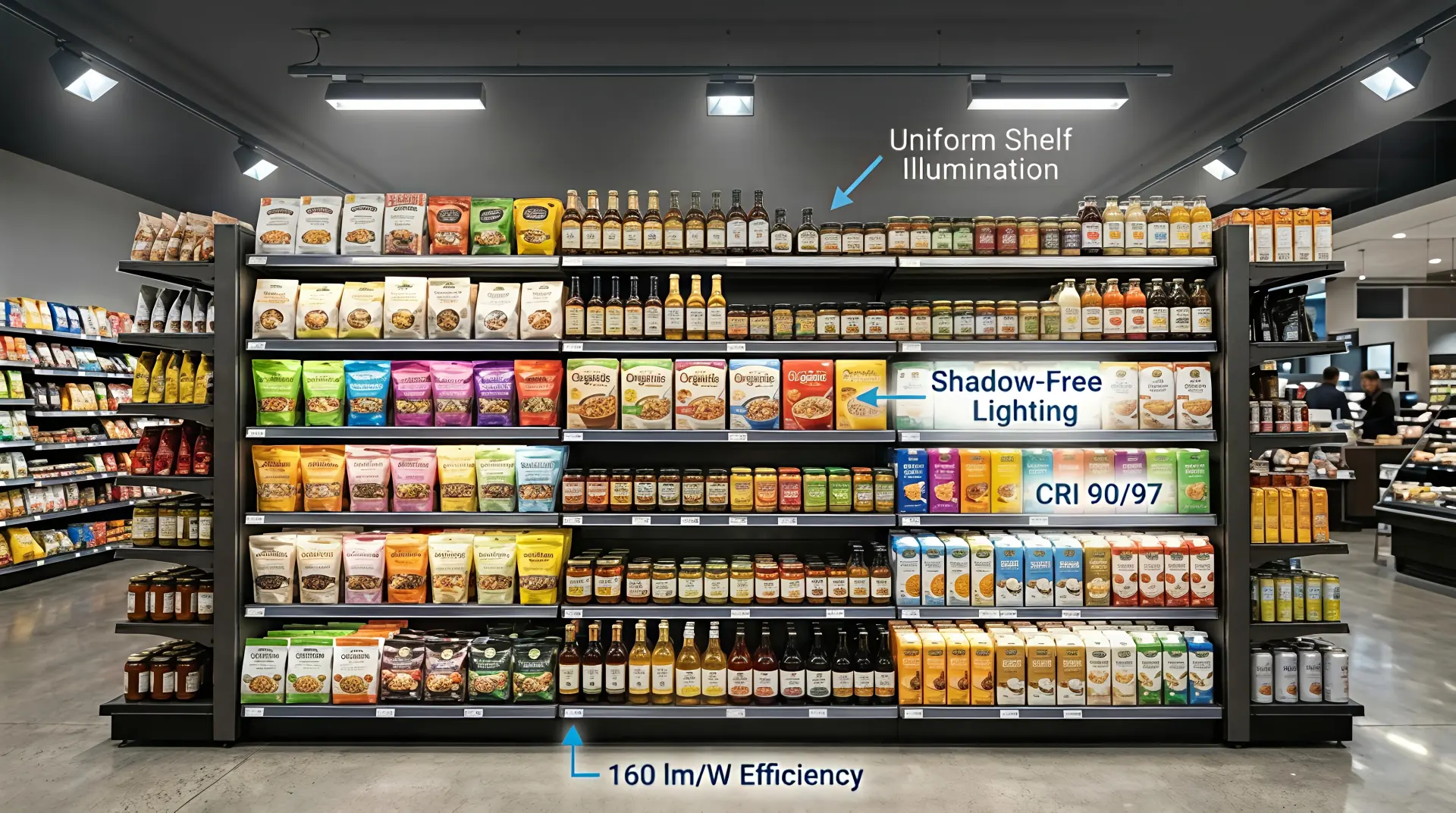
Traditional spotlights were originally designed to highlight specific objects rather than illuminate entire shelf faces.
Modern shelf wall washer track lights for supermarkets take a different approach.
Using specialized asymmetric optics, these fixtures distribute light evenly across the full height of a gondola shelf.
Benefits include:
Uniform Vertical Illumination
Products remain clearly visible from the top shelf to the bottom shelf.
Shadow-Free Product Presentation
Multiple shadows and distracting hotspots are minimized.
Better Customer Experience
Customers can easily identify products and read labels without visual discomfort.
Improved Merchandise Visibility
Uniform shelf lighting helps products stand out and creates a more premium retail environment.
Best Practices for Supermarket Shelf Lighting Layout
Even the most efficient fixture can underperform if installed incorrectly.
One of the most important principles in supermarket lighting design standards is fixture orientation.
For gondola shelving systems, linear track lights should generally be installed:
- Parallel to shelving rows
- Centered above aisles
- Positioned to illuminate both shelf faces evenly
When combined with an asymmetric wall-washing optic, this layout produces consistent vertical illuminance across the entire merchandise display.
The result is a cleaner visual environment, improved wayfinding, and a more comfortable shopping experience.
Balancing Efficiency and Light Quality in Retail Environments
For many years, lighting designers faced a difficult trade-off:
Higher efficacy often meant lower lighting quality.
Advances in LED technology and optical engineering have largely eliminated this compromise.
Today’s premium retail fixtures can deliver:
- Up to 160 lm/W efficacy
- CRI 90 or CRI 97 options
- Low-glare performance
- Uniform shelf illumination
- Long operational life
Programs such as ENERGY STAR Commercial Lighting Resources also emphasize the importance of selecting efficient lighting products that maintain quality and reliability.
Conclusion: What Is the Best Lumen Per Watt for Supermarkets Today?
So, what is the best lumen per watt for supermarkets?
For most modern retail projects, the answer lies in the 140–160 lm/W range, with 160 lm/W emerging as a leading benchmark for energy-efficient supermarket lighting.
However, efficacy alone should never be the only selection criterion.
The most successful supermarket lighting systems combine:
- High efficacy
- Uniform shelf illumination
- Excellent color rendering
- Low glare
- Shadow-free merchandising
As retail lighting continues to evolve from simply illuminating spaces to enhancing merchandise visibility, high-efficiency shelf wall washer track lighting is becoming an increasingly valuable tool for reducing operating costs while improving the shopping experience.
FAQ
What is the best lumen per watt for supermarkets?
For most modern supermarkets, a lighting efficacy of 140–160 lm/W offers the best balance between energy efficiency, operating costs, and lighting quality.
Is 160 lm/W good for supermarket lighting?
Yes. A 160 lm/W fixture can reduce electricity consumption by approximately 25% compared with a 120 lm/W fixture while delivering the same light output.
Why is vertical shelf illumination important in supermarkets?
Customers primarily view products displayed on shelves, not the floor. Proper vertical illumination improves product visibility, enhances packaging appearance, and supports purchasing decisions.
Are shelf wall washer track lights better than spotlights?
In most supermarket applications, shelf wall washer track lights provide more uniform shelf illumination, fewer shadows, and better merchandise presentation than traditional spotlights.
How long does it take to recover the investment in high-efficiency supermarket lighting?
The payback period varies by operating hours and electricity costs, but many supermarkets achieve a return on investment within one to three years, with some projects recovering costs even faster.

