



Centralized Lighting Control for Retail Stores: A Smarter Way to Manage Modern Retail Environments
By Powerstar
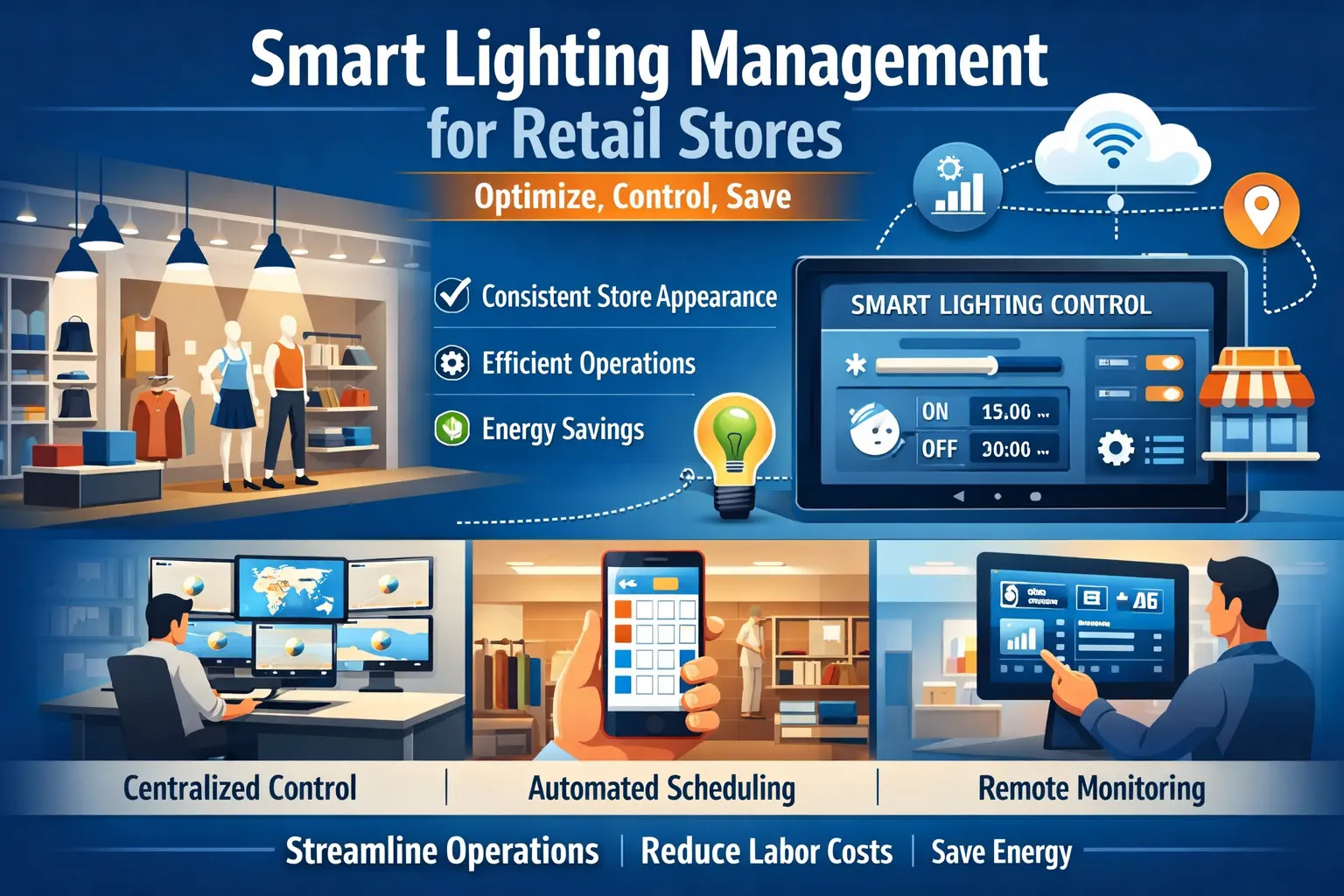
Retail lighting has evolved far beyond basic illumination. In today’s commercial environment, lighting affects how products are seen, how stores are experienced, how efficiently teams operate, and how consistently a brand is presented across locations. For this reason, retailers are no longer focused only on choosing the right fixtures. They are also paying more attention to how those fixtures are controlled. This is where centralized lighting control for retail stores becomes increasingly important.
Instead of relying on manual switching, separate dimmers, or inconsistent local adjustments, centralized lighting systems allow retailers to manage store lighting more efficiently through a unified control strategy. This makes it easier to standardize store appearance, reduce unnecessary labor, improve operational consistency, and support long-term scalability.
For chain retailers, franchise groups, supermarkets, fashion brands, and showroom operators, centralized lighting control is not simply a technical feature. It is a practical management solution that helps lighting perform as part of a larger retail strategy.
Why Retailers Need Better Lighting Control
Retail spaces are not static. Product displays change, promotional zones move, seasonal campaigns create new focal points, and store layouts may be adjusted throughout the year. These changes mean that lighting needs are constantly evolving as well.
In many traditional retail environments, lighting control is still handled in a fragmented way. Individual staff members turn lights on and off manually. Brightness levels may depend on habit rather than a defined strategy. Some stores operate with overlit spaces, while others fail to highlight key products effectively. Over time, these small inconsistencies create larger operational and visual problems.
The issue becomes even more serious when a retailer operates across multiple stores. One branch may follow the intended brand standard, while another may use a completely different lighting pattern. Entrance brightness, display emphasis, and promotional visibility may vary from location to location. As a result, the customer experience becomes less consistent and managers spend more time correcting avoidable problems.
Centralized lighting control helps address these issues by replacing scattered local decisions with a more structured and unified system.
What Centralized Lighting Control for Retail Stores Means
Centralized lighting control for retail stores refers to a system that allows lighting to be managed from a unified control point rather than handled separately at each fixture or only through manual in-store action. Instead of treating lighting as a collection of isolated switches, the system organizes lighting into an integrated strategy that can be adjusted, monitored, and scheduled more efficiently.
Depending on the project, centralized control can include:
- Unified on and off scheduling
- Grouped dimming by zone
- Preset scenes for different retail needs
- Remote access for adjustments
- Store-wide lighting synchronization
- Status monitoring across one or multiple locations
This approach changes lighting from a basic electrical function into an operational tool. Retailers can decide how lighting should support visual merchandising, daily operations, energy performance, and brand consistency, then apply those decisions in a more repeatable way.
In practical terms, it becomes easier to control entrance lighting, display walls, fitting areas, feature tables, promotional zones, and checkout counters according to a planned strategy instead of relying on daily manual intervention.
Improving Store Consistency Across Locations
One of the strongest advantages of centralized lighting control is improved consistency. In retail, visual consistency is not a small detail. It directly affects brand perception.
Customers expect stores under the same brand name to feel connected. If one branch appears bright, polished, and well-balanced while another feels uneven or poorly lit, the difference weakens the brand image. Even if the products are the same, the shopping experience feels less unified.
A centralized control system helps retailers define lighting standards that can be repeated across locations. For example, a business can establish how bright the entrance should be, how much emphasis should be placed on hero displays, and how promotional areas should stand out during seasonal campaigns. These settings can then be implemented more consistently instead of being interpreted differently by each store team.
This does not mean every store must be visually identical in every detail. Local flexibility may still be necessary due to differences in ceiling height, floor plan, product mix, or architecture. However, centralized lighting control creates a stronger baseline, making it much easier to maintain a shared visual identity while allowing selective refinements when needed.
For chain retailers and franchise businesses, this is a major advantage.
Reducing Manual Work and Simplifying Daily Operations
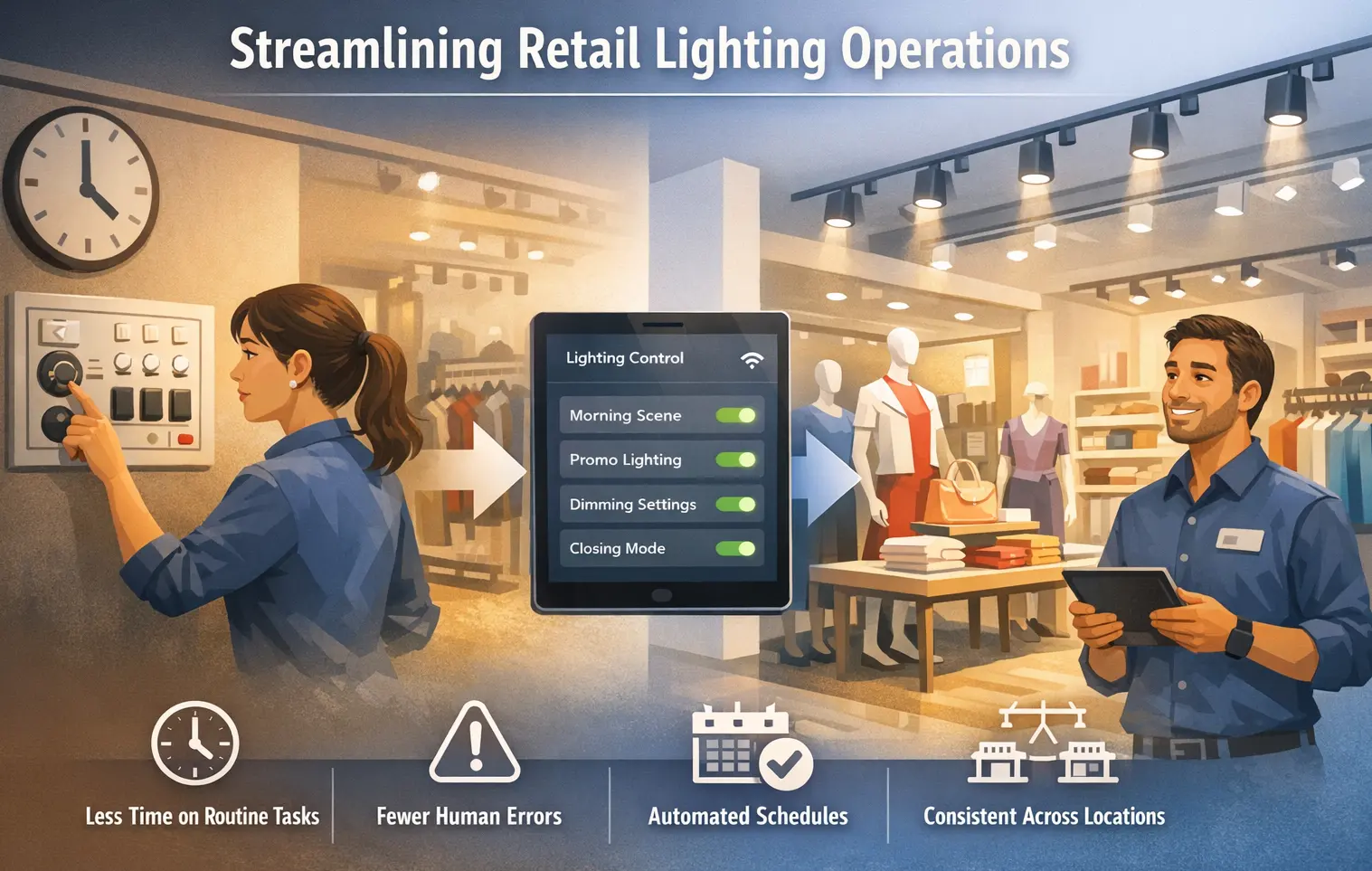
In many stores, lighting control still depends too much on repetitive staff action. Team members open the store and switch lighting on. They dim certain areas manually. They change settings for promotions. They try to remember what needs to be turned off at the end of the day. These tasks may seem small, but across many stores and many months, they add up to significant labor use and management inefficiency.
Centralized lighting control simplifies this routine. Instead of asking store staff to handle the same adjustments again and again, businesses can automate much of the process. Schedules can be applied consistently, key areas can be grouped under shared settings, and common scenes can be activated without repeated manual changes.
This helps retailers achieve several practical benefits:
- Less time spent on routine lighting tasks
- Fewer human errors in switching and dimming
- More reliable opening and closing procedures
- Easier management of promotional lighting changes
- Better alignment between operations and visual merchandising
For retail businesses with multiple locations, these time savings become especially meaningful. Even a modest reduction in manual effort per store can create major operational value when scaled across an entire network.
Supporting Better Visual Merchandising
Lighting is one of the most important tools in visual merchandising. It influences where customers look, how products are perceived, and which areas of the store feel most important. However, this effect depends not just on fixture quality, but on control.
Without a clear control strategy, even good lighting hardware can produce weak results. A store may be uniformly bright but visually flat. Promotional displays may fail to stand out. Entrance areas may not feel inviting enough. Key products may not receive the emphasis they deserve.
Centralized lighting control makes it easier to match lighting performance with merchandising goals. Retailers can create different control layers for different parts of the store, such as:
- Ambient lighting for overall visibility
- Accent lighting for hero products
- Promotional lighting for seasonal campaigns
- Task lighting for service counters
- Comfort lighting for fitting rooms or lounge areas
These layers can be managed more intentionally when the system is centralized. Instead of treating every part of the store the same way, retailers can build a more strategic lighting environment that supports customer attention and improves presentation quality.
Enabling Smarter Scheduling and Scene Management
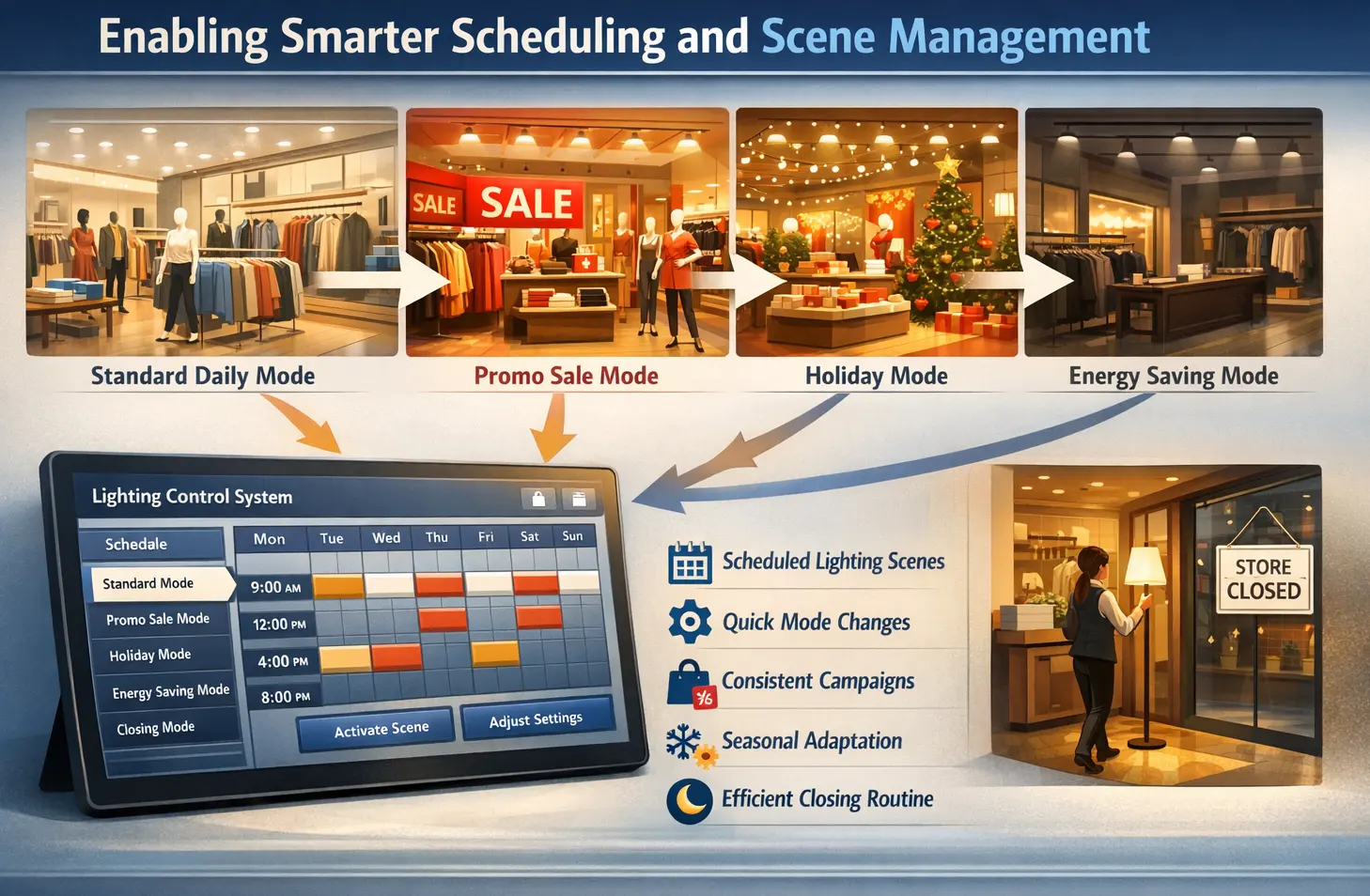
Retail lighting needs are rarely the same all day, every day. A store may require one lighting mood for opening hours, another for special promotions, and another for closing procedures. Holiday periods, product launches, and campaign events may also require temporary changes in emphasis.
With decentralized or purely manual systems, these adjustments are often inconsistent and inconvenient. Some stores apply them correctly, while others do not. Staff may forget to update settings, or they may simply avoid making changes because the process is too time-consuming.
Centralized lighting control solves this by allowing schedules and preset scenes to be managed more efficiently. Retailers can create store modes for different operational needs, such as:
- Standard daily trading mode
- Promotional sale mode
- Holiday presentation mode
- Energy-saving mode during low-traffic periods
- Closing mode for end-of-day operations
This makes the lighting system more responsive to real retail activity. It also helps ensure that temporary campaigns or seasonal strategies are implemented in a more consistent and professional way.
Improving Energy Management Without Sacrificing Experience
Energy efficiency is a growing priority for retail businesses, especially as operating costs rise and sustainability expectations increase. However, retailers cannot simply reduce lighting without considering its effect on product visibility and customer experience. The challenge is to use energy more intelligently rather than less effectively.
Centralized lighting control supports this balance. When lighting can be dimmed, grouped, scheduled, and adjusted by zone, retailers gain more control over where and when energy is used. This makes it possible to reduce unnecessary operation without compromising the quality of the environment.
For example, businesses can:
- Avoid running full brightness in every zone all day
- Reduce lighting in lower-priority areas during non-peak periods
- Align lighting schedules more precisely with store hours
- Prevent lights from being left on after closing
- Adjust brightness levels based on functional need
The result is not only lower waste, but also better discipline in how the store uses lighting. This turns energy management into part of a broader operational strategy rather than an isolated technical concern.
Why Centralized Control Matters More for Growing Retail Brands
As retail businesses grow, operational complexity increases. Managing one store manually may still seem possible. Managing ten, twenty, or fifty stores that way becomes increasingly inefficient. Systems that depend too heavily on local interpretation eventually create inconsistency, unnecessary labor, and weaker control over brand standards.
Centralized lighting control helps growing brands scale more effectively. It creates a repeatable structure that new stores can adopt and existing stores can align with. This is especially important for brands that want to maintain a recognizable identity while expanding into more locations.
For franchise systems, centralized control can also help support better compliance with company standards. Instead of relying only on written guidelines, businesses can implement a more direct control framework that influences how stores actually perform on a daily basis.
In this sense, centralized lighting control is not just about technology. It is about building a retail infrastructure that supports growth without losing consistency.
Combining Centralized Control With Smart Track Lighting
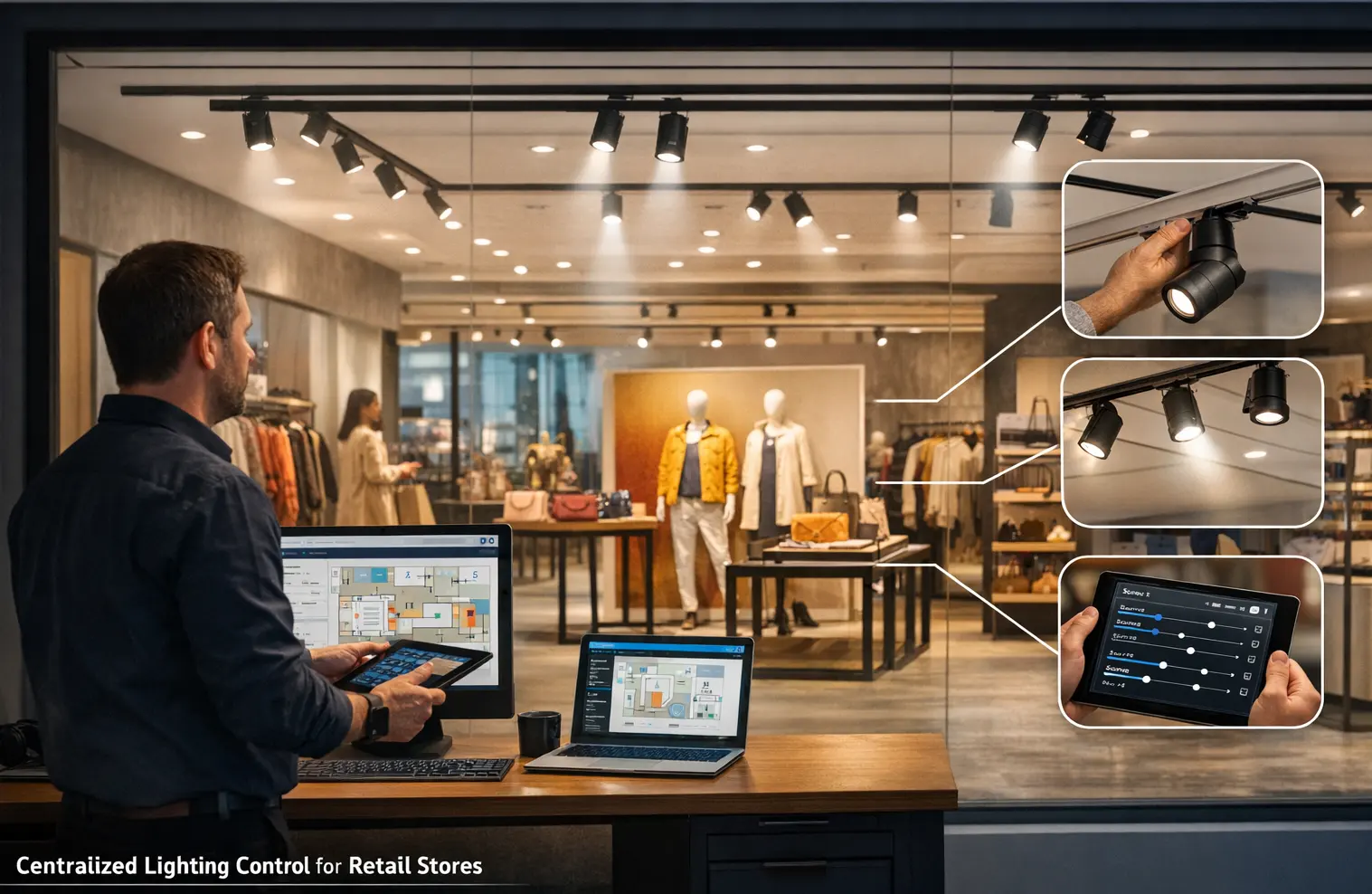
Centralized control becomes even more powerful when paired with smart track lighting. Track lighting already offers physical flexibility because fixtures can often be repositioned or redirected more easily than fixed ceiling systems. When combined with centralized control, retailers gain both physical adaptability and operational efficiency.
This is particularly valuable in stores where layouts change frequently. Product launches, promotional tables, mannequin positions, and display walls may all shift over time. Smart track fixtures can adapt to these changes physically, while centralized controls ensure they remain part of the same scheduling and scene-management system.
This combination allows retailers to create lighting systems that are not only visually effective, but also easier to manage over the long term.
Conclusion
Centralized lighting control for retail stores is becoming an essential solution for modern retail management. It helps businesses move beyond fragmented manual control and toward a more efficient, consistent, and scalable lighting strategy. By unifying schedules, simplifying adjustments, supporting visual merchandising, improving energy use, and strengthening brand consistency, centralized control turns lighting into a valuable operational asset.
For single stores, it can improve discipline and efficiency. For multi-store retailers, it can solve much larger challenges related to standardization, labor use, and daily management. As retail spaces continue to evolve, centralized lighting control offers a practical way to manage change while maintaining a polished and consistent customer experience.
In today’s competitive retail environment, better lighting control is no longer optional. It is part of building a smarter store operation.

