



Bright Enough to Impress—or Too Harsh to Stay? How Linear Lights with Louvers for Retail Stores Can Help
By JC
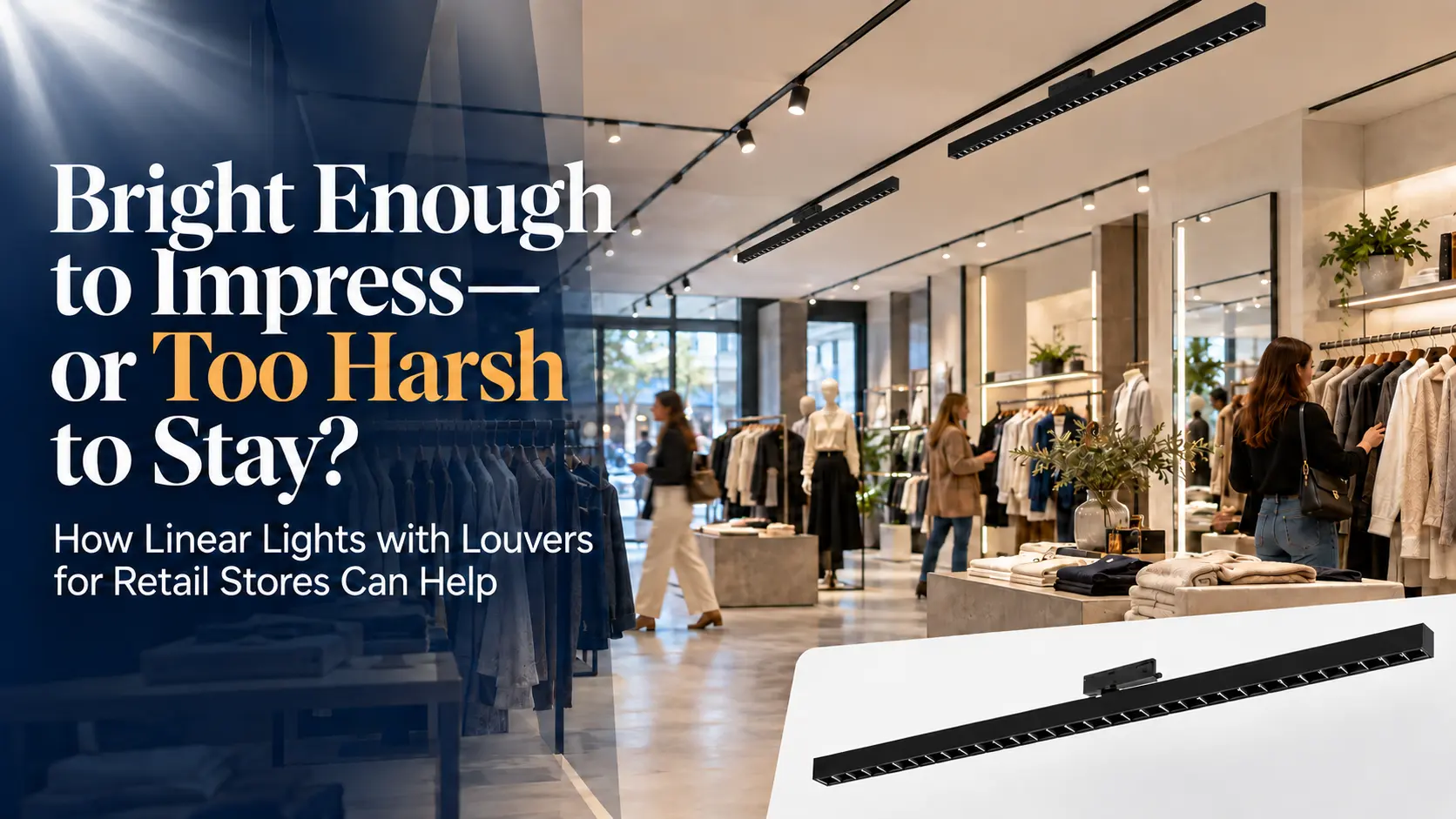
When customers walk into a store, the lighting not only allows them to see the merchandise but also shapes their initial impression of the space. The clothing color, the details of display fixtures are influenced by lighting. However, a store being sufficiently bright doesn’t necessarily mean that customers are at a comfortable environment. A bright store should feel inviting, not glaring—and linear lights with louvers for retail stores can help achieve that balance.
In some stores, floors are highly reflective, yet looking up reveals glaring light sources; in other display areas, while the lighting is ample, the fixtures themselves end up being more eye-catching than the merchandise. For store owners, what they need to consider is minimizing visual distractions and improving shopping experience, instead of increasing brightness.
LED linear lights with louvers for retail stores offer a solution that balances effective illumination with visual comfort. Through well-engineered louver structures, precise light distribution, and strategic installation layouts, these fixtures help minimize direct glare. It helps ensuring that the lighting optimally supports both product display and the overall shopping experience.
How well a product is lit and how much glare a light fixture produces are two different things
Merchandise, price tags, and aisles require sufficient illumination to allow customers to easily browse and compare products. However, if the high-brightness emitting surfaces of light fixtures fall directly within a customer’s field of view, they may experience glare—even if the merchandise itself is well-lit.
This is a particular concern when customers walk along aisles, look up to locate section signage. Excessive brightness contrast between a light fixture and its background can further exacerbate visual discomfort. When evaluating store lighting, check both merchandise illumination and whether the light sources appear too bright to customers.
Simply dimming the lights may create new problems
Reducing power can mitigate some of the glare, but it may also cause details on merchandise, items on lower shelves. For stores simply lowering the overall light intensity is not necessarily the best solution.
A better approach is to check light direction, source shielding, and fixture placement to reduce unwanted direct light in customers’ view.
How linear lights with louvers reduce glare for retail stores?
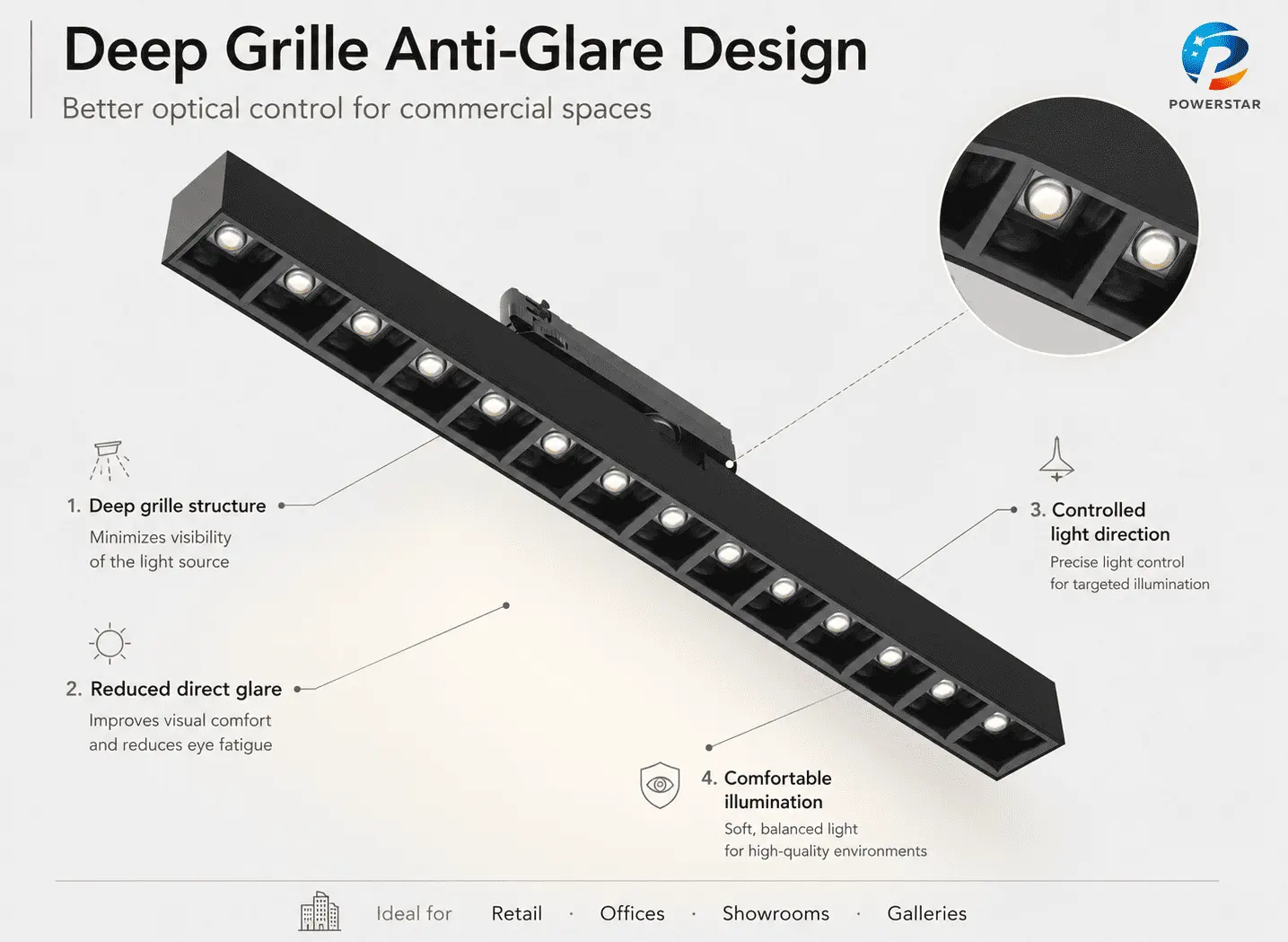
The recessed light source and a light-shielding structure
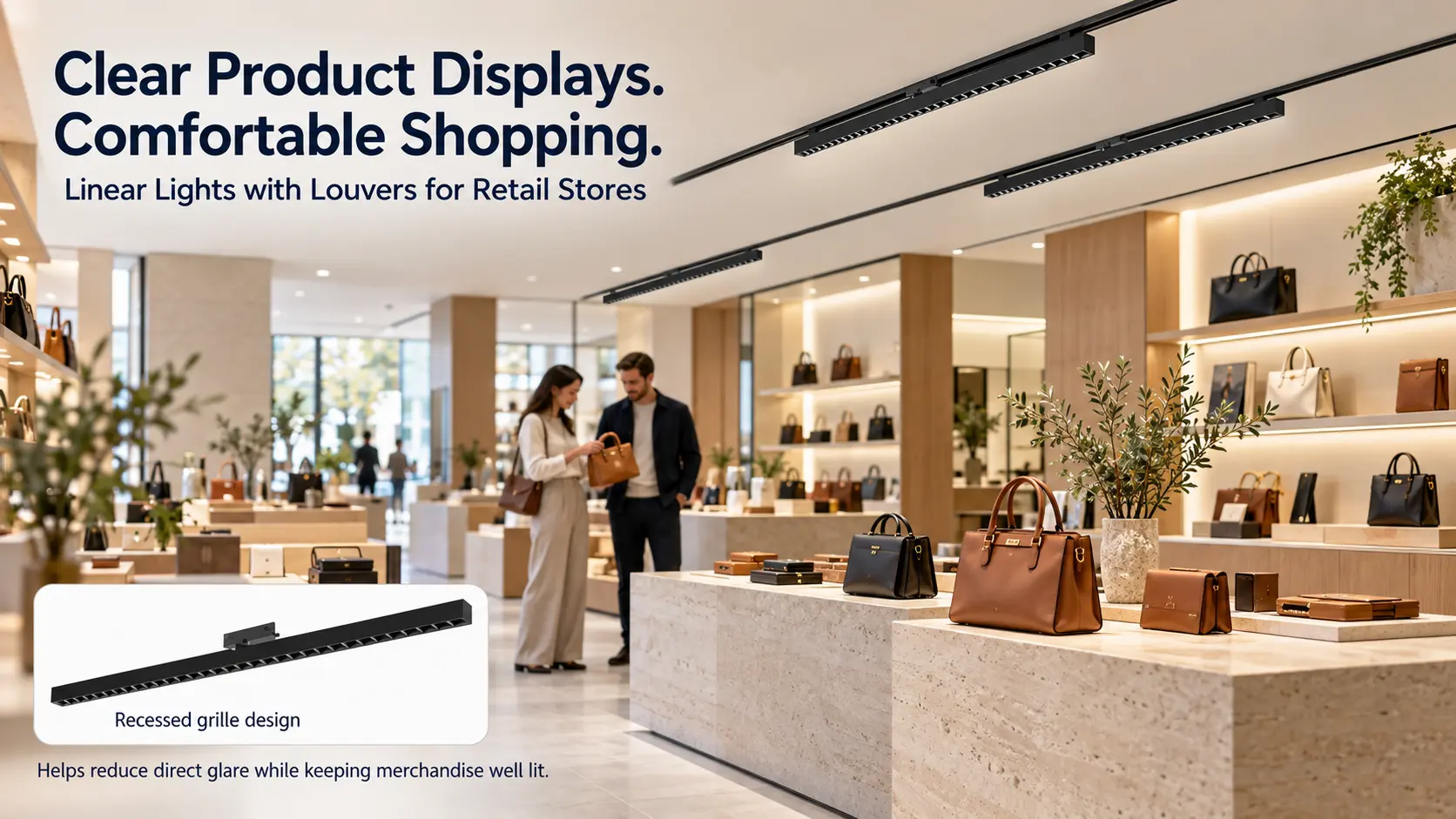
In a louvered linear light, the light-emitting elements are typically positioned within the louvers. The side walls of the louvers act as a shield between the light source and the observer. It prevents the high-brightness emitting surfaces from being directly visible when viewed from certain oblique angles.
This can be thought of as adding a “visual barrier” to the light source. While downward illumination can still pass through the openings is obstructed by the louvers. The depth of the louvers, the size of the openings, and the placement of the light source all influence the effectiveness of this shielding.
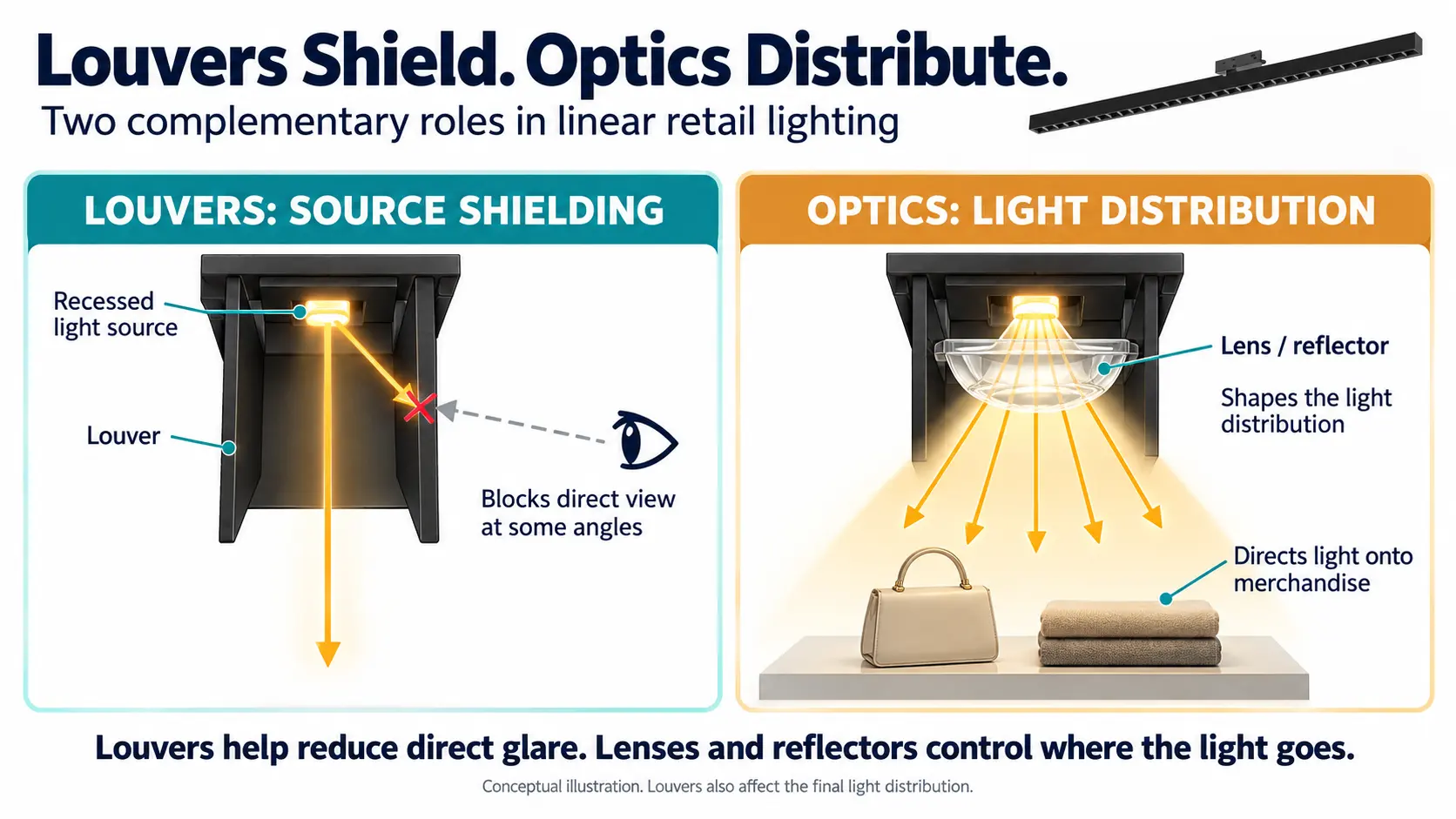
The louvers provide shielding, while the optical system distributes the light
In products equipped with lenses, the lens and the louver serve distinct functions. The lens controls light distribution. It helps ensuring the target area is illuminated, while the louver helps restrict direct visibility of the light source.
Consequently, the effectiveness of glare control cannot be determined solely by the presence or absence of a louver. Selecting the appropriate fixture requires considering light distribution, mounting height, and viewing angles.
Furthermore, the inclusion of a louver does not mean there is no loss in luminous flux; therefore, project specifications should be based on the actual light output and photometric data of the complete luminaire.
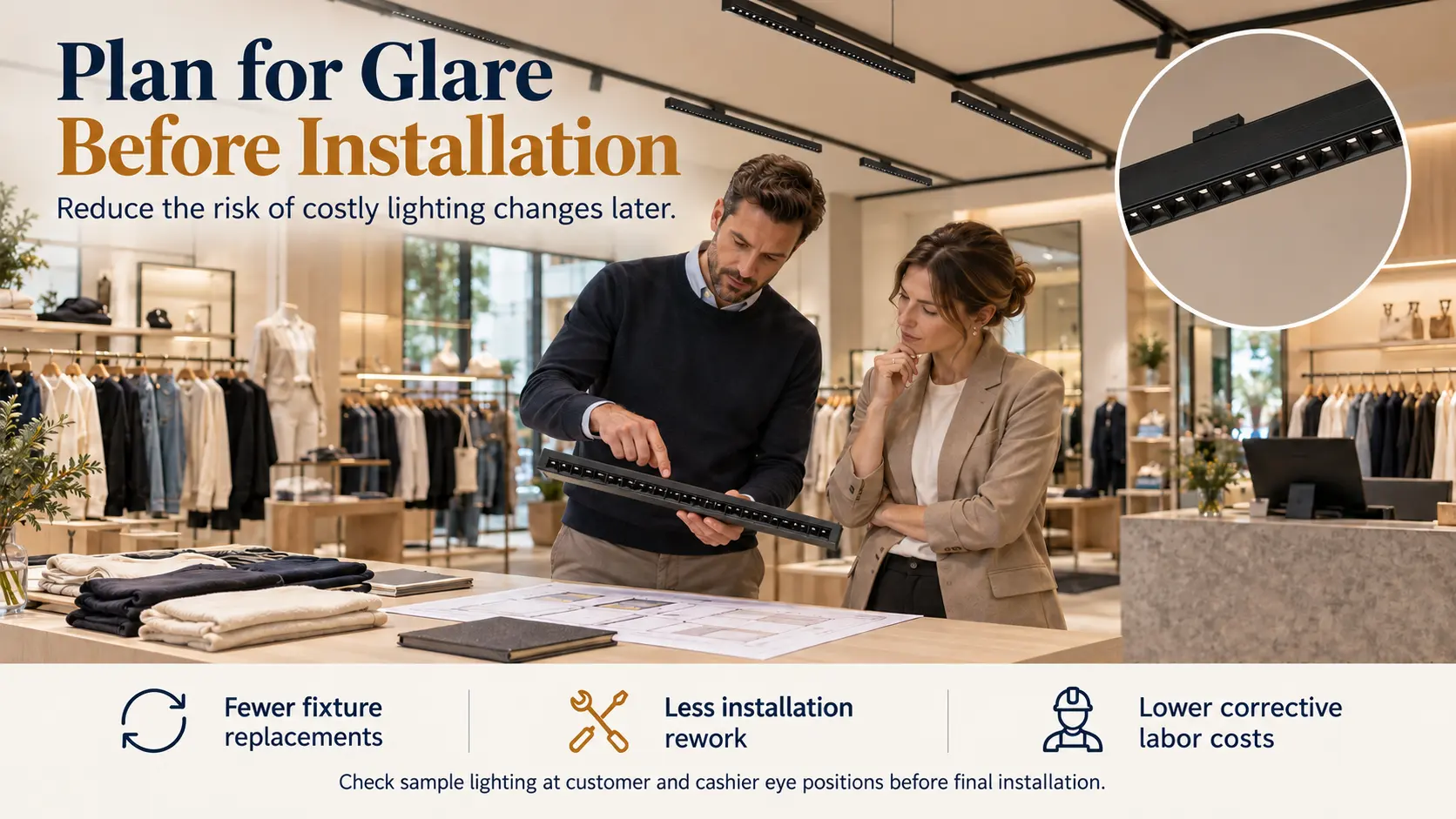
Choosing Low-Glare Retail Lighting to Reduce Rework Costs
For a store owner, the purchase price of lighting fixtures is only one part of the total investment in lighting. Additional costs may arise from replacing lamps after installation, adjusting light positioning, or making modifications to accommodate changes in product displays.
Upgrading Retail Lighting with Compatible Existing Tracks
If a store is already equipped with track lighting system, but requires glare control in specific areas, consider whether the existing track system can accommodate the addition or replacement of linear louvered fixtures.
Provided that the track interface, electrical specifications, and load capacity are compatible, retaining the existing infrastructure helps limit the scope of the renovation.
This allows store owners to focus their budget on the areas that truly need improvement, rather than reconfigur the entire system every time the lighting is updated.
Verifying compatibility prior to purchase also prevents issues such as fixtures being incompatible upon arrival—avoiding the costs and delays associated with exchanges, or the need for additional components.
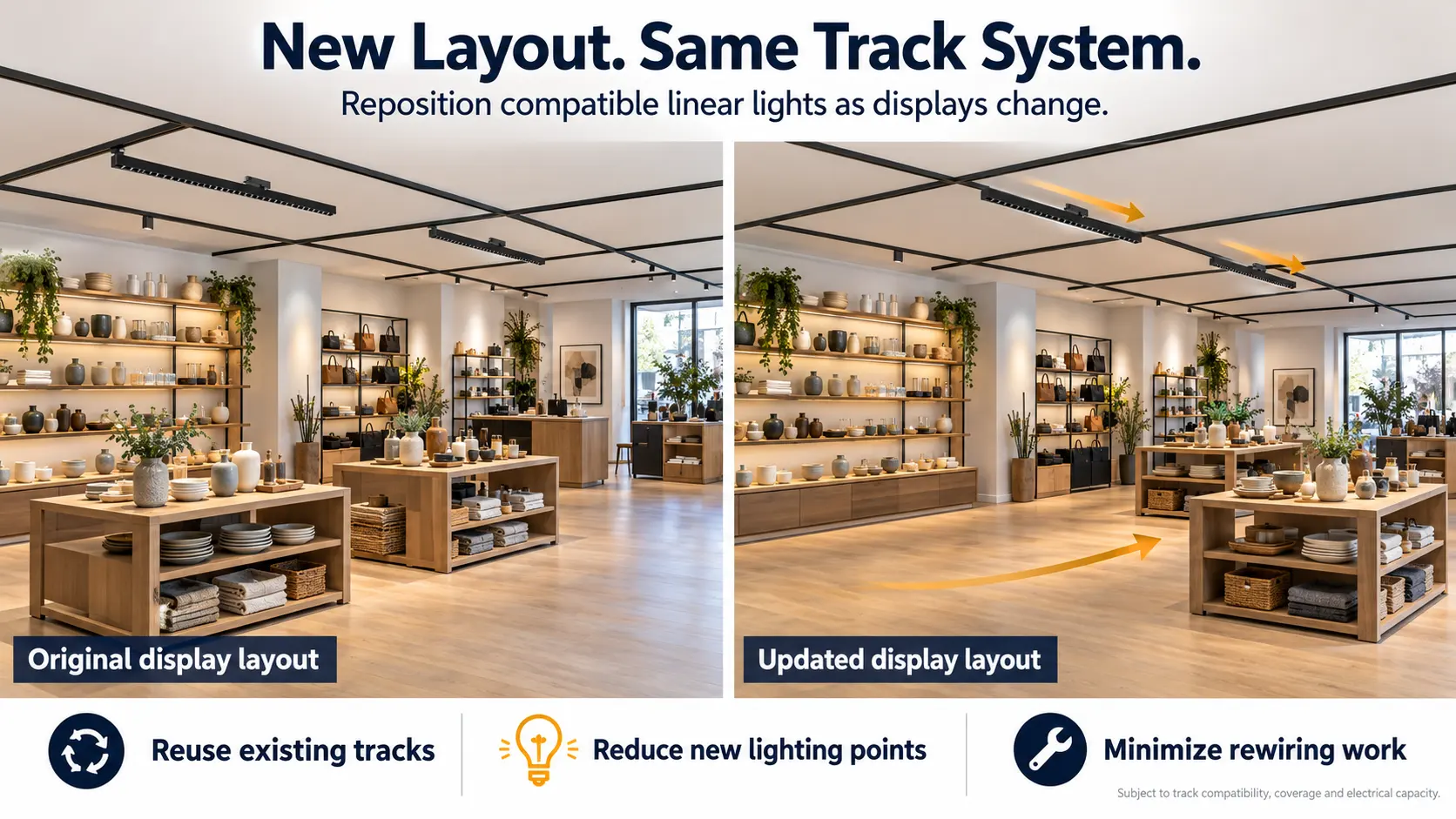
Facilitate lighting adjustments for product displays
For track-mounted linear grille lights, provided the track system is compatible and the layout permits, the positioning of the fixtures can be adjusted in response to changes in the arrangement of shelving and display units.
This is particularly practical for store owners who frequently update their seasonal displays or promotional areas. It is important to distinguish that this flexibility stems from the track-mounting system, while the reduction of direct glare is primarily achieved through the use of louvers and specific optical structures; it is the combination of these elements that creates a comprehensive operational advantage.
Redeploy existing, functional lighting fixtures to reduce redundant procurement
Following a layout adjustment, light fixtures that are no longer needed in a particular area do not necessarily have to be left idle or discarded. For other areas with compatible specifications and matching lighting requirements, consider relocating the linear track lights for continued use.
For example, once a promotional area is removed, the existing light fixtures can be redeployed to aisles or other open spaces based on a new lighting layout.
Therefore, the value proposition of track-mounted linear grid lights encompasses both the reduced risk of costly retrofitting—achieved through proper product selection—and the flexibility for reuse afforded by the track-mounting system. It should be noted that the grid design itself does not inherently equate to greater energy efficiency; rather, operational electricity costs should be evaluated based on the total system power required to meet specific lighting needs, the duration of use.
Where to use louvered linear lights in retail stores?
Shopping Aisles and Open Display Areas
A passageway should not only facilitate movement but also serve to guide customers as they browse. Linear grid-style lighting can be installed along these paths—or integrated into the layout of product displays—to provide illumination for the floor and surrounding areas.
When designing lighting, one should not merely check for brightness directly beneath the fixtures; it is also important to ensure there are no noticeable dark zones between adjacent units. If the light distribution is too narrow and the spacing between fixtures is too wide, the result can be uneven illumination—even if each individual light provides sufficient output.
Clothing Racks and Boutique Display Areas
In a clothing store, the primary focus is often on merchandise displayed vertically. Simply illuminating the floor may not provide sufficient light for the front-facing surfaces of the garments. Therefore, it is essential to assess the lighting on vertical planes based on the positioning of the shelving units, incorporating targeted accent lighting or wall illumination where necessary.
Checkout and Service Area
The checkout and consultation area serves both customers and staff; therefore, the lighting design must accommodate reading, communication, and screen use. When planning the lighting layout, consider the perspectives of both standing customers and staff members to ensure that high-intensity light sources—or their reflections—do not consistently appear within their primary lines of sight.
How to choose low glare linear lighting for retail stores?
Planning Mounting Height and Spacing for Linear Track Lights
When selecting products, one should not rely solely on wattage. Luminaires with the same power rating may differ in their actual luminous flux and light distribution, which ultimately results in variations in the area they illuminate.
In stores with low ceilings, special attention must be paid to visual comfort when light sources are viewed from close range; in spaces with higher ceilings, it is essential to ensure that both merchandise and aisles receive adequate illumination. The number and spacing of light fixtures should be determined based on the dimensions of the space and the light distribution characteristics—avoid the practice of compensating for poor layout by simply increasing the wattage of the lamps.
Evaluate the anti-glare effect from a realistic perspective
When testing sample lighting, observe the effects from various vantage points—such as at the entrance, along the ends of aisles, in front of shelving units, and at the checkout area—rather than simply standing directly beneath the fixtures to check if they are illuminated. Whenever possible, perform lighting calculations based on photometric data.
If a supplier provides UGR data, the corresponding test or calculation conditions should also be examined. Since UGR depends on factors such as the room, the arrangement of luminaires, and the observer’s position, a single numerical value cannot be assumed to be a fixed result applicable to all stores.
For a store owner, effective lighting should make merchandise easy to see while ensuring a comfortable viewing experience for customers. When selecting linear grid lights, it is essential to consider anti-glare features alongside appropriate light distribution and installation positioning; this transforms a space that is merely “bright enough” into a shopping environment that is both more comfortable and more inviting.

