



Energy-Efficient LED Lighting: From 160 lm/W to Smart Lighting Systems
By Vincent

In the field of commercial lighting, energy efficiency is becoming an increasingly important design indicator. In the past, when customers selected LED luminaires, they usually paid more attention to power, brightness, lifespan and price. Nowadays, as commercial buildings are paying growing attention to energy consumption and operating costs, lighting systems also need to achieve higher overall efficiency. This is also why Energy-Efficient LED Lighting has attracted increasing attention.
High-efficiency LED fixtures can produce the same light output with lower power consumption. Meanwhile, smart lighting systems can further control the operating time, coverage area and brightness of lights. The combination of the two enables commercial lighting to evolve from simple high-efficiency products into more efficient intelligent systems.
Why Energy-Efficient LED Lighting Matters
Commercial buildings require substantial lighting every day. Retail stores, hotels, offices, restaurants, exhibition halls and large commercial spaces all demand stable lighting environments. As building floor area expands, the quantity of lighting fixtures rises rapidly. Therefore, even if the power of a single fixture is reduced by just a few watts, noticeable impacts can be achieved when scaled across a large number of fixtures and long operating hours.
This means commercial lighting should not merely focus on “whether it is bright enough”. It is also necessary to consider how much light can be produced per watt, the daily operating hours of lighting fixtures, and which areas truly need illumination. More efficient LED fixtures can cut power requirements at the source of the lighting system. This is also the fundamental value of Energy-Efficient LED Lighting.
However, truly efficient lighting is not simply about adopting fixtures with higher luminous efficacy. It also requires ensuring lights operate at the right time, in the right areas and with appropriate brightness. This is a key reason why high-efficiency LED lighting further evolves into smart lighting.
160 lm/W: An Important Step in Energy-Efficient LED Lighting
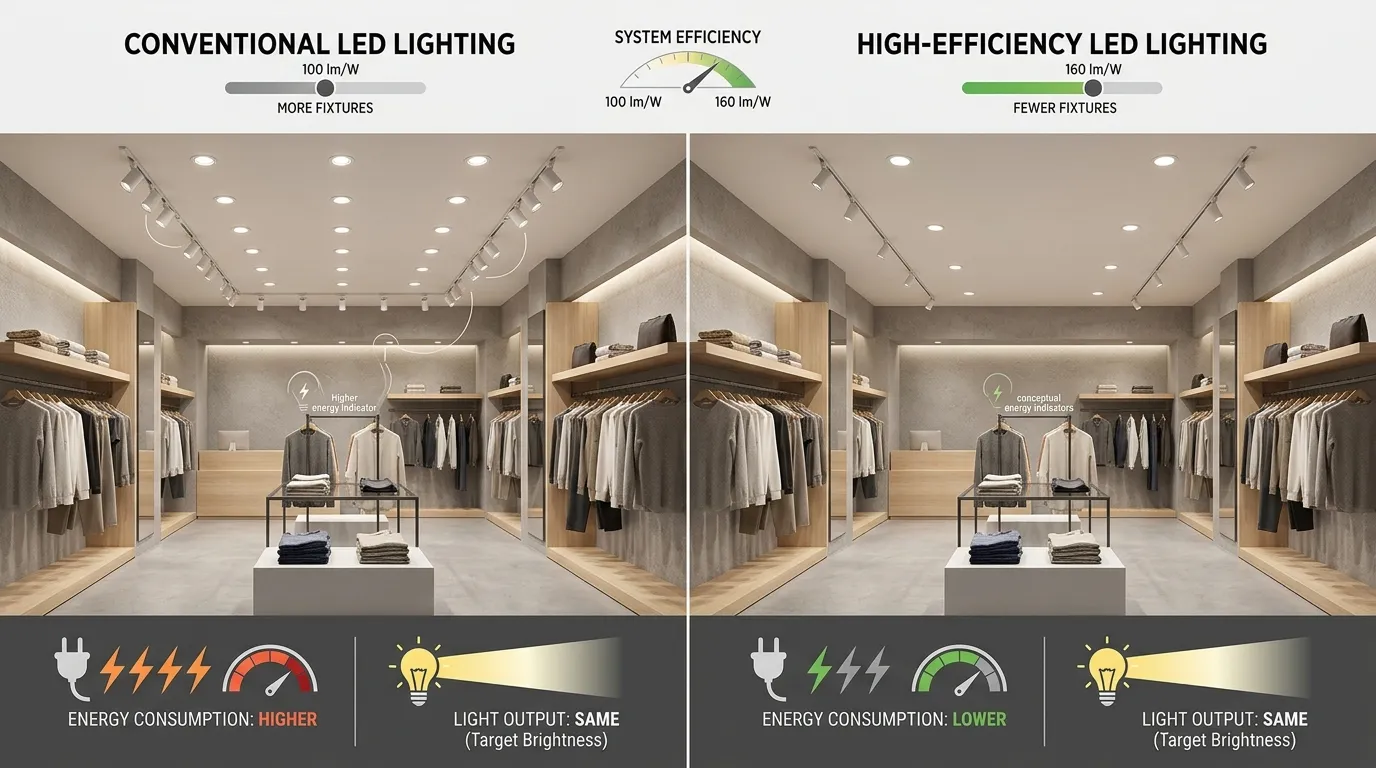
In LED lighting, luminous efficacy is usually expressed in lm/W. lm stands for lumens and W stands for watts. Simply put, the higher the lm/W value, the greater the light output a luminaire can produce at the same power consumption.
For example, a luminaire needs to deliver a light output of 3000 lm. If its luminous efficacy is 100 lm/W, the theoretical power consumption is approximately 30W. If the luminous efficacy is increased to 160 lm/W, the theoretical power required to achieve the same light output is about 18.75W.
In other words, under a theoretical comparison at the same light output, the input power of a 160 lm/W luminaire can be around 37.5% lower than that of a 100 lm/W luminaire. This indicates that high-efficacy LEDs can significantly reduce the power required per unit of light output. For commercial projects with a large number of luminaires, this difference accumulates with the quantity of fixtures and operating hours.
Of course, this 37.5% figure only compares luminaire power under identical light output conditions. It cannot be directly interpreted as a 37.5% energy saving for the entire commercial project. Actual results are affected by factors including the number of luminaires, operating hours, lighting design and control methods.
Therefore, 160 lm/W should be regarded as an important step to improve lighting efficiency rather than the ultimate goal. Higher luminous efficacy makes the luminaire itself more energy-efficient, yet it cannot solve all problems of energy waste in lighting.
| Efficiency | Out-put | Wattage | Power requirement under the same light output |
| 100 lm/W | 3000 lm | 30 W | Benchmark |
| 120 lm/W | 3000 lm | 25 W | Approximately 16.7% lower |
| 140 lm/W | 3000 lm | 21.4 W | Approximately 28.6% lower |
| 160 lm/W | 3000 lm | 18.75 W | Approximately 37.5% lower |
This simple comparison demonstrates the value of high-lumen-efficiency LEDs. For the same light output, a higher lm/W rating means lower theoretical power requirements. For commercial projects with a large number of luminaires operating over long periods, this efficiency difference can translate into long-term energy and operational savings.
Why High-Efficiency LED Lighting Is Not Enough
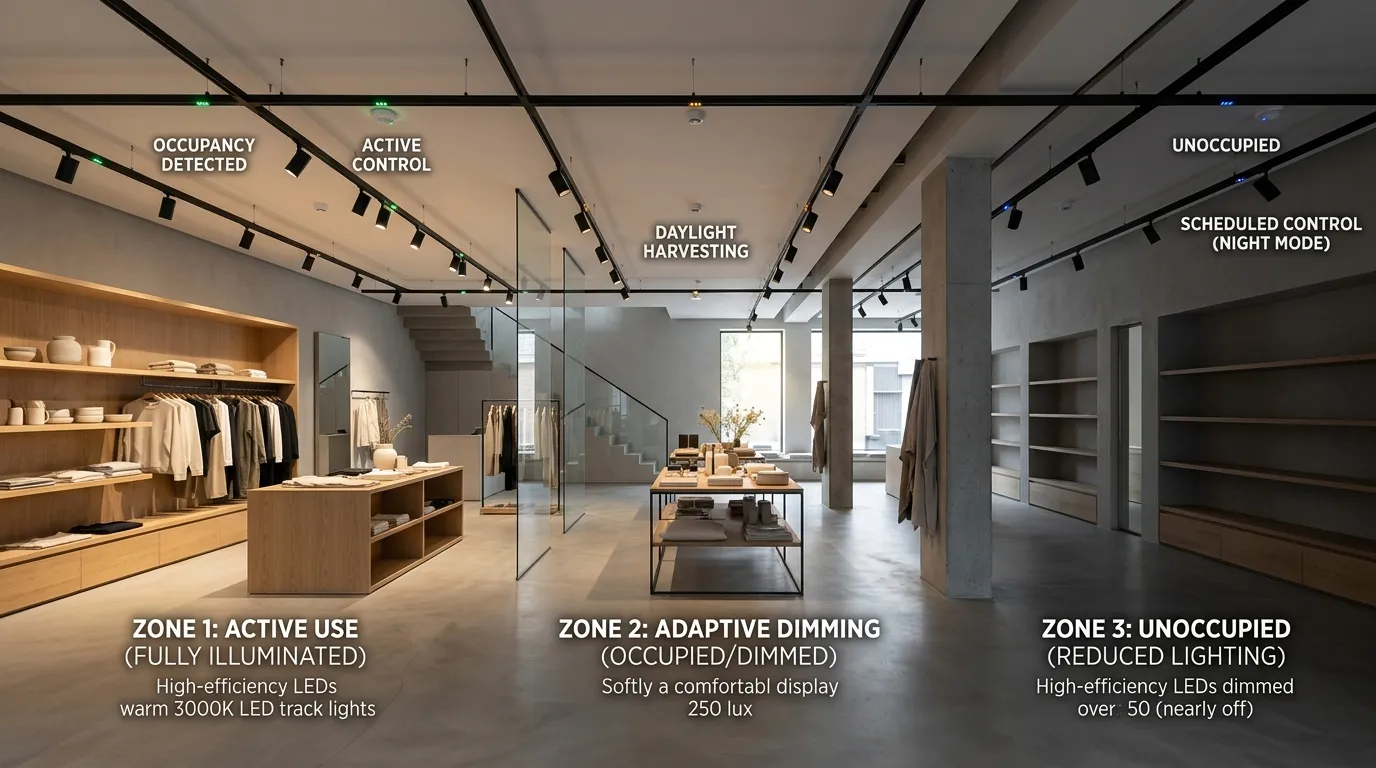
Even if an LED luminaire boasts a high efficacy of 160 lm/W, it can still generate unnecessary energy consumption if it maintains 100% brightness at all times when lighting is not required.
For example, a retail store operates for 12 hours each day. The sales area may require continuous lighting, yet storage zones, staff areas, or some corridors do not necessarily need to stay at the same brightness throughout the day. If luminaires in these areas keep operating at 100% output from opening to closing hours, high efficacy only addresses the efficiency of the fixture itself.
This raises another question:
Do we really need 100% lighting all the time?
The answer is usually no. The usage of commercial spaces keeps changing. Lighting requirements vary across different zones, time periods and activities. Therefore, future Energy-Efficient LED Lighting should focus not only on the luminous efficacy of luminaires, but also on the actual way lighting is used.
From High-Efficiency Lighting to Smart Lighting
The core of smart lighting is not to make luminaires more complex, but to make lighting better aligned with practical needs. Through intelligent control, luminaires can adjust according to human activity, time, natural light and space functions.
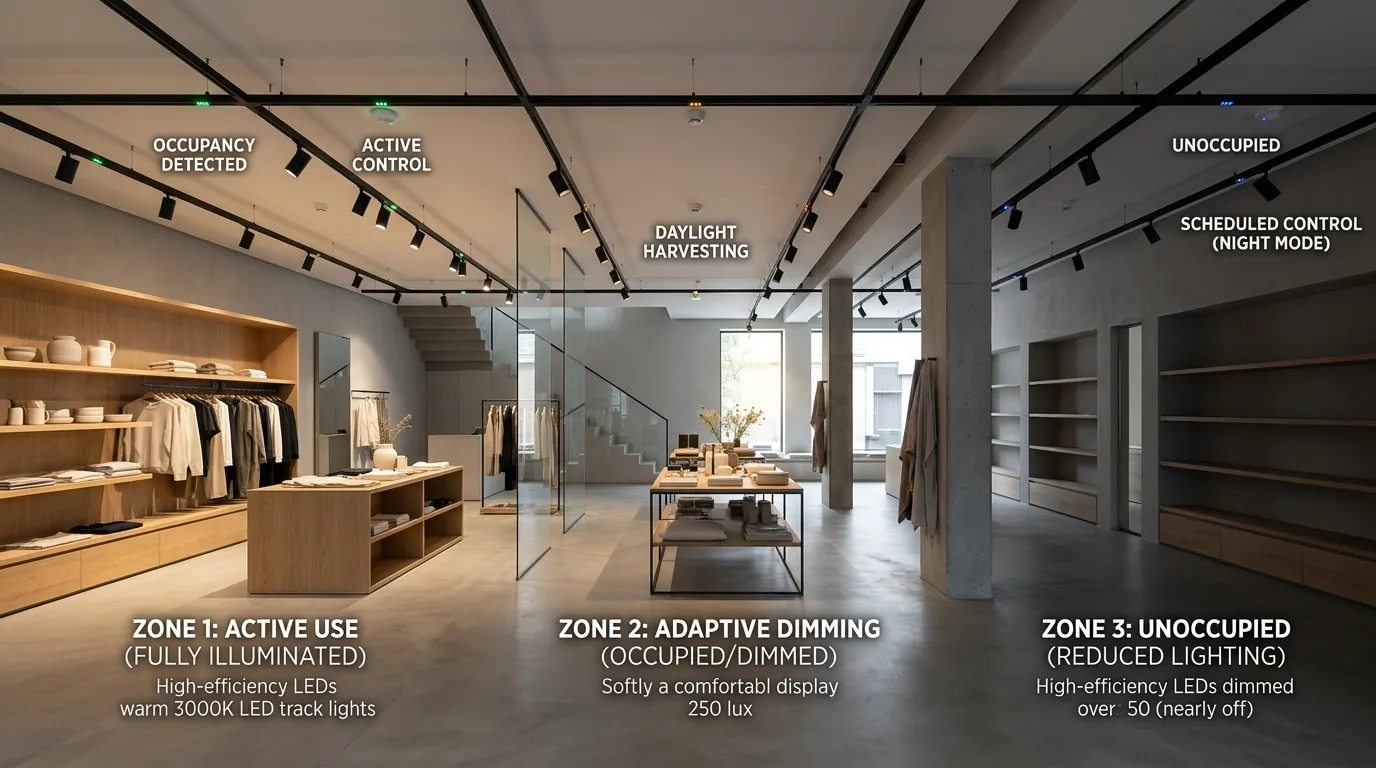
For example, lights can turn on automatically or increase brightness when people enter an area. When an area remains unoccupied for a long time, the lights can dim. Zones near windows can also be adjusted based on natural daylight levels, avoiding excessive artificial lighting when natural light is sufficient.
Time-based control is also a common application in commercial lighting. The system can set different lighting modes according to business hours. For instance, full lighting is activated at store opening, standard brightness is maintained during operating hours, and lighting output for non-essential areas is reduced after closing. In this way, the lighting system is no longer limited to simple “on” and “off” operations.
More importantly, smart lighting supports dimming. Luminaires do not have to run at 100% output at all times. Brightness can be set to 80%, 60% or even lower according to actual requirements. This approach further cuts down unnecessary lighting output.
Energy-Efficient LED Lighting + Smart Control
High-efficiency LEDs and smart controls address two distinct issues.
What high-efficiency LEDs solve is:
How efficiently do we produce light?
What smart controls solve is:
Do we need this light right now?
Therefore, combining the two can create a more comprehensive energy-saving logic. 160 lm/W reduces the power required to generate the same light output, while smart controls cut down unnecessary lighting duration and light output.
For example, a retail project uses 160 lm/W LED downlights and track lights. First, high-efficiency luminaires lower the power demand for base lighting. Then, the smart control system enables zone-based control for sales areas, display zones, corridors and back-of-house areas.
Sales areas can maintain high brightness. Key display zones can be highlighted according to merchandise requirements. Non-core areas can operate at lower brightness. Unoccupied areas can automatically reduce output based on system settings. In this way, the efficiency of the lighting system no longer comes solely from the luminaires themselves.
Thus, the future of commercial lighting can be understood with a simple formula:
High Efficiency + Smart Control = More Complete Energy Efficiency
| Lighting Approach | Main Challenge Addressed | Practical Function | Lighting Approach Main Challenge Addressed Practical Function |
| High-Efficiency LED | Lighting fixtures consume relatively high power | Higher lm/W produces the same light output with less power | Reduces baseline lighting power consumption |
| Dimming Control | Lighting does not always need to operate at 100% output | Adjusts light output according to actual requirements | Reduces unnecessary power consumption |
| Occupancy Control | Lights remain on when spaces are unoccupied | Adjusts lighting based on occupancy | Reduces energy waste in unused areas |
| Daylight Control | Artificial lighting remains high when natural light is sufficient | Adjusts artificial lighting according to available daylight | Makes better use of natural light |
| Scheduling | Lighting requirements vary throughout the day | Automatically adjusts lighting according to operating hours | Reduces energy consumption outside business hours |
| Smart Lighting System | A single control method offers limited flexibility | Combines dimming, control, scheduling, and scene management | Improves the long-term efficiency of the entire lighting system |
One Lighting System, Multiple Control Options
The requirements of different commercial projects are not entirely the same. Large commercial buildings may require centralized digital control, retail spaces may focus more on zoning and scene control, while hotels and exhibition halls may need more flexible lighting modes.
Therefore, a truly flexible smart lighting system needs to support multiple control methods. DALI is suitable for digital lighting control and enables fixture addressing, grouping and dimming. DMX512 is ideal for commercial environments requiring dynamic lighting control. 0-10V and TRIAC are still applicable to many mature dimming scenarios.
Wireless control is also becoming an important trend in commercial lighting. Zigbee can be used for wireless device connection, and Casambi can achieve flexible control via Bluetooth Mesh. Tuya and Matter can be applied to various smart devices and IoT environments.
For lighting suppliers, what really matters is not simply stacking protocol names, but providing appropriate control solutions according to project requirements. An excellent smart lighting system should have sufficient compatibility and be able to adapt to the control requirements of different projects.
Downlights and Track Lights: Combining General and Accent Lighting
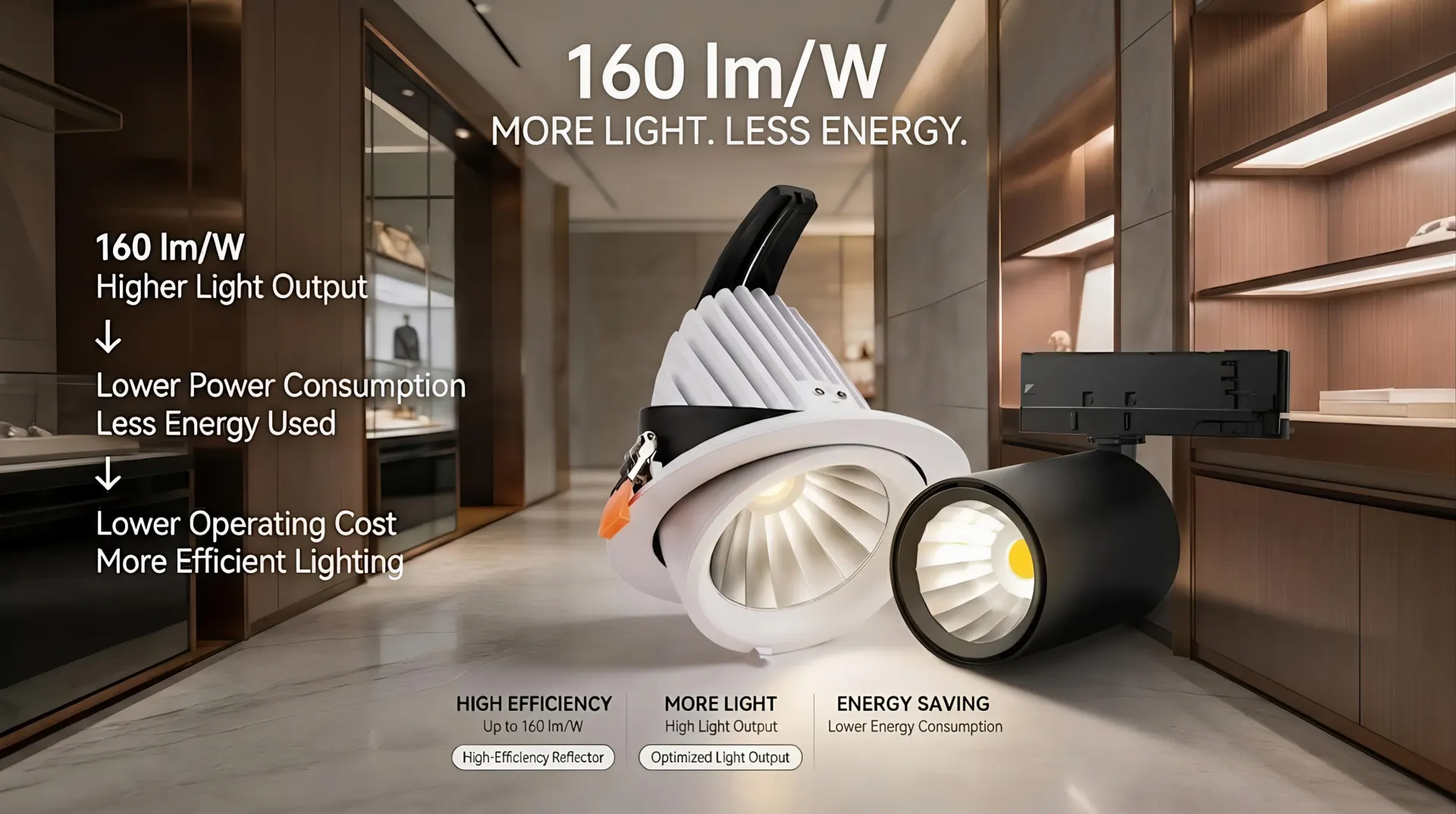
Commercial spaces usually do not rely on a single type of luminaire. Different lighting fixtures perform distinct lighting tasks, so they need to be combined from a systematic perspective.
LED downlights are generally suitable for providing ambient lighting. They can create relatively uniform ambient light and are used in retail stores, hotels, restaurants, offices and public areas. For spaces requiring stable illuminance, downlights can serve as the primary lighting equipment.
Track lights are more ideal for accent lighting. They can focus light onto merchandise, walls, artworks, shop windows and key display areas. The direction of track lights can be adjusted according to space layout and product positions, making them especially suitable for retail and exhibition environments.
Combining the two types of lights creates a clearer lighting hierarchy. Downlights handle the overall ambient illumination while track lights highlight key zones. Grouping and dimming different areas via smart controls can further enhance the flexibility of the entire lighting system.
This also represents an important embodiment of Energy-Efficient LED Lighting evolving from individual light fixtures to comprehensive lighting solutions.
Why Smart Lighting Works Well in Retail Spaces
Retail spaces serve as a highly typical application scenario for smart lighting. Merchandise displays change, business hours vary, and lighting requirements differ across different zones.
For example, a clothing store may use downlights to provide ambient lighting. Track lights are used to highlight apparel displays, shop windows and themed display areas. Different lighting brightness levels and control strategies can be adopted for checkout zones, fitting rooms and corridors.
If all these light fixtures are connected to an intelligent control system, lighting scenes can be created to meet diverse needs. Full lighting can be activated when opening the store. Standard mode can be maintained during business hours. The brightness of selected track lights can be increased for featured displays. After closing, the lighting output of most non-essential areas can be reduced.
In this way, the lighting system evolves from a simple assembly of light fixtures into a manageable and adjustable system. For chain retail brands, this standardized control method can also be applied across different stores.
Smart Lighting Is About More Than Energy Saving
Energy saving is an important value of smart lighting, yet not the only one.
Smart systems can also improve the efficiency of lighting management. When faults occur in traditional lighting systems, managers usually need to conduct on-site inspections. In contrast, smart systems deliver clearer control logic and make it easier to manage lighting status across different zones.
This is especially critical for enterprises with multiple commercial spaces. If similar lighting fixtures and control strategies are adopted in various stores, enterprises can establish unified lighting standards.
Meanwhile, smart lighting enhances the flexibility of space utilization. Lighting scenes can be reconfigured when product layouts change, and control strategies can be quickly adjusted when business hours are modified.
Therefore, the values brought by smart lighting include not only Energy Saving, but also Lighting Management, Flexibility, User Experience and Long-Term Value.
Look Beyond the Initial Lighting Cost
When purchasing lighting fixtures for commercial projects, price is certainly important. However, comparing only the upfront purchase price of lamps makes it difficult to see the full lifecycle value.
A lighting fixture may have a low purchase price, yet it may require higher operating power if its luminous efficiency is poor. If it runs for long hours every day, the long-term energy cost will also rise.
On the other hand, high-efficiency LEDs can reduce baseline power requirements. Intelligent controls can also cut unnecessary operating hours and lighting output. Therefore, projects should also take long-term operating costs into account when selecting lighting fixtures.
Comprehensive evaluation can be carried out from several aspects, including Initial Cost, Energy Cost, Maintenance Cost, Control Cost and Operational Value.
A truly valuable lighting system is not necessarily the one with the lowest purchase price. For commercial projects
From Lighting Products to Complete System Solutions
In the past, lighting suppliers usually focused more on individual products. Customers might purchase track lights, downlights, linear lights or panel lights, and then the project side would take charge of subsequent design and system configuration.
However, as commercial lighting becomes increasingly complex, merely supplying products can hardly meet all project requirements. Customers may also need lighting design, optical solutions, luminaire layout, illuminance calculation, glare control, intelligent control and project technical support.
Therefore, commercial lighting suppliers are gradually transforming from single-product suppliers to system solution providers.
This mindset can be summarized as:
Product + Smart + Simulation = System Solution
Products are the foundation of the entire system. Smart control is responsible for improving the flexibility of the system. Lighting Simulation helps verify lighting effects for projects in advance.
The combination of these three parts can deliver more complete solutions for commercial projects.
The Role of Lighting Simulation
In a commercial lighting project, clients need to know not only the parameters of light fixtures but also the final lighting effect.
This is where Lighting Simulation plays an important role.
Through lighting simulation, illuminance, uniformity, the number of light fixtures, installation positions and light distribution can be evaluated before physical installation. This method is especially valuable for complex spaces such as retail stores, hotels and exhibition halls.
For example, if the illuminance in a certain area is insufficient, the number or installation positions of light fixtures can be adjusted before construction. If a display area requires stronger accent lighting, the light distribution and mounting angle of track lights can also be adjusted in advance.
This reduces the risk of later modifications and rework.
Therefore, Lighting Simulation is not a standalone add-on service. It can be an important part of commercial lighting system design.
The Future of Energy-Efficient LED Lighting
LED technology is still evolving continuously. Higher luminous efficacy remains an important research direction, and 160 lm/W will not be the ultimate efficiency limit.
However, future competition will not revolve around a single lm/W figure.
The efficiency of the luminaire itself is only the first layer. More efficient optical design can further boost effective light output. Smart controls allow lighting to be adjusted according to actual needs. Sensors, wireless connectivity and digital management will also make lighting systems more flexible.
Therefore, future Energy-Efficient LED Lighting will gradually develop into a complete system.
It includes higher luminous efficacy, improved light distribution, smart controls, system connectivity, lighting simulation and project management.
The ultimate goal is not to keep all luminaires operating at maximum brightness all the time.
Instead:
Provide the Right Light, at the Right Time, in the Right Place.
Deliver light at the right time.
Deliver light in the right area.
Deliver light at the right brightness level.
This is high-efficiency lighting in the true sense.
From 160 lm/W to Smart Lighting Systems
Commercial lighting is gradually shifting from competition centered on standalone LED products to system-based competition.
160 lm/W stands for higher luminaire efficiency. It reduces power requirements for the same light output. Smart controls can further cut unnecessary lighting. Lighting Simulation helps projects optimize luminaire layout and lighting performance.
When these three elements are integrated, the value of a lighting system extends far beyond luminaire specifications.
It enables commercial projects to achieve higher energy efficiency, more flexible lighting control and superior long-term operational value.
Therefore, 160 lm/W is not the end of Energy-Efficient LED Lighting. Instead, it marks a new starting point.
The future of commercial lighting is not merely about:
More Light. Less Energy.
It should focus on:
The Right Light.
At the Right Time.
In the Right Place.
From high-efficiency LEDs and smart controls to complete lighting solutions, this represents the likely direction for the next phase of development in commercial lighting.

