



Why Replace Track Lights When You Can Adjust Them? 3 CCT selectable wattage track light Help You
By JC

In retail lighting projects, selecting the right fixtures involves more than just determining wattage and brightness. A 3 CCT and selectable wattage LED track light offers flexible lighting solutions for retail stores, helping business owners reduce energy costs, minimize unnecessary replacements, and adapt to changing lighting needs.
For retail chains with multiple stores, these variations introduce further challenges: Is it needed to purchase track lights with different color temperatures and wattages for every individual store? And if the brightness proves unsuitable after installation, must the fixtures be replaced entirely? Even within a single store, different areas—such as window displays, product shelving, aisles, and checkout counters—may require distinct lighting effects.
With traditional track lights—which feature fixed wattage and fixed color temperature—specific specifications must typically be locked in during the procurement phase. Should requirements on-site change, it may become necessary to swap them out for different models.
A 3 CCT and selectable wattage LED track light provides greater flexibility for store renovations, helping retailers adapt to changing merchandise displays while minimizing replacement and installation costs.
The 3-CCT wattage-selectable LED track light offers a more flexible solution to these issues.
It allows installers to select different color temperatures and power ratings based on on-site requirements. It enables the same luminaire to be used across a wider range of commercial lighting scenarios.
What is a 3-CCT and Selectable Wattage Track Light?
A single track light offering three color temperature options
“3 CCT” indicates that a light fixture comes with 3 preset correlated color temperature (CCT) settings. Customers can select via a DIP switch on the fixture itself.
Taking a track light that supports 2700K, 3000K, and 4000K as an example:
2700K produces a warmer light, ideal for spaces where comfort and ambiance are prioritized; 3000K strikes a balance between a warm atmosphere and the requirements for product display; 4000K provides a crisper, more neutral visual effect.
Consequently, project procurement teams do not need to commit to a fixed color temperature for each area when ordering; instead, they can make their selections based on the actual spatial design and specific product display requirements.
How is power selection achieved with “Selectable Wattage”?
Beyond color temperature, wattage also influences the lighting effect in commercial spaces.
For example, a track light that offers 3 wattage—25W, 30W, and 35W allow to select the appropriate power based on specific requirements.
When a particular area demands a higher light output, a higher wattage setting can be chosen; conversely, if a lower setting is sufficient to meet the required illuminance, there is no need to default to the highest level.
By combining three color temperature options with three wattage settings, one can theoretically achieve nine distinct preset configurations. This means a single luminaire can address a variety of application needs that might otherwise require multiple, separate product specifications.
It is important to note that selectable wattage is not the same as real-time dimming, and selectable color temperature is not the same as dynamic color tuning. These settings are typically configured during the installation and commissioning phases and should be adjusted in accordance with the product manual.
How can CCT-selectable LED track lighting improve the lighting experience in retail stores?
H2: How Can 3 CCT and Selectable Wattage LED Track Lights Benefit Retail Store Owners?
| Product Feature | Practical Application | Benefits for Store Owners |
|---|---|---|
| 3 CCT Selectable (2700K/3000K/4000K) | Choose suitable color temperatures for different retail areas. | Create the desired shopping atmosphere without replacing fixtures. |
| Selectable Wattage (25W/30W/35W) | Adjust light output according to actual lighting needs. | Reduce unnecessary energy consumption and electricity costs. |
| Field-Adjustable Settings | Change CCT or wattage when store layouts or display needs change. | Minimize fixture replacements and renovation costs. |
| Multiple Settings in One Fixture | Use one fixture model across different retail projects. | Simplify purchasing, reduce SKUs and inventory pressure. |
| Adjustable Beam Angle (15°–45°) | Direct light toward products and display areas. | Improve product visibility and adapt to different merchandise displays. |
Different products require different visual presentation approaches
Color temperature influences the atmosphere of a space and shapes how customers perceive the environment in which products are displayed.
In clothing stores, boutiques, or warmer lighting is often better suited to creating a comfortable and sophisticated shopping experience. For instance, 3000K can be used in certain apparel display areas, ensuring sufficient illumination while imbuing the space with a cozy, inviting feel.
For areas where product details need to be clearly showcased, 4000K may be a more appropriate choice. This is often ideal for displays of everyday goods, retail shelving units, and showrooms with a modern aesthetic, where a more neutral lighting effect is desired.
However, color temperature is not the only factor that determines how products are presented. The color rendering index (CRI), spectral characteristics, illuminance levels, and light beam distribution are equally important; therefore, the final selection should always be based on the specific type of merchandise and the intended visual effect on-site.
Reduce rework caused by unsuitable color temperature after installation
Suppose a clothing store initially planned to use 4000K track lights, but after completing the renovation and merchandise display, the owner finds the overall lighting too “cool white” and wishes to switch to 3000K.
If the installed fixtures are fixed at 4000K, the contractor might need to purchase new units, remove the existing ones, and carry out replacements.
For the store owner, this helps avoid additional costs related to materials, installation, and the coordination of construction work that would otherwise arise from an unsuitable initial color temperature choice.
How can selectable-wattage LED track lights help store owners control their electricity costs?
Higher wattage does not necessarily mean more suitable lighting
In actual retail projects, some areas may suffer from excessive lighting.
For instance, a store might be designed with 35W track lights throughout; however, once installed, it may become apparent that certain display racks are positioned too close to the fixtures, or that specific areas simply do not require such high light output.
If fixed-wattage fixtures are used, reducing energy consumption would necessitate replacing the lights or implementing alternative control solutions.
In contrast, track lights with adjustable wattage settings allow installers to lower the power from 35W to 30W or 25W. Thereby reducing electricity consumption while still meeting lighting requirements.
For store owners, the benefit goes beyond merely lowering brightness; it prevents them from continuously paying for unnecessary light output.
From individual stores to a chain, energy-saving benefits can gradually accumulate
Consider a retail store equipped with 100 track lights, operating for 10 hours a day, 300 days a year.
If the 100 fixtures—originally rated at 35W—can be adjusted to 25W (following an on-site assessment of required illuminance levels), the power consumption of each unit is reduced by 10W.
Under these operating conditions, the store would reduce its annual lighting-related electricity consumption by approximately 3,000 kWh.
For a retail chain with 20 such stores, the theoretical annual reduction in lighting electricity consumption could reach 60,000 kWh.
The actual cost savings will depend on factors such as local electricity tariffs, operating hours, the specific power settings used, and whether the adjusted lighting still meets the original illumination requirements.
These calculations do not imply that all stores should uniformly reduce their lighting power; rather, they demonstrate that when maximum light output is not required on-site, adjustable-power designs offer a viable option for lowering long-term operational costs.
How does field-adjustable LED track lighting accommodate changes in store layout?
As product displays change, lighting requirements may also shift.
The layout of a retail store is not static.
A clothing store might shift the placement of merchandise displays with the changing seasons; a retail chain might periodically update its shelving; and a showroom might adjust its display areas to accommodate new product launches.
Such changes inevitably affect lighting requirements.
For instance, high-output track lights originally intended for a large display platform may no longer require the same power configuration once that platform is replaced by a smaller merchandise rack.
By using field-adjustable track lights, installers can re-evaluate lighting needs and select the appropriate power output, rather than having to replace the entire lighting fixtures.
Adjustable beam angle further enhances lighting flexibility
For track lights with an adjustable beam angle (ranging from 15° to 45°), the beam coverage can be tailored—in addition to adjusting color temperature and power—based on the dimensions of the merchandise and the installation distance.
A narrower beam angle is ideal for highlighting specific items, such as mannequins in a window display, individual showcase pieces, or particular decorative zones.
A wider beam angle, by contrast, can be used to illuminate larger display areas, such as an entire rack of clothing or an expansive merchandise section.
By combining adjustments to beam angle, color temperature, and power, lighting contractors gain greater flexibility in fine-tuning lighting effects.
For store owners, this means that the lighting fixtures can better adapt to changes in product displays, potentially reducing the need for repeat purchases when specific lighting requirements shift.
Nevertheless, whether a given fixture can meet the needs of a new lighting scheme must still be evaluated by considering factors such as installation height, light distribution data, and the actual illuminance levels on-site.
How can CCT and wattage-selectable track lights help reduce inventory and procurement pressure?
A single product covers a wider range of predefined specification requirements.
For lighting distributors and project contractors, inventory management represents a significant cost factor in the commercial lighting business.
Consider a series of track lights available in three color temperatures and three power ratings. If only fixed-specification products are used, a distributor might need to manage nine distinct combinations of power and color temperature.
This not only increases the number of product variants but also complicates procurement forecasting, warehouse management, and replenishment processes.
By adopting a design that offers selectable color temperatures and power ratings—while keeping other product parameters consistent—a single luminaire model can cover multiple pre-set combinations.
This helps reduce the number of SKUs that must be kept in stock, lowering the risk of overstocking certain models while facing shortages of others.
Chain stores can more easily achieve product standardization.
For retail brands operating multiple locations, product standardization is equally important.
Individual stores may vary in terms of floor area, interior design style, and product assortment. If each location procures track lighting with entirely different specifications, it can complicate processes such as sourcing spare parts, replacing units, and ongoing maintenance.
By adopting a unified series of adjustable track lights, retail chains can tailor color temperature and power output to the specific needs of each store, while ensuring that the actual lighting models remain consistent across the board.
Within the same product line, one clothing store might utilize 3000K, 30W fixtures. Another store—based on its specific requirements—might opt for 4000K, 35W units.
This configuration flexibility helps procurement departments streamline product management. Maintenance staff can easily source the correct replacement when needed.
Commercial LED Track Lighting:How to reduce the cost of long-term using and maintainance?
Reduce redundant procurement resulting from specification changes
The purchase price of lighting fixtures represents only one component of the total cost for a commercial lighting project.
For retail store owners, factors such as installation costs, ongoing maintenance, the need to stock spare parts, and the logistics of carrying out work during store renovations can all influence the long-term cost of a lighting system.
If fixtures with fixed color temperatures or fixed power ratings, it may fail to meet new lighting requirements. Store owners may be forced to purchase different equipment. Then it will incur additional expenses for removal and reinstallation.
In contrast, track lights with multiple preset parameters can often adapt to changing needs within their adjustable range, thereby reducing the need for unnecessary fixture replacements.
Minimize operational disruption during store renovations
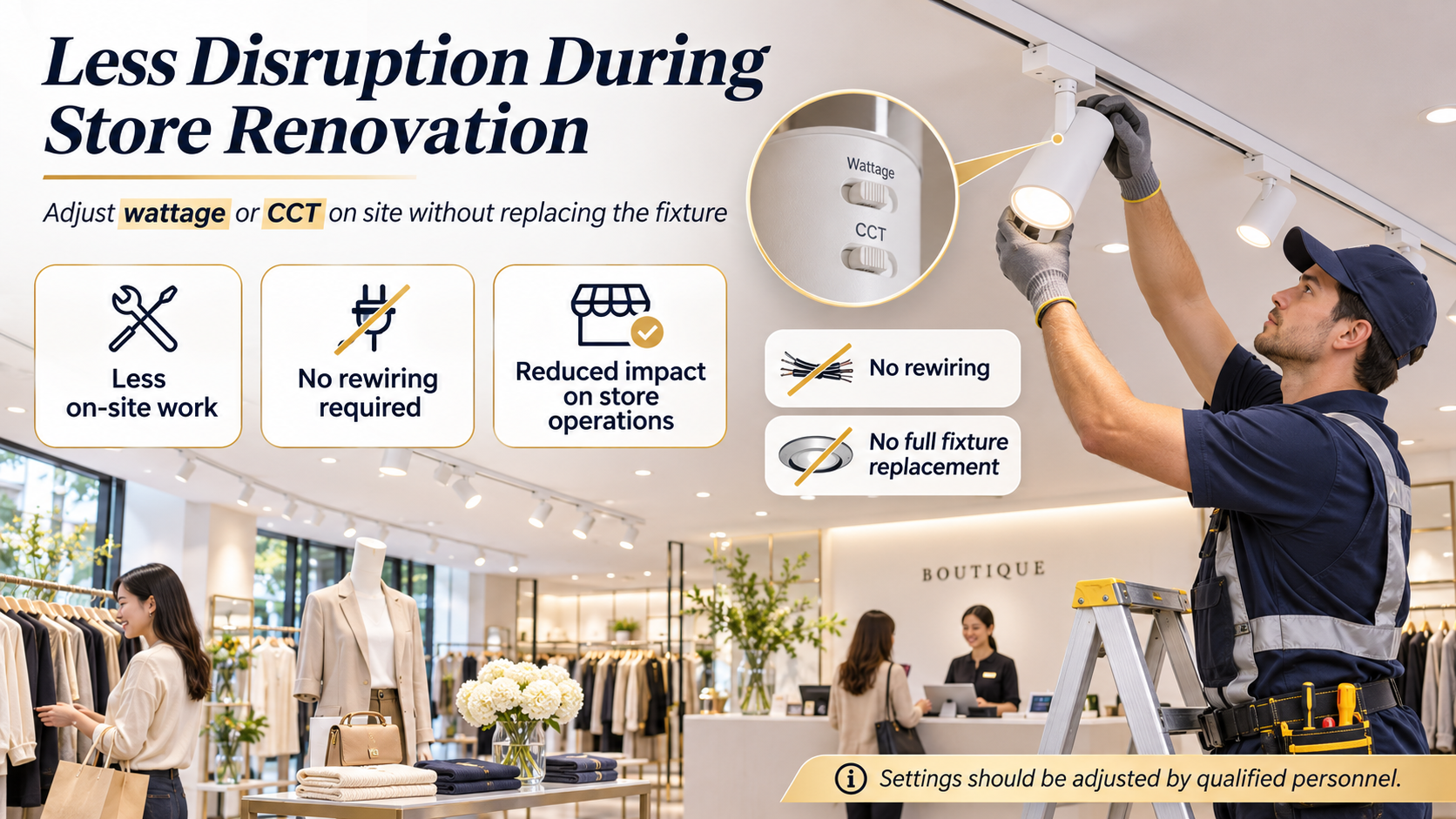
For stores that remain open for business, lighting retrofits may require the coordination of construction schedules and could potentially impact certain areas.
If the project only involves adjusting the wattage or color temperature—without the need for rewiring or replacing the fixtures themselves—the scope of work is generally more limited than a full-scale replacement.
This helps minimize on-site labor and reduces disruption to store operations during the retrofit process.
Naturally, any such adjustments must be performed by qualified personnel in accordance with product specifications and relevant electrical safety requirements; the fact that a fixture is “field-adjustable” does not mean that customers can—or should—make such changes themselves.
How to Choose a 3 CCT and Selectable Wattage LED Track Light?
Confirm that the color temperature and power setting meet your actual requirements
When selecting track lights, first verify that the preset color temperatures of the fixtures align with the store’s design requirements.
For instance, a combination of 2700K, 3000K, and 4000K offers a range of warm-white to neutral-white lighting options; however, this does not imply that such a selection can cover the entire spectrum of color temperature needs.
Furthermore, it is essential to examine the luminous flux and actual luminous efficacy for each power setting, rather than focusing solely on the maximum power rating.
If a 25W setting is sufficient to meet the project’s requirements, higher power settings can be reserved as configuration options for other installation scenarios.
Focus on color rendering, beam angle, and anti-glare performance
In commercial lighting, brighter is not necessarily better.
For apparel, food, and other retail merchandise, appropriate color rendering is essential, enabling customers to accurately perceive colors and product details.
Therefore, it is important to evaluate a product’s color rendering index (CRI) and other relevant optical parameters.
Furthermore, the beam angle of track lights, their installation positioning, and glare control all significantly influence the actual shopping experience.
Even if a track light offers adjustable power and color temperature settings, an unsuitable light distribution—relative to the placement of shelving—can still lead to issues such as overly bright aisles or insufficient illumination on product displays.
Confirm track compatibility and on-site adjustment methods
For retrofit projects, it is also necessary to verify that the light fixtures are compatible with the existing track system, and to ensure that the color temperature and power switches are positioned in a way that facilitates installation and commissioning.
Furthermore, one should confirm that the product specifications—across various settings—as well as driver performance, certifications, and warranty terms, all align with the project requirements.
Checking these details in advance helps prevent situations where fixtures are found to be unsuitable only after they have arrived on-site.
FAQ about Selectable CCT Track Lighting:
Can track lights with 3 selectable CCT be used with different color settings in different areas?
Yes. As long as each light fixture supports independent configuration, installers can set different preset color temperatures to suit the specific requirements of various areas.
For instance, in a single store, 3000K might be used for key display areas, while 4000K could be selected for other product display zones—the exact choice should be determined by the overall lighting design.
Does adjustable power mean the lights can be dimmed at any time?
Not exactly.
“Selectable Wattage” typically refers to adjusting a luminaire’s operating power via preset settings; it is not the same as 0–10V, DALI, or other real-time dimming systems.
If a project requires continuous or automated brightness adjustments, we should verify whether the luminaire supports the appropriate dimming functionality.
For which types of projects are track lights with adjustable wattage and color temperature suitable?
These types of luminaires are particularly well-suited for retail stores, clothing shops, showrooms, chain outlets, and commercial renovation projects that require diverse lighting solutions.
For distributors and contractors, a key potential advantage is the reduction in the number of fixed-specification models they need to manage.
However, for projects where lighting specifications are fully defined and unlikely to change over the long term, products with fixed specifications may offer a more favorable procurement cost.
Conclusion: Adapt the lighting system to the store, rather than making the store accommodate the lighting fixtures
For retail store owners, an ideal lighting system should not only deliver the right illumination on the day of installation but also continue to provide value as merchandise changes, spaces are reconfigured, or stores undergo renovations.
LED track lights with selectable CCT (correlated color temperature) and wattage allow for both color temperature and power output to be adjusted within a single fixture, enabling retail spaces to be tailored to specific lighting requirements.
The practical value of such a system lies in its ability to reduce the number of distinct SKUs required, prevent unnecessary energy consumption, minimize repeat purchases caused by shifting lighting needs, and offer greater flexibility for future store adjustments.
When combined with an adjustable beam angle design, these fixtures can further enhance the versatility of a retail lighting scheme by allowing the light coverage to be adapted to different display areas.
By choosing 3 CCT and selectable wattage track light, businesses can reduce unnecessary energy consumption, simplify inventory management.
For businesses planning new store openings, upgrading existing lighting systems, or standardizing lighting configurations across a retail chain, LED track lights with on-site adjustability are a compelling option to consider during the procurement and lighting design process.

