



Energy Efficient Linear Lighting for Commercial Spaces: More Light with Lower Energy Consumption
By JC
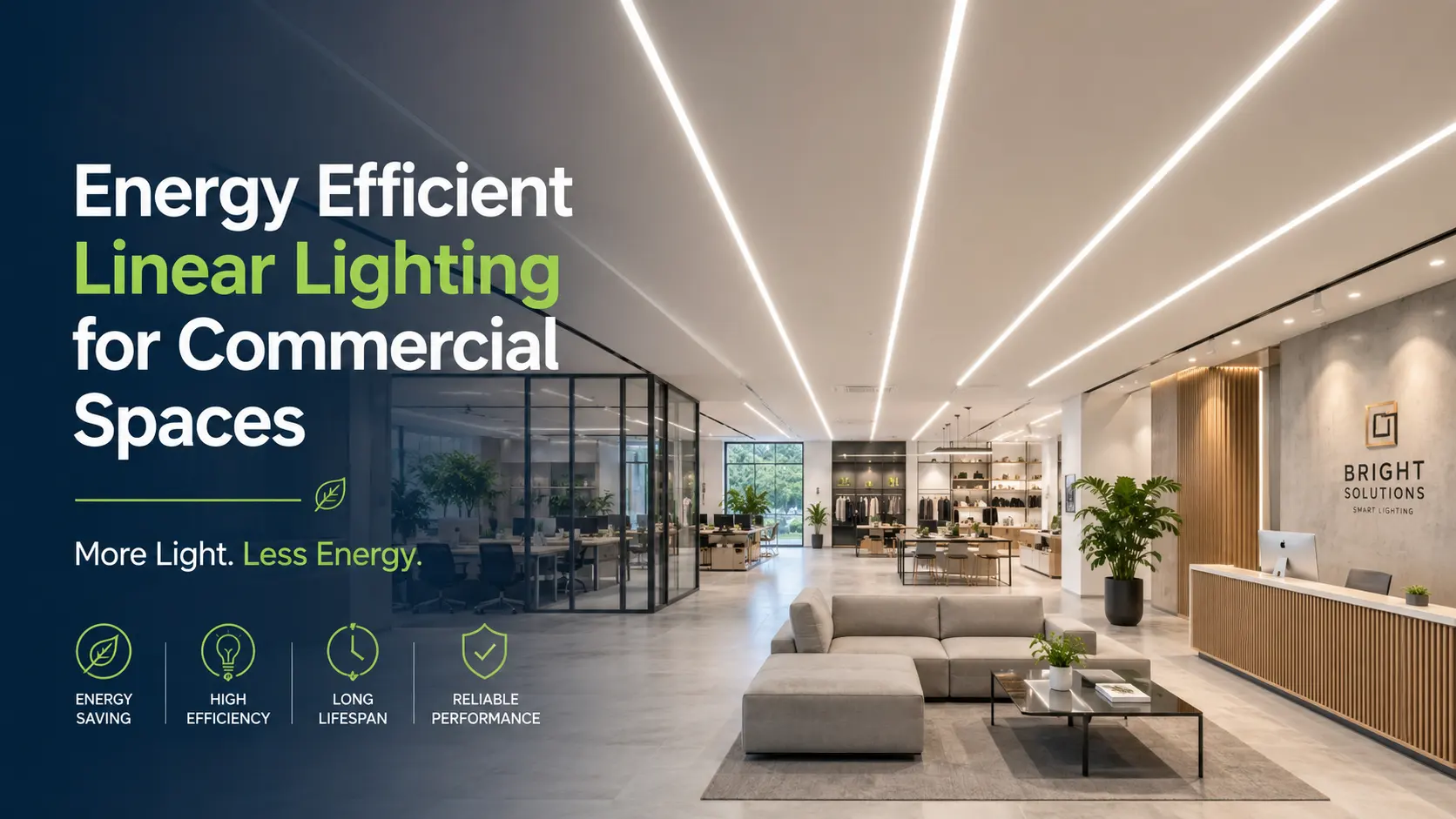
Energy Efficient Linear Lighting for Commercial Spaces helps businesses achieve high-quality illumination while reducing electricity consumption and long-term operating costs. From offices and retail stores to showrooms, hotels, and public buildings, commercial spaces need lighting systems that operate efficiently for many hours every day.
Modern LED linear lighting combines high luminous efficacy, uniform light distribution, low-glare optical control, and flexible installation options. Compared with traditional fluorescent or inefficient LED fixtures, an advanced linear lighting system can deliver more usable light with lower wattage.
For commercial building owners, lighting designers, contractors, and retailers, energy-efficient linear lighting is not only an environmental choice. It is also a practical investment that can improve visual comfort, support better space design, and reduce maintenance requirements.
1. Why Energy Efficiency Matters in Commercial Lighting
Commercial buildings often use lighting for eight, twelve, or even twenty-four hours per day. As a result, lighting can represent a significant part of a building’s electricity consumption.
Improving lighting efficiency allows businesses to lower energy use without reducing brightness or visual quality. This is especially important in large commercial spaces where dozens or hundreds of luminaires may be installed.
1.1 Lower Electricity Consumption
Energy-efficient LED linear lights are designed to convert more electrical energy into usable light. A fixture with high luminous efficacy can produce the required lumen output using less power than a conventional lighting product.
For example, a commercial project may previously have required a higher-wattage fixture to achieve the necessary illumination level. By using a high-efficiency linear light, the project may achieve similar or better brightness with lower wattage.
The result is lower electricity consumption throughout the lifetime of the lighting installation.
1.2 Reduced Long-Term Operating Costs
The purchase price of a light fixture is only one part of its total cost. Commercial lighting projects must also consider:
- Electricity costs
- Maintenance expenses
- Replacement frequency
- Installation labor
- Business disruption during maintenance
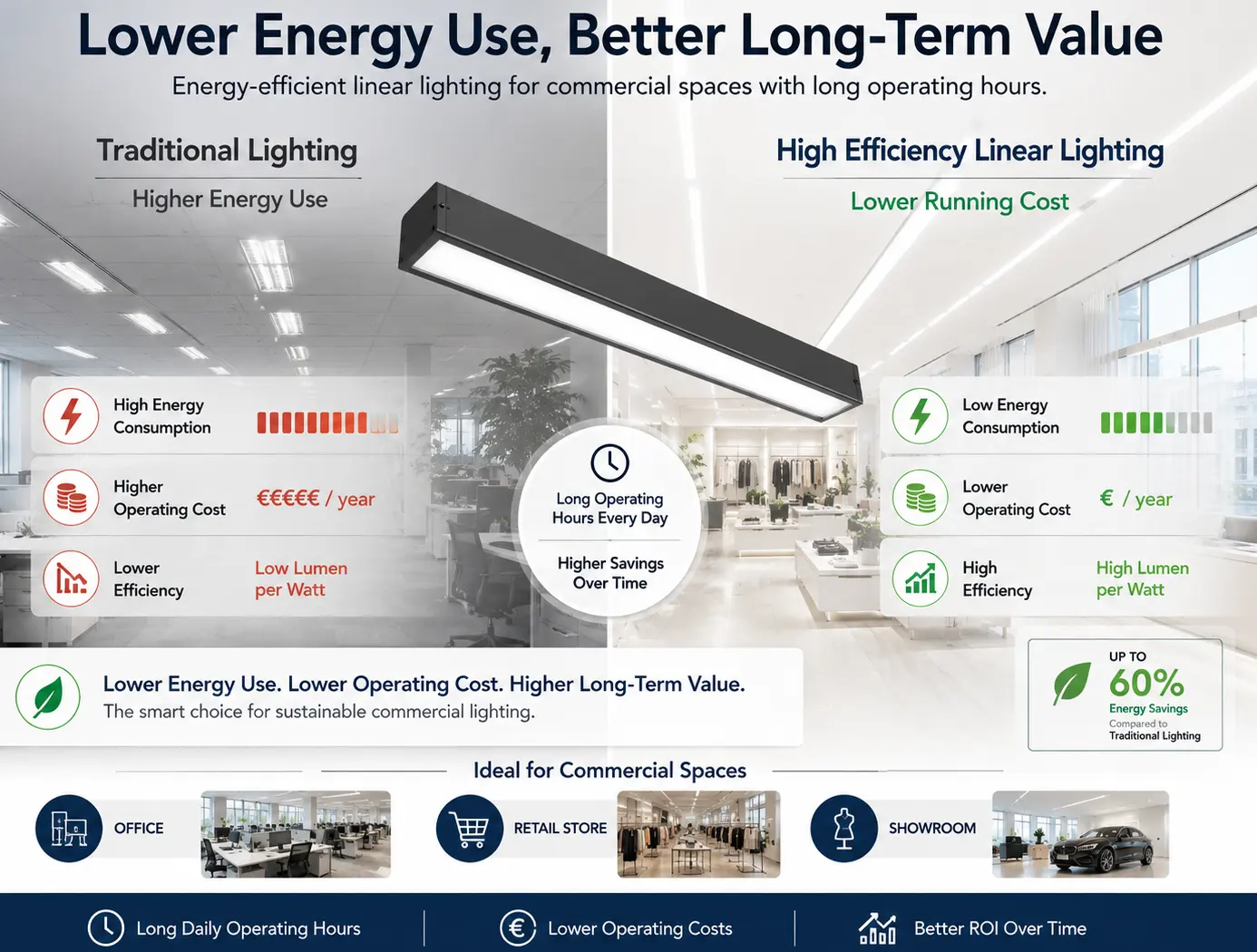
Energy-efficient LED linear lighting can reduce both energy and maintenance costs. A reliable LED system with a long operating life requires fewer replacements, helping businesses avoid frequent maintenance work.
1.3 Support for Sustainable Building Goals
Many commercial projects now include energy-saving and sustainability requirements. Building owners, architects, and lighting consultants are looking for solutions that reduce unnecessary energy consumption while maintaining a comfortable indoor environment.
Energy Efficient Linear Lighting for Commercial Spaces can support energy-conscious building strategies by providing high output, precise light control, and compatibility with intelligent lighting systems.
2. Key Features of Energy Efficient Linear Lighting
Lighting efficiency is not determined by wattage alone. A well-designed commercial linear light must combine efficient LED technology with effective thermal management, professional optics, and reliable control components.
2.1 High Luminous Efficacy
Luminous efficacy describes how much light a fixture produces for each watt of electrical power. It is normally expressed in lumens per watt.
A high-efficacy linear light delivers more lumen output while consuming less energy. Some advanced commercial linear lights can achieve up to 160 lm/W, making them suitable for projects that require both high brightness and lower power consumption.
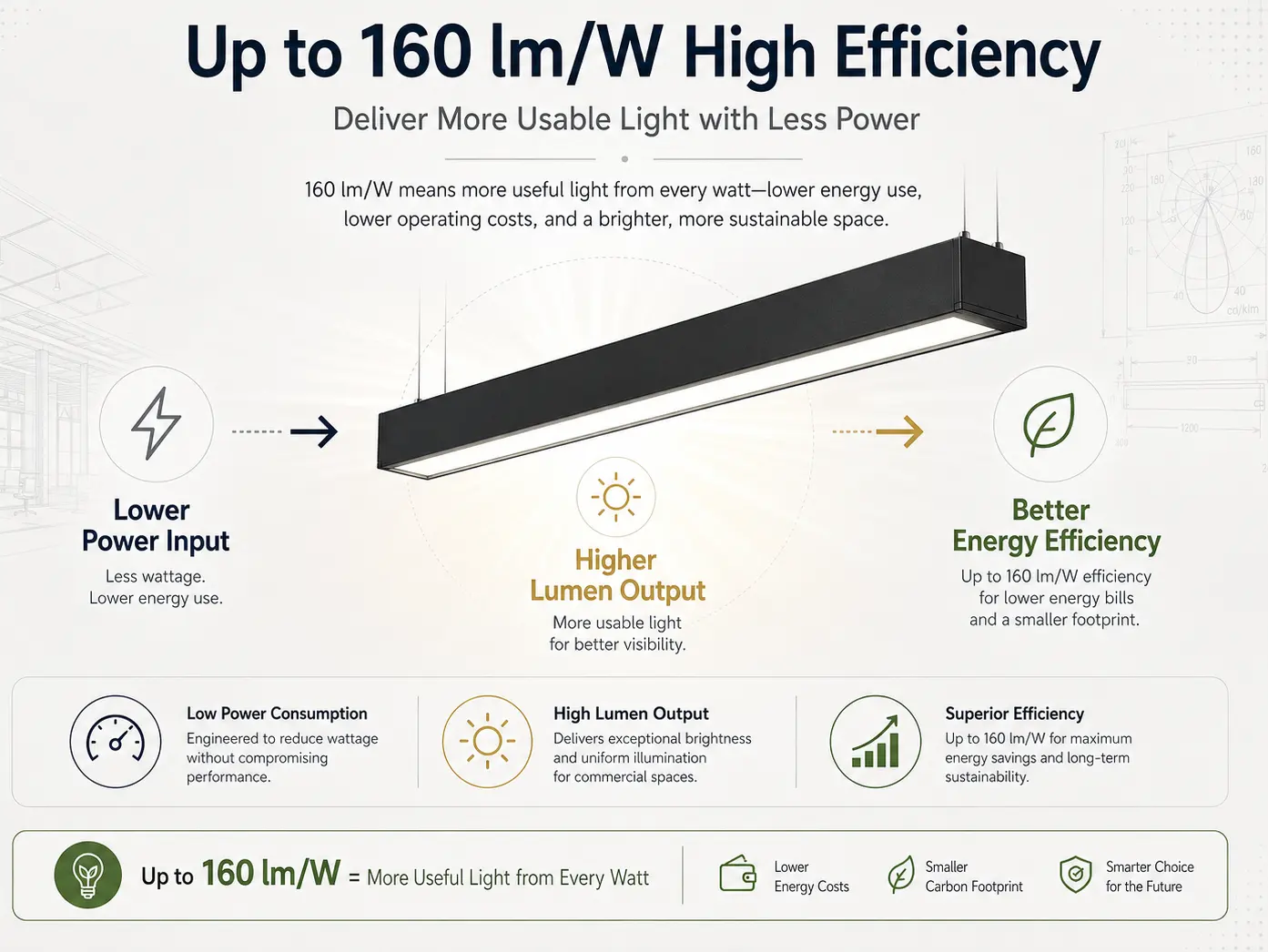
Higher efficacy can provide several advantages:
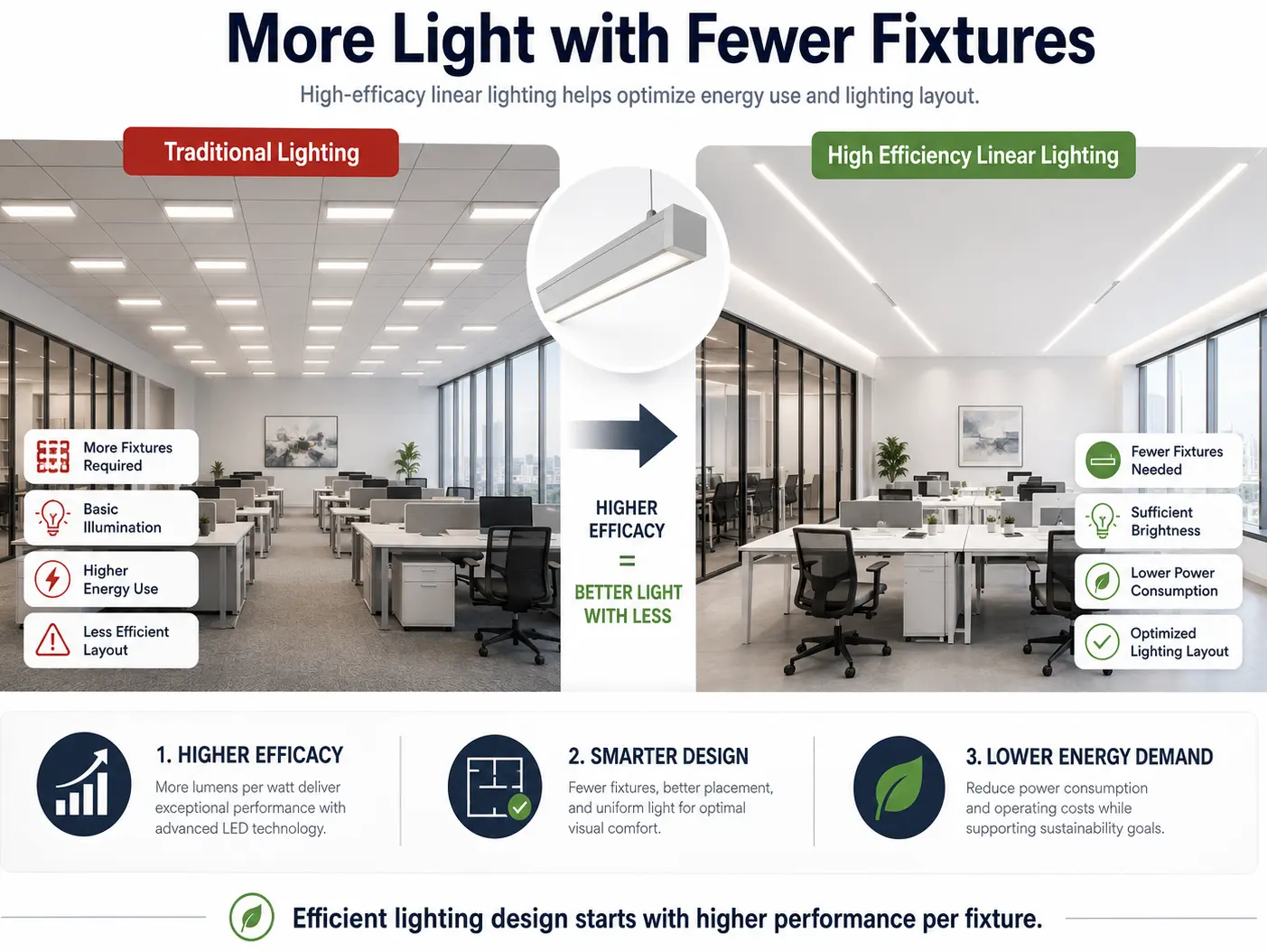
- Fewer fixtures may be required
- Lower wattage can achieve the target illumination
- Energy costs can be reduced
- Heat generation may be better controlled
However, luminous efficacy should always be evaluated together with optical performance and lighting quality.
2.2 Uniform Light Distribution
High lumen output is not useful if the light is poorly distributed. Bright spots, shadows, and dark areas can make a commercial space uncomfortable and visually unbalanced.
Professional LED linear lighting uses lenses, reflectors, diffusers, or louver structures to distribute light evenly across the target area.
Uniform illumination is particularly important in:
- Open-plan offices
- Retail aisles
- Supermarket shelves
- Showrooms
- Educational spaces
- Commercial corridors
By delivering light where it is needed, an efficient optical system reduces wasted illumination and improves the overall effectiveness of the fixture.
2.3 Low-Glare Optical Design
An energy-efficient light should not create visual discomfort. Excessive glare can make a space feel harsh, even when the measured illumination level is technically sufficient.
Commercial linear lights may use deep reflectors, recessed light sources, anti-glare louvers, or controlled beam distributions to limit direct glare.
Low-glare linear lighting can improve:
- Employee comfort
- Customer experience
- Screen visibility
- Product presentation
- Overall interior quality
For offices and other work environments, UGR<19 lighting is often preferred to create a more comfortable visual environment.
2.4 Effective Thermal Management
Heat can affect the performance and lifetime of LED components. A well-designed aluminum housing helps transfer heat away from the LED chips and driver.
Effective thermal management supports stable lumen output, reliable operation, and a longer product lifespan. It also reduces the risk of early lumen depreciation caused by excessive operating temperatures.
3. Commercial Applications of Energy Efficient Linear Lighting
Linear lighting is suitable for many commercial environments because of its clean appearance, continuous light effect, and flexible configuration.
3.1 Energy Efficient Linear Lighting for Offices
Office lighting needs to support concentration, communication, screen-based work, and employee comfort.
Energy-efficient linear lighting can provide uniform ambient illumination across desks and work areas. Low-glare optical structures can also reduce discomfort when employees look toward the ceiling or work on computer screens.
Linear luminaires can be installed as:
- Suspended office lighting
- Surface-mounted ceiling lighting
- Recessed linear lighting
- Continuous lighting systems
Dimmable control can further reduce energy consumption by adjusting brightness according to occupancy or daylight conditions.
3.2 Energy Efficient Linear Lighting for Retail Stores
Retail stores need lighting that makes products visible while creating an attractive shopping atmosphere.
Linear lights can provide general illumination for aisles, shelves, display tables, and circulation areas. Uniform lighting helps reduce dark zones and allows customers to view products more clearly.
In fashion stores and boutiques, linear lighting can be combined with track spotlights. The linear lights provide comfortable ambient illumination, while spotlights highlight selected products and displays.
This layered lighting approach improves both energy efficiency and visual impact.
3.3 Energy Efficient Linear Lighting for Showrooms
Showrooms often require a clean architectural appearance and reliable product illumination.
Continuous linear lighting can guide visitors through the space while reinforcing the geometry of the interior. It is suitable for furniture showrooms, automotive displays, technology stores, and building-material exhibitions.
High-efficiency fixtures help illuminate large areas without unnecessarily increasing the connected lighting load.
3.4 Energy Efficient Linear Lighting for Hospitality Spaces
Hotels, restaurants, lounges, and reception areas need lighting that supports both functionality and atmosphere.
Dimmable LED linear lighting can be used in:
- Hotel corridors
- Reception areas
- Restaurants
- Conference rooms
- Lounge spaces
Different brightness levels can be programmed for daytime, evening, cleaning, or event modes. This allows the lighting system to use only the amount of energy required for each situation.
4. Smart Controls Improve Lighting Efficiency
Even a highly efficient fixture can waste energy if it remains at full brightness when maximum illumination is not required.
Smart controls allow commercial spaces to adjust lighting according to occupancy, schedules, daylight availability, and different activities.
4.1 DALI Dimming and Lighting Management
DALI-compatible linear lighting allows individual fixtures or groups of fixtures to be controlled digitally.
A DALI system can support:
- Smooth dimming
- Lighting groups
- Scheduled operation
- Scene setting
- Centralized management
For offices, retail stores, and large commercial buildings, DALI control provides flexibility while helping reduce unnecessary power consumption.
4.2 Occupancy and Daylight Sensors
Occupancy sensors can reduce brightness or switch lights off when an area is not in use. Daylight sensors can adjust artificial lighting according to the amount of natural light entering the building.
These controls are especially useful in:
- Meeting rooms
- Storage areas
- Corridors
- Offices near windows
- Low-traffic commercial areas
Combining high-efficiency linear lights with sensors can provide greater savings than replacing fixtures alone.
4.3 Customizable Lighting Scenes
Commercial spaces frequently require different lighting conditions throughout the day.
A retail store may use brighter lighting during business hours and lower brightness during restocking or cleaning. A showroom may require separate scenes for product presentations, customer visits, and special events.
Customizable scenes allow one lighting system to respond to different requirements without manually adjusting every fixture.
5. Flexible Configurations for Different Projects
Commercial projects vary in ceiling height, room layout, illumination requirements, and installation conditions. Flexible linear lighting products can simplify specification and inventory management.
5.1 Selectable Wattage
A selectable-wattage linear light may offer several power settings, such as 20W, 30W, and 40W.
This allows installers to select the appropriate output according to:
- Ceiling height
- Target lux level
- Fixture spacing
- Application area
- Project design
One product can therefore meet several lighting requirements, reducing the number of separate models that distributors and contractors need to stock.
5.2 Multiple Installation Methods
Energy-efficient linear lighting can be designed for different installation methods, including:
- Suspended mounting
- Surface mounting
- Recessed installation
- Track mounting
Suspended fixtures are suitable for offices and architectural spaces, while surface-mounted versions work well where recessed installation is not possible. Track-mounted linear lights offer greater flexibility for stores and showrooms with changing layouts.
5.3 Different Lengths and Optical Options
Commercial linear lights are often available in multiple lengths, color temperatures, beam distributions, and optical structures.
Selecting the correct configuration ensures that the fixture provides useful illumination rather than producing excess light in unnecessary areas.
6. How to Choose Energy Efficient Linear Lighting for Commercial Spaces
A successful lighting project should evaluate more than the headline wattage or lumen value.
6.1 Compare Lumens per Watt
Check the complete fixture efficacy rather than only the performance of the LED chip. The final luminaire efficiency may be affected by the diffuser, reflector, driver, and thermal design.
A clearly stated fixture efficacy makes it easier to compare different lighting products.
6.2 Review Lighting Quality
Energy savings should not come at the cost of lighting quality.
Important factors include:
- Color rendering index
- Color temperature
- Glare control
- Flicker performance
- Light distribution
- Color consistency
For retail stores, showrooms, and hospitality spaces, good color rendering helps products and interior materials appear more natural.
6.3 Evaluate Control Compatibility
Choose fixtures that can support the control requirements of the project.
Depending on the application, this may include:
- On/off control
- 0–10V dimming
- DALI dimming
- Sensor control
- Smart building integration
Control compatibility gives the lighting system greater flexibility and can improve future upgrade options.
6.4 Consider Reliability and Maintenance
Commercial lighting operates for long periods, so component quality is essential.
Evaluate the LED chips, driver, housing, thermal management, warranty, and expected service life. A reliable fixture can reduce maintenance frequency and improve the total return on investment.
7. Conclusion: A Smarter Approach to Commercial Illumination
Energy Efficient Linear Lighting for Commercial Spaces offers a practical way to reduce power consumption while improving illumination quality, visual comfort, and architectural appearance.
High luminous efficacy, uniform light distribution, low-glare optics, selectable wattage, and intelligent controls allow modern linear lighting systems to meet the needs of offices, retail stores, showrooms, hotels, and other commercial environments.
By choosing the right fixture and control system, businesses can create brighter and more comfortable spaces without relying on unnecessarily high energy consumption. Energy-efficient linear lighting is therefore not only a lighting upgrade, but also a long-term investment in lower operating costs, improved user experience, and more sustainable commercial design.

