



How Selectable Wattage Linear Track Light Reduces SKU Complexity
By JC
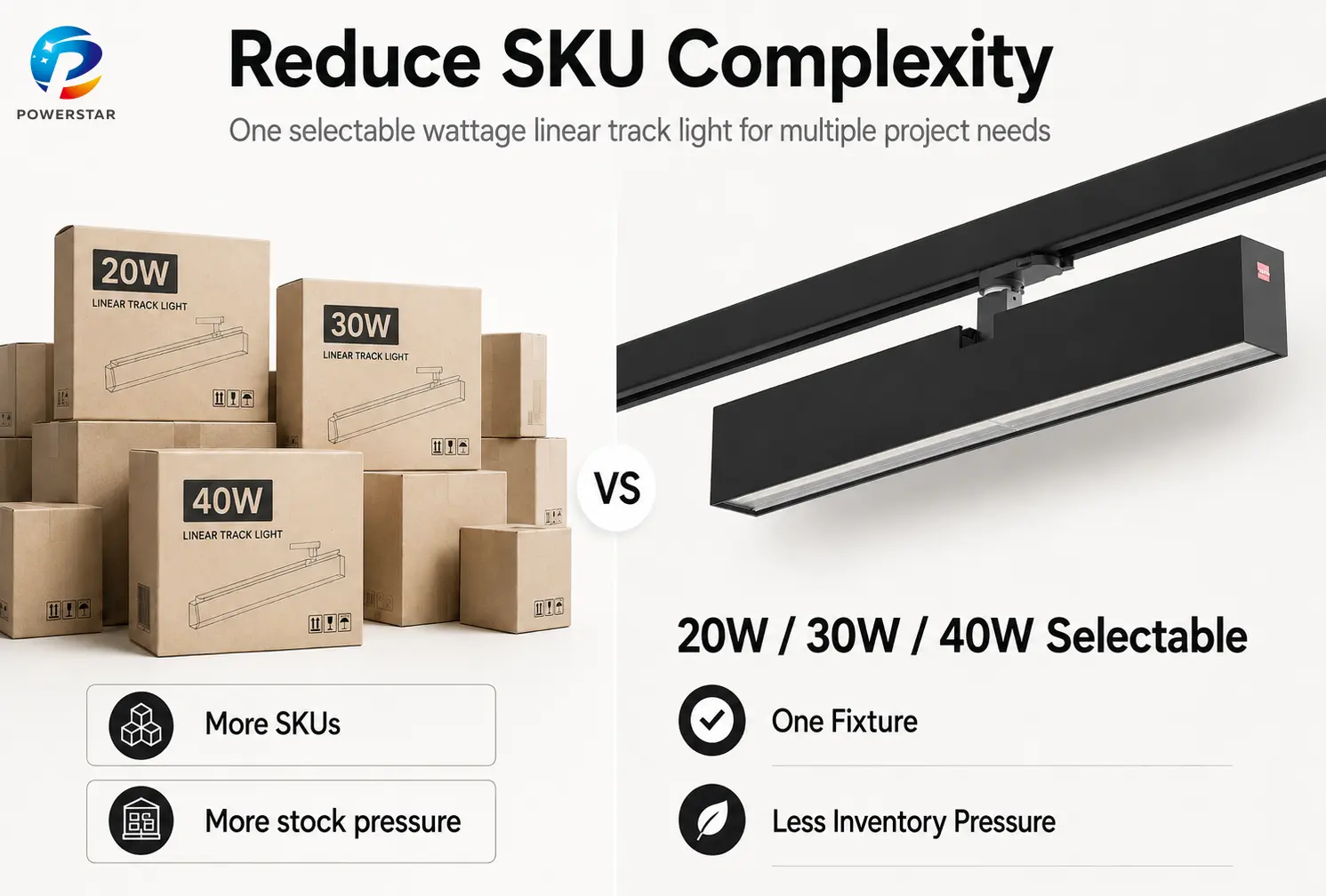
SKU complexity is a common challenge in commercial lighting supply. A single lighting project may require different wattages for different areas. For example, a retail store may need lower output lighting near display walls, medium output lighting for general areas, and higher output lighting for aisles or promotional zones. A selectable wattage linear track light is a linear track-mounted LED fixture that allows users to choose different power levels on the same product. This is usually done by using a dip switch or power selection switch on the fixture.
Why SKU Complexity Becomes a Problem in Lighting Projects
If every wattage requires a separate model, the product list quickly becomes complicated. A supplier may need to prepare 20W, 30W, 40W, or even higher power versions. Each version may also include different color temperatures, beam angles, housing colors, and control options. As a result, the number of SKUs increases rapidly.
This creates several problems:
- More inventory pressure
- More complicated quotation work
- Higher risk of choosing the wrong model
- Slower communication between supplier and client
- More warehouse space required
- More difficulty in project replacement or after-sales support
For lighting distributors and contractors, reducing unnecessary product variations can make the whole process more efficient.
What Is a Selectable Wattage Linear Track Light?
One linear track light may support 20W, 30W, and 40W in the same body. Instead of ordering three different models, the installer can adjust the wattage according to the actual lighting requirement on site.
This design is especially useful for commercial projects where lighting needs may change during installation. Drawings and simulations can provide guidance, but the final brightness often needs to be checked in the real space. Shelf height, ceiling height, wall color, product display, and customer experience can all affect the final lighting result.
With selectable wattage, the fixture becomes more flexible and easier to adapt.
How Selectable Wattage Reduces Product Variations
Traditional fixed-wattage lighting requires one SKU for each power option. If a project requires 20W, 30W, and 40W linear track lights, the supplier must prepare three separate product codes. If each wattage also has different CCT options, the number of SKUs becomes even higher.
A selectable wattage design helps combine these options into fewer models.
For example:
| Traditional Fixed Wattage | Selectable Wattage Design |
|---|---|
| 20W model | One fixture with 20W / 30W / 40W |
| 30W model | One fixture with 20W / 30W / 40W |
| 40W model | One fixture with 20W / 30W / 40W |
This means one product can cover several project requirements. For suppliers, this reduces the need to stock multiple versions. For buyers, it makes product selection easier. For installers, it provides more freedom during final adjustment.
In B2B lighting, this kind of simplification is valuable because it improves both sales efficiency and project flexibility.
Easier Inventory Management for Wholesalers and Distributors
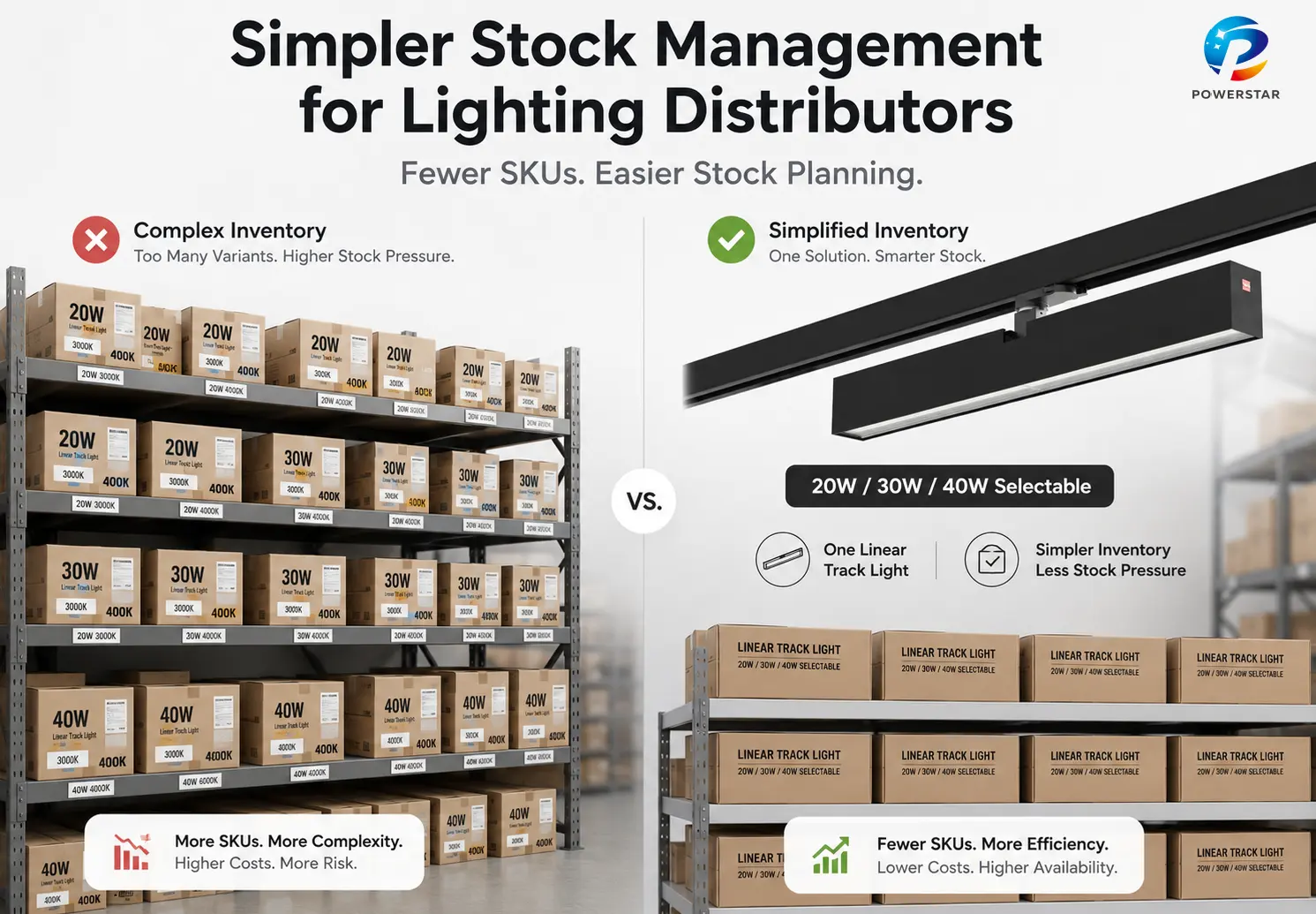
Wholesalers and distributors often need to keep products in stock before project demand is fully clear. If they stock too many fixed-wattage models, inventory becomes heavy and difficult to manage. Some models may sell quickly, while others may stay in the warehouse for a long time.
A selectable wattage linear track light helps reduce this risk. Since one fixture can cover multiple wattage needs, distributors can keep fewer models in stock while still serving more project types.
This can bring several benefits:
- Lower inventory pressure
- Faster response to customer enquiries
- Less risk of slow-moving stock
- Simpler product training for sales teams
- Easier replacement and after-sales service
For example, if a client is not sure whether a store needs 30W or 40W lighting, the distributor does not need to push the client to choose immediately. A selectable wattage product gives both sides more flexibility.
This is especially useful for commercial lighting suppliers who serve different types of projects, such as retail chains, supermarkets, offices, galleries, and showrooms.
Faster Quotation and Product Selection
In lighting sales, quotation speed matters. When a client sends a project enquiry, the supplier usually needs to confirm wattage, length, color temperature, beam angle, dimming option, track type, and installation details.
If every wattage requires a separate model, the quotation process becomes slower. Sales teams need to check different product codes, prices, stock levels, and technical data sheets. This can delay communication, especially when the client is comparing several suppliers.
Selectable wattage linear track lights make the quotation process easier. A sales team can recommend one flexible model and explain that the wattage can be selected according to the final site requirement.
This gives the client a clearer message:
One fixture. Multiple wattage options. More project flexibility.
For European lighting contractors, this kind of clarity is important. They often prefer practical product solutions that can reduce decision-making time and make installation smoother.
Better Flexibility During Installation
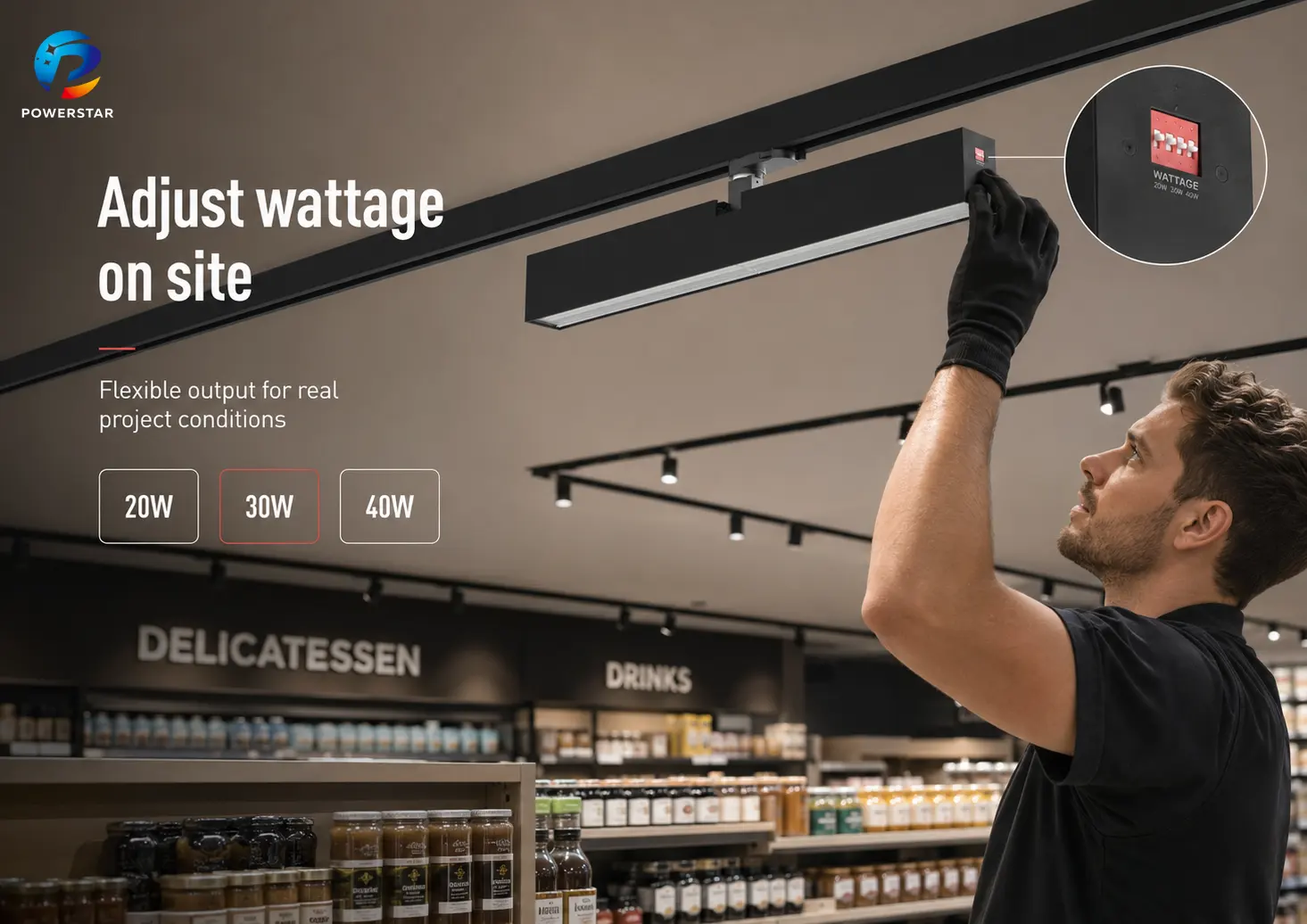
Even with careful lighting design, the real site may require adjustment. A store may have a lower ceiling than expected. A supermarket aisle may need stronger lighting because the shelves are tall. A showroom may need softer light to create a more comfortable atmosphere.
With fixed-wattage fixtures, changing brightness may require replacing the product. This can increase labor cost, delay installation, and create extra communication between the contractor and supplier.
With selectable wattage, the installer can adjust the output directly on the fixture. This makes the lighting easier to fine-tune during installation.
For example:
- Use lower wattage in areas with low ceilings
- Use medium wattage for general retail lighting
- Use higher wattage for supermarket aisles or wide display areas
- Adjust output after checking the real lighting effect on site
This is one of the biggest advantages of selectable wattage lighting. It gives the project team more control without changing the product model.
Useful for Retail Stores, Supermarkets, and Chain Projects
Selectable wattage linear track lights are particularly useful in retail and supermarket lighting because these spaces often include different lighting zones.
A fashion store may need soft and comfortable lighting in fitting areas, brighter lighting on product shelves, and stronger lighting near promotional displays. A supermarket may require different brightness levels for dry goods, fresh food areas, checkout areas, and long aisles.
Using fixed-wattage products for all these areas can increase the number of models in the project. But with selectable wattage, the same fixture family can cover different lighting requirements.
For chain stores, the advantage is even stronger. A brand may want to use the same lighting design across multiple locations, but each store may have a different size, ceiling height, or layout. Selectable wattage fixtures allow the brand to standardize the product while keeping enough flexibility for local site conditions.
This helps create a more consistent lighting experience while reducing product management complexity.
Selectable Wattage vs Fixed Wattage Linear Track Lights
Fixed-wattage linear track lights are still useful for projects where the lighting requirement is already very clear. If the designer knows exactly what output is needed, a fixed model can work well.
However, selectable wattage linear track lights are more flexible for projects with changing requirements or uncertain site conditions.
| Comparison Point | Fixed Wattage Linear Track Light | Selectable Wattage Linear Track Light |
| Power output | Fixed | Adjustable by switch |
| SKU quantity | More models needed | Fewer models needed |
| Inventory pressure | Higher | Lower |
| Site adjustment | Limited | More flexible |
| Project flexibility | Medium | High |
| Suitable for | Standard projects | Retail, supermarket, renovation, chain stores |
The key benefit is not only technical flexibility. It is also business efficiency. Fewer SKUs can make product management easier, while adjustable wattage can make project installation more practical.
Why It Matters for Commercial Lighting Suppliers
For commercial lighting suppliers, product simplification can improve competitiveness. Clients do not only care about the fixture itself. They also care about how easy the product is to specify, order, install, and maintain.
A selectable wattage design can become a strong selling point because it solves several practical problems at the same time:
- It reduces the number of product models.
- It makes stock planning easier.
- It helps contractors handle different site conditions.
- It reduces the risk of incorrect wattage selection.
- It supports faster quotation and project communication.
- It improves flexibility for retail and commercial lighting projects.
This makes the product easier to promote to wholesalers, distributors, engineering contractors, and retail lighting project managers.
In a competitive lighting market, practical flexibility can be just as important as high efficiency or modern design.
Conclusion
A selectable wattage linear track light is more than a lighting fixture with adjustable power. It is a practical solution for reducing SKU complexity in commercial lighting projects.
By combining several wattage options into one product, it helps suppliers simplify inventory, helps contractors adjust lighting on site, and helps buyers reduce the risk of choosing the wrong model. For retail stores, supermarkets, showrooms, and chain projects, this flexibility can make lighting design and installation much easier.
As commercial spaces continue to demand more flexible and efficient lighting solutions, selectable wattage linear track lights offer a smarter way to manage different project requirements with fewer product variations.
For lighting suppliers and project buyers, this means one clear advantage:
Less inventory pressure, easier project planning, and more flexible lighting control from one fixture.

