



How Smart Track Lighting for Commercial Spaces Solves Fixed Lighting Challenges
By Powerstar
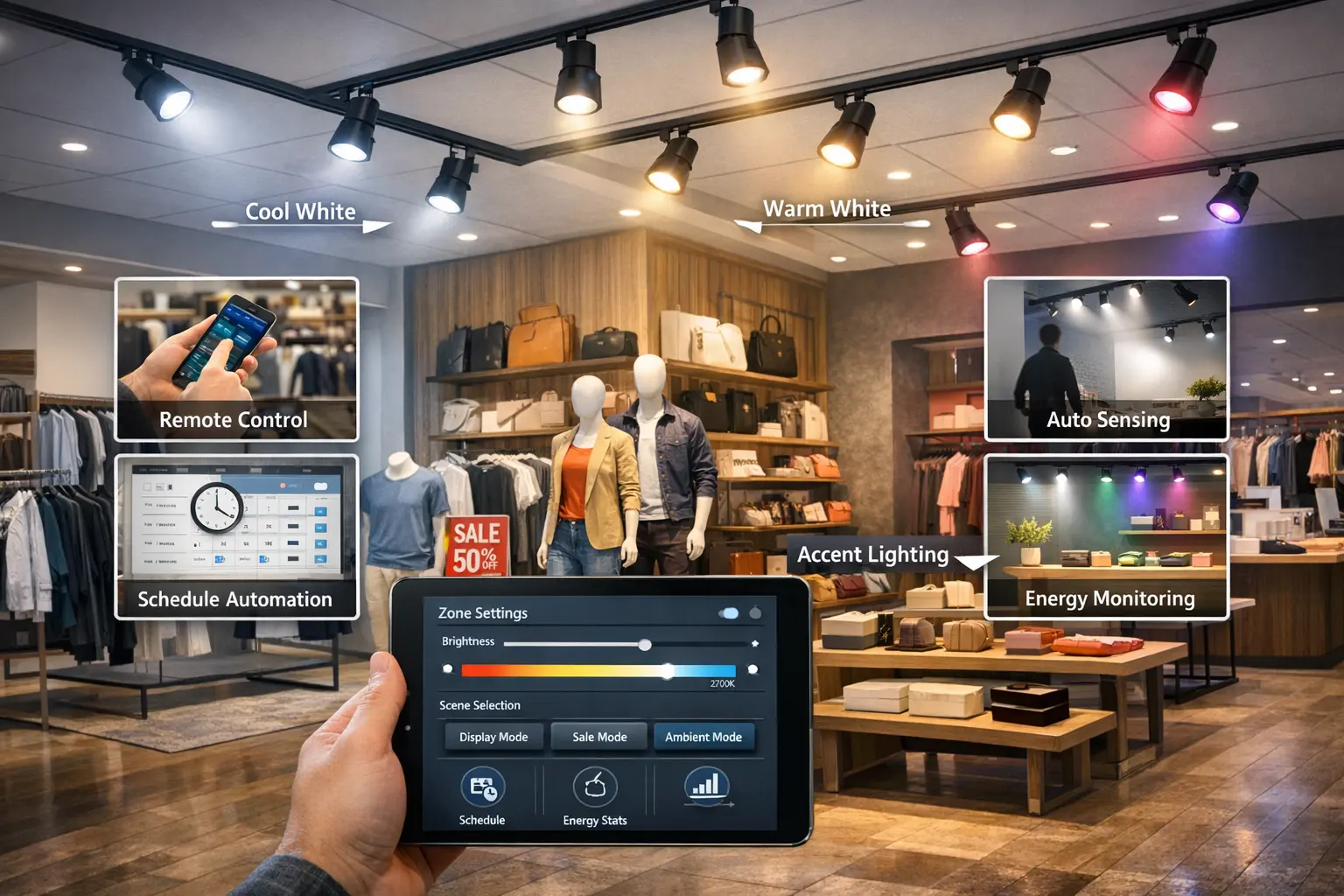
Smart track lighting for commercial spaces provides businesses with a flexible lighting strategy that adapts to changing layouts and merchandising needs. Flexibility is one of the strongest reasons businesses choose smart track lighting for commercial spaces. Track-mounted fixtures can be repositioned along the rail, and the direction of each luminaire can usually be adjusted without major effort. This alone makes track lighting far more adaptable than many fixed ceiling systems.
When smart control features are added, that flexibility increases significantly. Businesses can adjust brightness, assign fixtures to different groups, and in some cases modify color temperature according to the purpose of the area. Instead of rebuilding part of the lighting system every time the layout changes, operators can adapt the existing setup much more efficiently.
This is especially useful in spaces where presentation is constantly evolving. Fashion retailers rotate collections. Showrooms update focal displays. Supermarkets shift product emphasis according to season or promotion. Galleries and branded spaces frequently redesign visual pathways. In all of these cases, the lighting system needs to support change rather than resist it.
A flexible lighting strategy also reduces the risk of over-lighting or under-lighting certain areas. Because smart track lighting can be fine-tuned, businesses can create a more intentional balance between ambient lighting and accent lighting.
Better Zoning and Scene Control for Multi-Use Commercial Interiors
Commercial spaces are rarely uniform. Different parts of the same environment serve different functions, and lighting should reflect that. One of the key strengths of smart track lighting for commercial spaces is the ability to improve zoning and scene control.
For example, a retail store may need bright, attention-grabbing light at the entrance, focused accent lighting on feature displays, comfortable general lighting in circulation areas, and softer lighting in fitting rooms or consultation zones. With a traditional system, achieving this level of variation can be difficult and expensive. With smart track lighting, it becomes much more manageable.
Lighting groups can be organized by function, zone, or display priority. Businesses can create different scenes for daytime trading, evening ambiance, promotional events, cleaning, restocking, or partial operation. This allows the same physical space to support multiple business needs without requiring constant manual adjustment.
Scene control also improves operational consistency. Staff do not need to guess which lights should be on or how bright they should be. Pre-programmed settings can help ensure the space always presents itself as intended.
How Smart Track Lighting Enhances Visual Merchandising
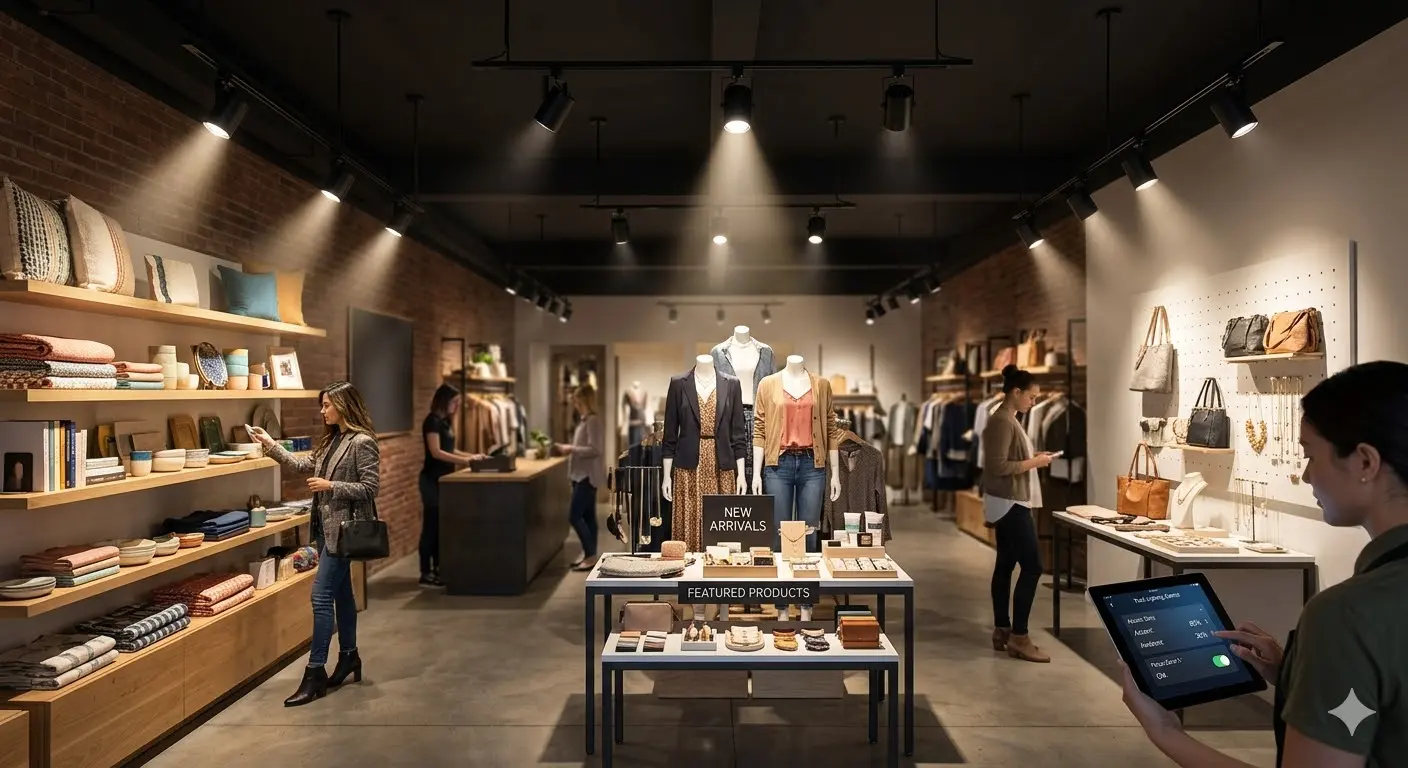
In commercial interiors, lighting is not only technical infrastructure. It is also a visual sales tool. Effective lighting directs attention, shapes perception, and influences how customers interact with products. This is where smart track lighting for commercial spaces delivers clear value.
Track fixtures are well suited to accent lighting because they can aim precisely at shelves, mannequins, wall displays, counters, and promotional tables. When combined with smart control, businesses can increase or reduce emphasis as needed. Featured products can be made more visually prominent without over-lighting the entire environment.
This supports stronger visual merchandising in several ways. First, it helps create focal points that guide the customer’s eye. Second, it improves depth and contrast in the space, making displays feel more layered and intentional. Third, it can enhance the perceived texture, finish, and color of products, especially when the lighting system is selected with suitable beam angles and good color rendering.
For retailers, this matters because product visibility and product appeal are closely linked. In competitive commercial environments, lighting that helps merchandise stand out can support stronger customer engagement and a more premium brand impression.
Energy Efficiency Benefits of Smart Track Lighting
Energy efficiency remains a top priority in commercial building operations. Lighting may represent a significant portion of electricity use, particularly in spaces with long opening hours. This is another reason why smart track lighting for commercial spaces is becoming increasingly attractive.
A smart system can reduce unnecessary power consumption in several ways. Dimming allows businesses to avoid running fixtures at full output when it is not needed. Scheduling makes it possible to match lighting levels to opening hours, cleaning routines, or low-traffic periods. Zoned control helps ensure that only relevant parts of the space are illuminated at a given time.
Some smart systems can also integrate with occupancy sensors or daylight-responsive controls. In areas with natural daylight or variable foot traffic, this creates additional opportunities for energy savings.
The benefit is not only lower electricity costs. More efficient use of light can also support sustainability goals, improve maintenance planning, and extend the practical value of the lighting investment over time.
Why Smart Track Lighting Is Ideal for Renovation and Upgrades
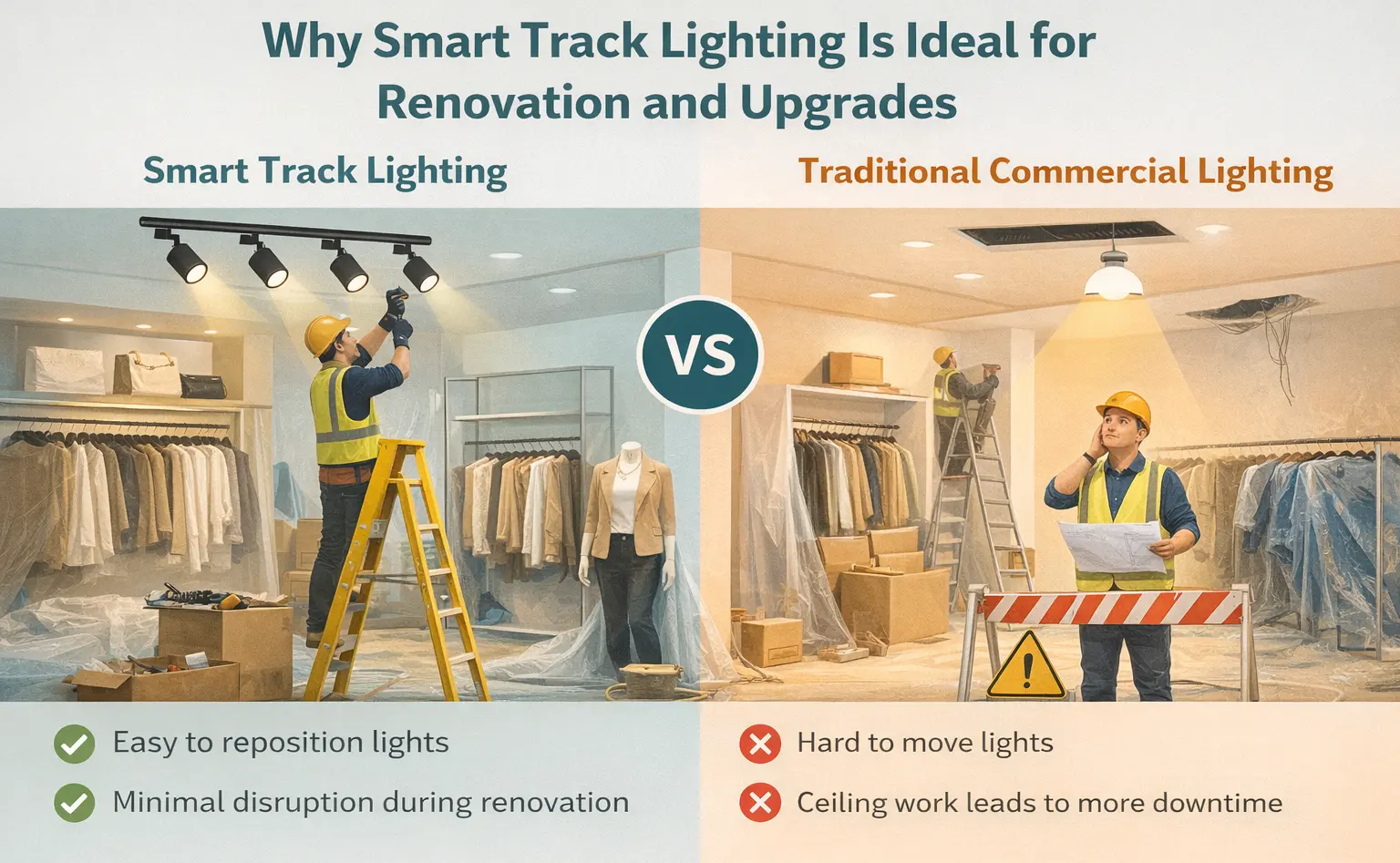
Commercial spaces are often updated in phases. Businesses may renovate to refresh brand image, improve customer flow, or adapt to new merchandising strategies. In these situations, smart track lighting for commercial spaces offers a practical advantage because it can support change without requiring a fully rigid lighting layout.
Track-based systems are already known for their adaptability. During renovation, luminaires can often be moved or re-aimed more easily than many fixed alternatives. When smart controls are included, businesses gain even more freedom to redefine how each zone is lit.
This is particularly useful in retrofit projects where owners want better lighting performance without extensive disruption. Rather than starting from zero, they can often improve control, flexibility, and visual impact through a more targeted upgrade strategy.
For commercial operators, less disruption can mean reduced downtime, fewer installation complications, and a faster return to normal trading conditions.
Smart Track Lighting vs Traditional Commercial Lighting
When comparing smart track lighting for commercial spaces with traditional commercial lighting, the difference is not simply digital versus non-digital. The deeper difference is adaptability.
Traditional systems can still provide basic illumination, but they often lack the control precision needed in modern commercial interiors. They may require manual switching, offer limited zoning, and respond poorly to layout changes. This can make them more costly to manage over time, even if the initial installation seems straightforward.
Smart track lighting, by contrast, supports a more strategic approach. It combines physical adjustability with intelligent control. This makes it easier to respond to changing business priorities, improve visual presentation, reduce waste, and maintain a more consistent customer experience.
For commercial projects where flexibility, presentation, and operational efficiency all matter, the value of a smarter lighting platform becomes much more obvious.
What to Consider When Choosing Smart Track Lighting for Commercial Spaces
Not all systems are the same, so specification still matters. When selecting smart track lighting for commercial spaces, businesses should consider how the lighting will actually be used within the environment.
Important factors include control compatibility, dimming performance, beam angle options, color rendering, and whether the system supports tunable white or scene programming. Reliability is also critical, especially in professional settings where maintenance interruptions can affect operations.
It is also useful to think beyond the fixture itself. A successful commercial lighting solution should support the larger goals of the space, including branding, customer comfort, energy management, and future flexibility.
Conclusion
Commercial lighting pain points often come down to one issue: the system cannot adapt to the way the business actually operates. Fixed layouts, weak zoning, poor display emphasis, high energy use, and difficult upgrades all limit performance. That is why more designers, retailers, and property operators are choosing smart track lighting for commercial spaces.
By combining adjustability, intelligent control, and stronger support for visual merchandising, smart track lighting helps commercial environments become more efficient, more flexible, and more customer-focused. For businesses that need lighting to do more than simply turn on, it offers a practical and future-ready solution.

