



How to Choose Energy Efficient Track Lighting for Sustainable Commercial Lighting
By Vincent
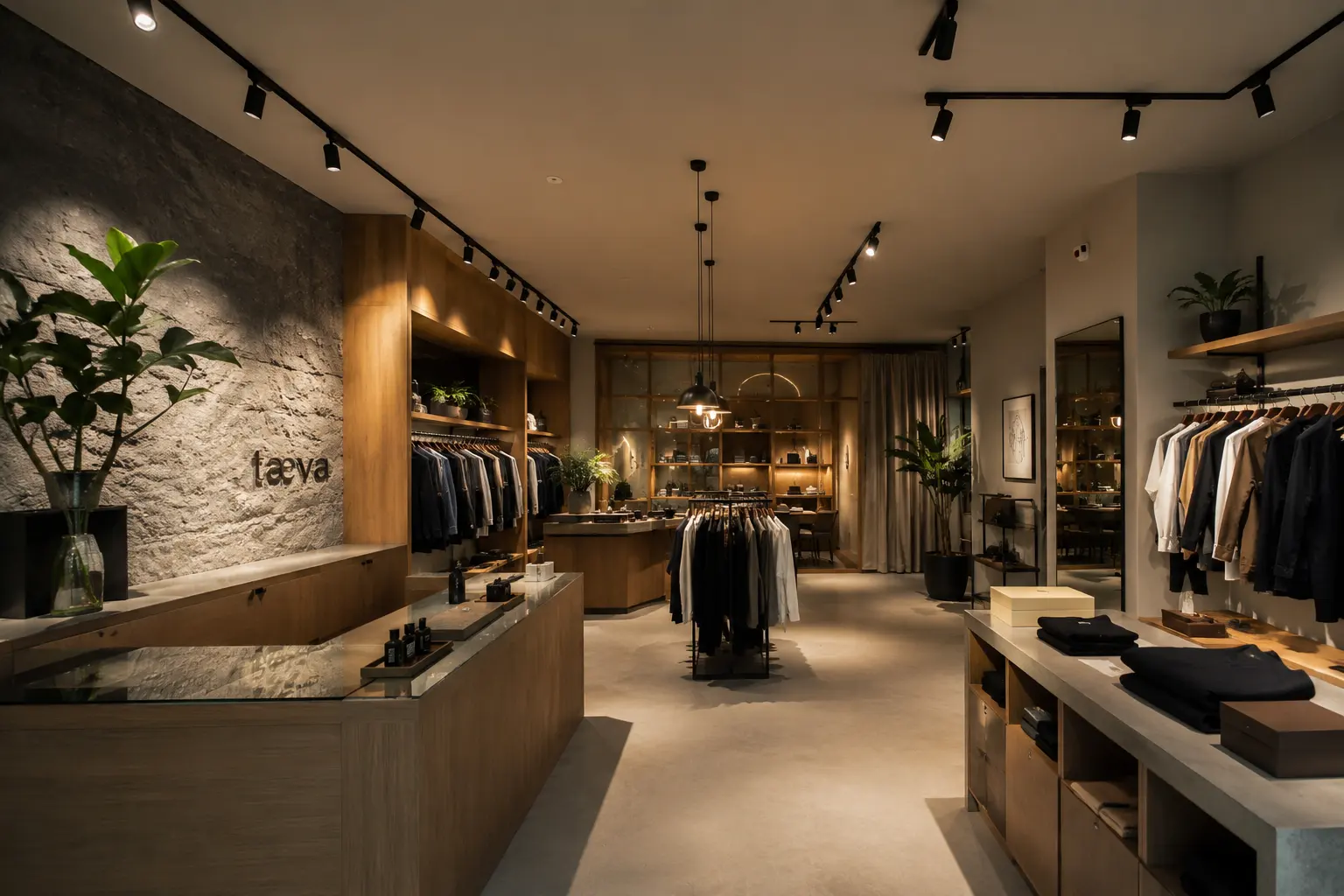
Modern businesses are under increasing pressure to reduce energy consumption while creating better customer experiences. From retail stores and galleries to offices and hospitality spaces, lighting now plays a critical role in both operational efficiency and environmental responsibility. That is why energy efficient track lighting has become one of the fastest-growing solutions in commercial lighting design.
Unlike traditional lighting systems that waste large amounts of energy as heat, modern LED track lighting offers higher efficacy, better beam control, lower maintenance costs, and improved visual comfort. More importantly, it helps businesses support sustainability goals without compromising the atmosphere or visual impact of a space.
According to the U.S. Department of Energy, LED lighting can significantly reduce energy use in commercial buildings while delivering longer service life and lower maintenance requirements. At the same time, organizations pursuing green building certifications such as LEED Certification increasingly rely on high-performance lighting systems as part of sustainable building strategies.
Why Energy Efficient Track Lighting Matters in Commercial Spaces
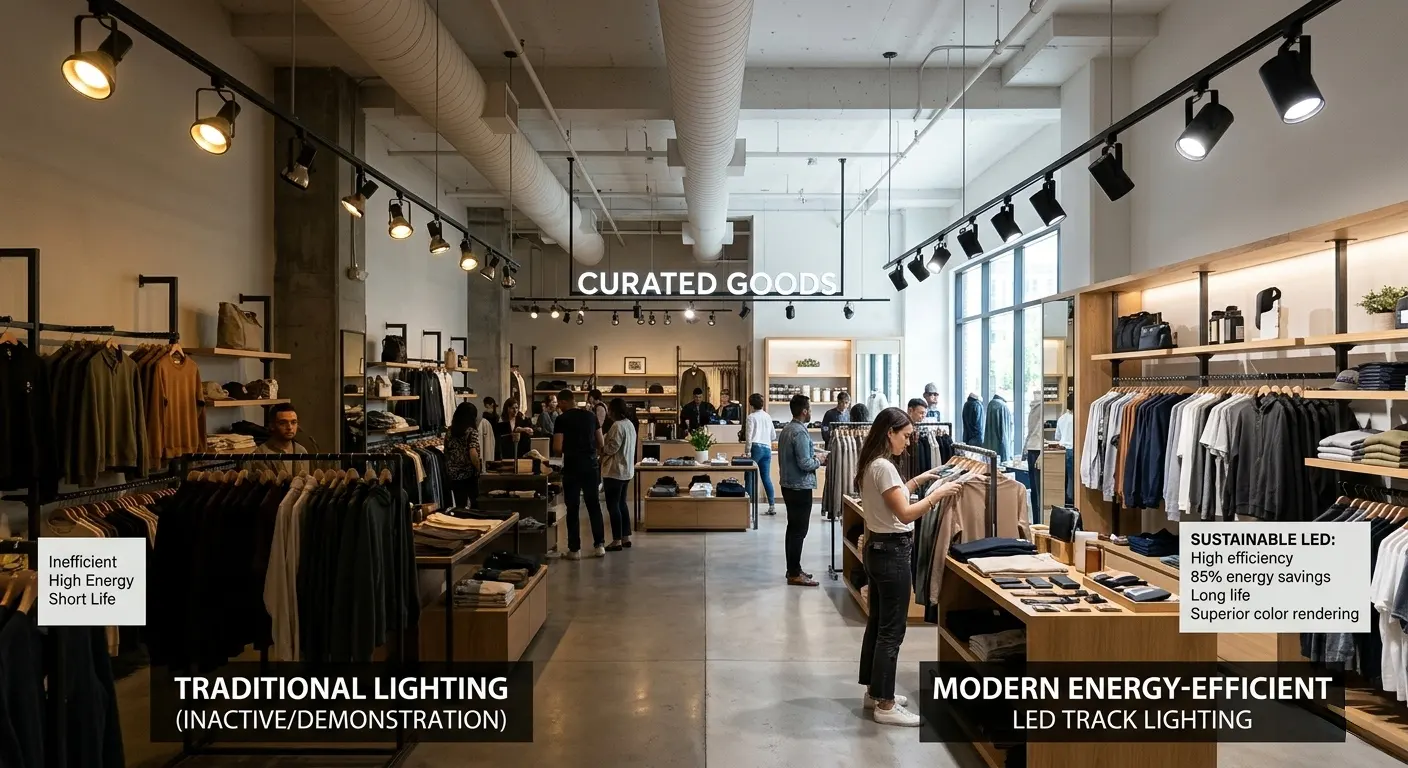
Lighting accounts for a substantial portion of electricity usage in commercial buildings. In retail environments where lighting operates 10–14 hours per day, inefficient fixtures can dramatically increase operational costs.
Traditional halogen and metal halide fixtures were once widely used because of their strong visual impact. However, they generated excessive heat, consumed large amounts of electricity, and required frequent maintenance.
Today, businesses are moving toward sustainable commercial lighting solutions that provide:
- Lower energy consumption
- Better lighting quality
- Reduced heat generation
- Longer lifespan
- Lower maintenance costs
Track lighting has become particularly popular because it combines flexibility with high-performance LED technology.
What Makes Energy Efficient Track Lighting Truly Efficient?
Many buyers still focus primarily on wattage when selecting fixtures. In reality, wattage alone says very little about actual lighting performance.
The real indicators of efficiency are system efficacy, optical performance, driver quality, and lighting control.
System Efficacy in Energy Efficient Track Lighting
System efficacy is measured in lumens per watt (lm/W). It shows how much usable light a fixture produces for every watt of electricity consumed.
Standard commercial LED track lights on the market typically deliver:
| Fixture Type | Typical Efficacy |
|---|---|
| Conventional LED Track Light | 80–100 lm/W |
| High-Efficacy Commercial Track Light | 130–160 lm/W |
A higher efficacy fixture can reduce energy consumption by 30–50% while maintaining the same brightness level.
For commercial projects operating daily, the long-term savings can be substantial.
Long-tail keywords naturally related to this topic include:
- high efficacy LED track lighting
- commercial LED track lighting solutions
- low glare track lighting
- sustainable retail lighting
- energy saving track lights
Real Lux Test Comparing Two Energy Efficient Track Lighting Systems
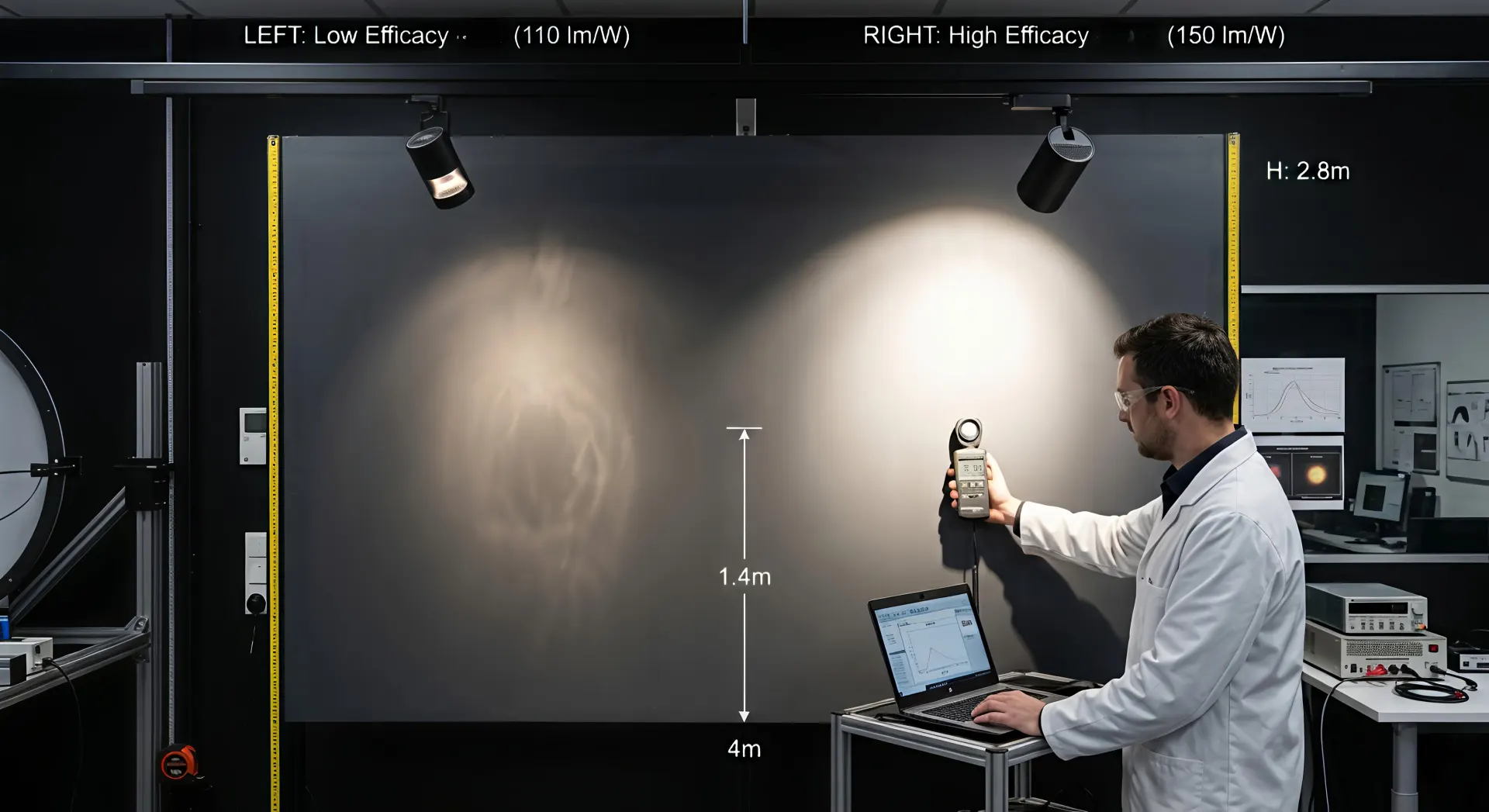
To better understand how efficacy impacts lighting performance, we conducted a real-world lux comparison test.
Test Conditions
| Test Parameter | Condition |
|---|---|
| Power Consumption | 28W |
| Tilt Angle | 45° |
| Testing Distance | 1.2m |
| Testing Environment | Same Environment |
Test Results
| Fixture | Measured Illuminance |
|---|---|
| 110lm/W Track Light | 6297 lux |
| 150lm/W Track Light | Approx. 7500 lux |
Despite using the same power consumption, the 150lm/W fixture delivered significantly higher illuminance.
This demonstrates an important concept in sustainable commercial lighting:
Better efficiency is not simply about producing more light. It is about producing more usable light with the same energy input.
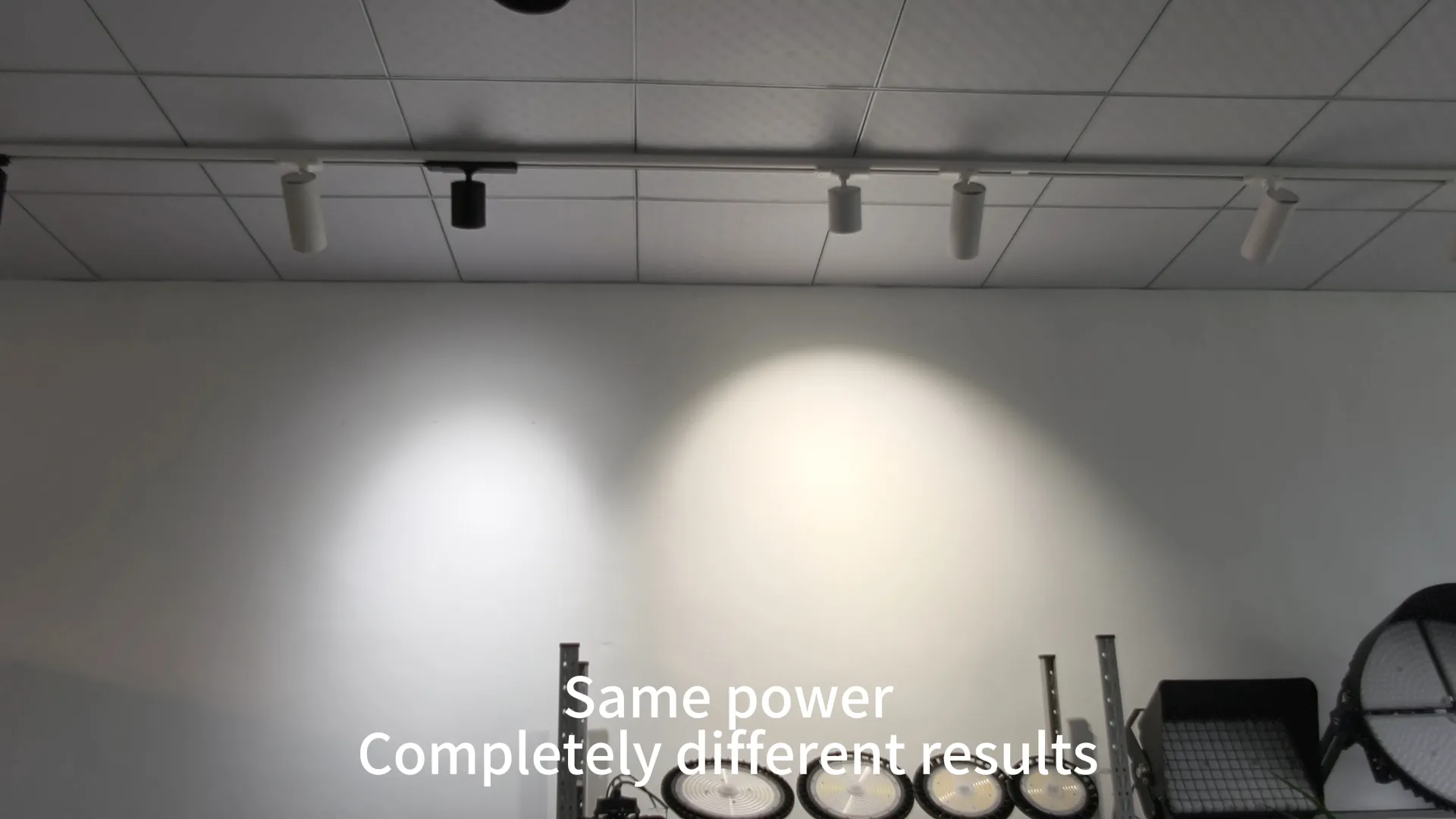
In practical applications, higher efficacy often means:
- Fewer fixtures required
- Lower electricity costs
- More uniform lighting
- Reduced ceiling clutter
- Better retail presentation
Color Rendering in Energy Efficient Track Lighting for Retail Applications
Efficiency should never come at the expense of visual quality.
For retail stores, galleries, museums, and hospitality projects, color rendering directly affects how products and spaces are perceived.
When selecting fixtures, commercial projects should prioritize:
| Application | Recommended CRI |
|---|---|
| General Commercial Lighting | CRI 90+ |
| Luxury Retail & Galleries | CRI 95–97+ |
R9 values are also important because they influence how reds, skin tones, leather products, and food displays appear under lighting.
High-quality commercial lighting helps merchandise appear more vibrant, natural, and premium.
Low Glare Energy Efficient Track Lighting Improves Visual Comfort
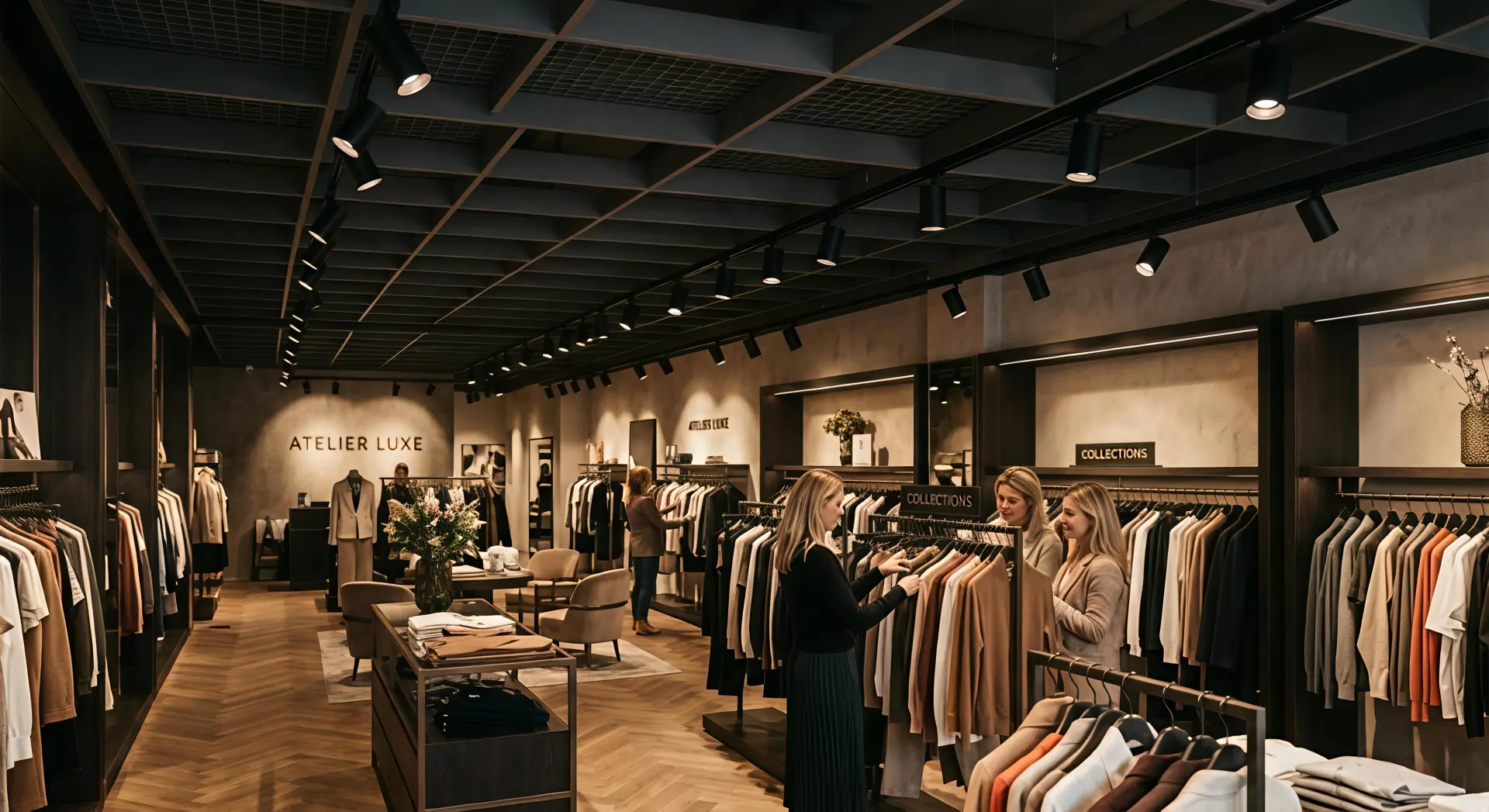
Brightness alone does not create a comfortable environment.
Poor glare control can negatively impact:
- Customer experience
- Employee productivity
- Perceived interior quality
- Time spent inside a retail space
Modern commercial fixtures often use:
- Deep anti-glare structures
- Black reflectors
- Honeycomb accessories
- Precision optical shielding
For offices, hospitality spaces, and premium retail projects, UGR<19 is commonly recommended.
Low glare track lighting has become an essential part of modern architectural lighting design.
Smart Controls Make Energy Efficient Track Lighting More Sustainable
Efficient hardware is only part of the equation. Intelligent lighting control systems can further reduce unnecessary energy use.
Modern systems increasingly support protocols such as:
- DALI-2
- Zigbee
- Bluetooth Mesh
Smart lighting allows businesses to:
- Dim fixtures automatically
- Respond to daylight conditions
- Reduce lighting in unoccupied areas
- Monitor fixture performance remotely
This type of adaptive lighting strategy plays a major role in sustainable building operations.
Additional information about smart lighting standards can be found through the DALI Alliance.
Flexible Energy Efficient Track Lighting Reduces Renovation Waste
Commercial interiors constantly evolve.
Retail layouts change seasonally. Galleries rotate exhibitions. Hospitality spaces update their atmosphere over time.
Unlike fixed recessed lighting, track lighting offers exceptional flexibility because fixtures can be:
- Moved
- Rotated
- Added
- Removed
without cutting ceilings or rewiring the space.
This flexibility reduces renovation waste and lowers long-term remodeling costs.
Modular Energy Efficient Track Lighting Supports Long-Term Sustainability
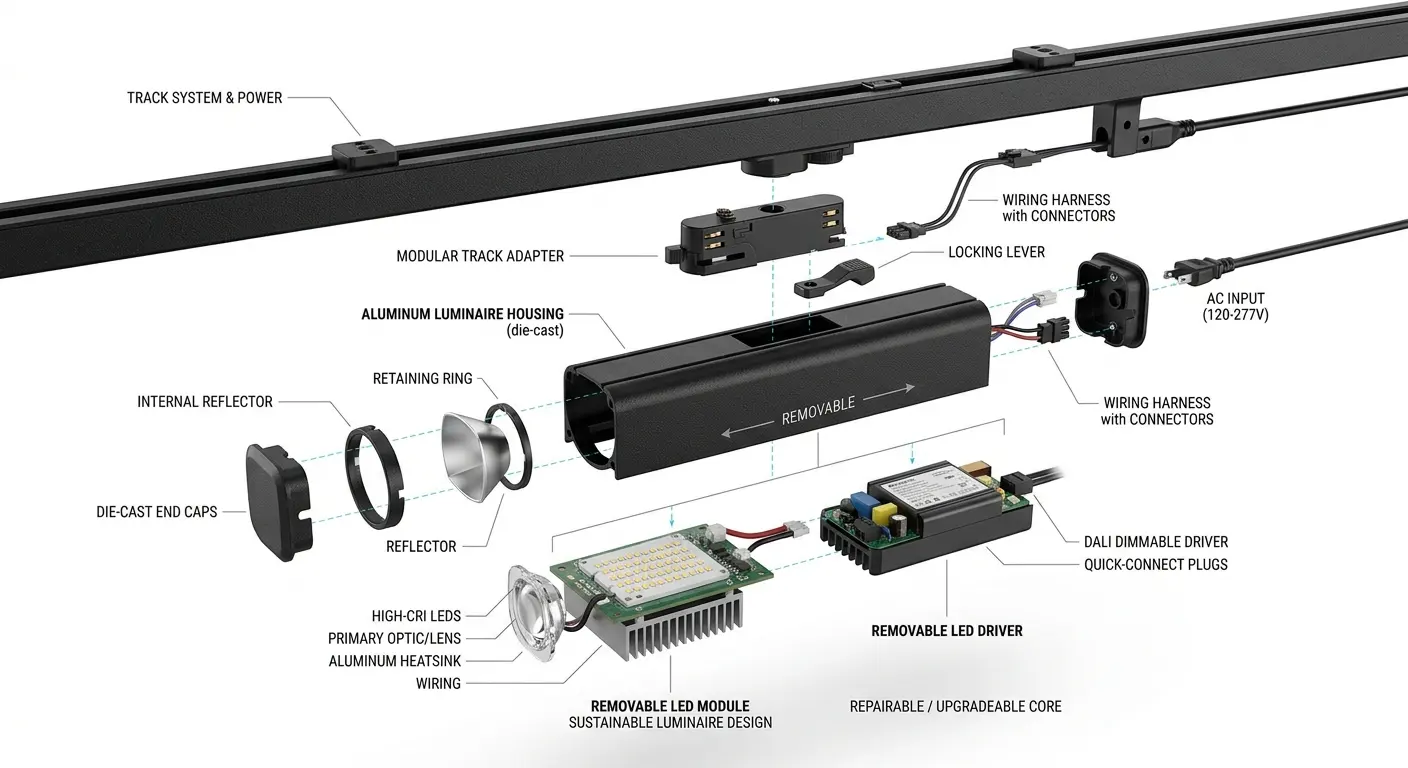
High-end commercial fixtures increasingly use modular designs.
Instead of replacing the entire fixture when a component reaches end of life, businesses can replace:
- LED modules
- Drivers
- Optical accessories
This repair-focused approach reduces electronic waste and supports circular economy principles.
For large-scale commercial projects, modular systems also simplify maintenance and minimize downtime.
ROI Benefits of Energy Efficient Track Lighting
While premium lighting systems may have higher upfront costs, the long-term financial return is often much stronger.
Lower Electricity Bills
Higher efficacy fixtures consume less power while maintaining lighting performance.
Reduced Cooling Costs
LED systems generate less heat compared to traditional lighting technologies.
Lower Maintenance Costs
Longer lifespan means fewer replacements and less maintenance labor.
Better Sustainability Credentials
Efficient lighting contributes to green building certifications such as:
- LEED
- WELL
- BREEAM
which can improve property value and brand reputation.
How to Choose the Right Energy Efficient Track Lighting
Before purchasing commercial track lighting, buyers should evaluate several key factors:
Check System Efficacy
For modern commercial projects, 130lm/W or higher is recommended.
Prioritize High CRI
Retail and hospitality spaces generally benefit from CRI 90+.
Evaluate Glare Control
Low glare design is critical for visual comfort.
Review Driver Quality
Look for high PF drivers with low flicker performance.
Consider Smart Control Compatibility
DALI and Zigbee compatibility can significantly improve energy management.
Verify Certifications
Commercial projects should prioritize fixtures certified by recognized standards such as:
- CE
- UL
- SAA
FAQ About Energy Efficient Track Lighting
What is considered high efficacy for commercial track lighting?
For modern commercial applications, fixtures above 130lm/W are generally considered high efficacy. Premium solutions may reach 150–160lm/W.
Does higher efficacy always mean better lighting?
Not necessarily. Good lighting also depends on glare control, color rendering, optical design, and beam distribution.
Is track lighting suitable for sustainable retail lighting?
Yes. Track lighting offers excellent flexibility, energy efficiency, and long-term adaptability for retail environments.
Why is CRI important in commercial lighting?
High CRI improves how products, interiors, and skin tones appear, which is especially important in retail and hospitality spaces.
How does smart lighting improve energy efficiency?
Smart systems automatically adjust brightness based on occupancy and daylight conditions, reducing unnecessary energy use.
Conclusion
Choosing the right lighting system is no longer only about illumination. Today, businesses need solutions that balance efficiency, sustainability, operational savings, and visual performance.
Well-designed energy efficient track lighting helps commercial spaces reduce electricity costs, improve lighting quality, support ESG goals, and create more flexible environments for the future.
As commercial lighting continues to evolve, the focus is shifting from simply producing more light to delivering smarter, more sustainable light.

