



More Light Won’t Fix Your Store’s Lighting Problem. How?
By JC
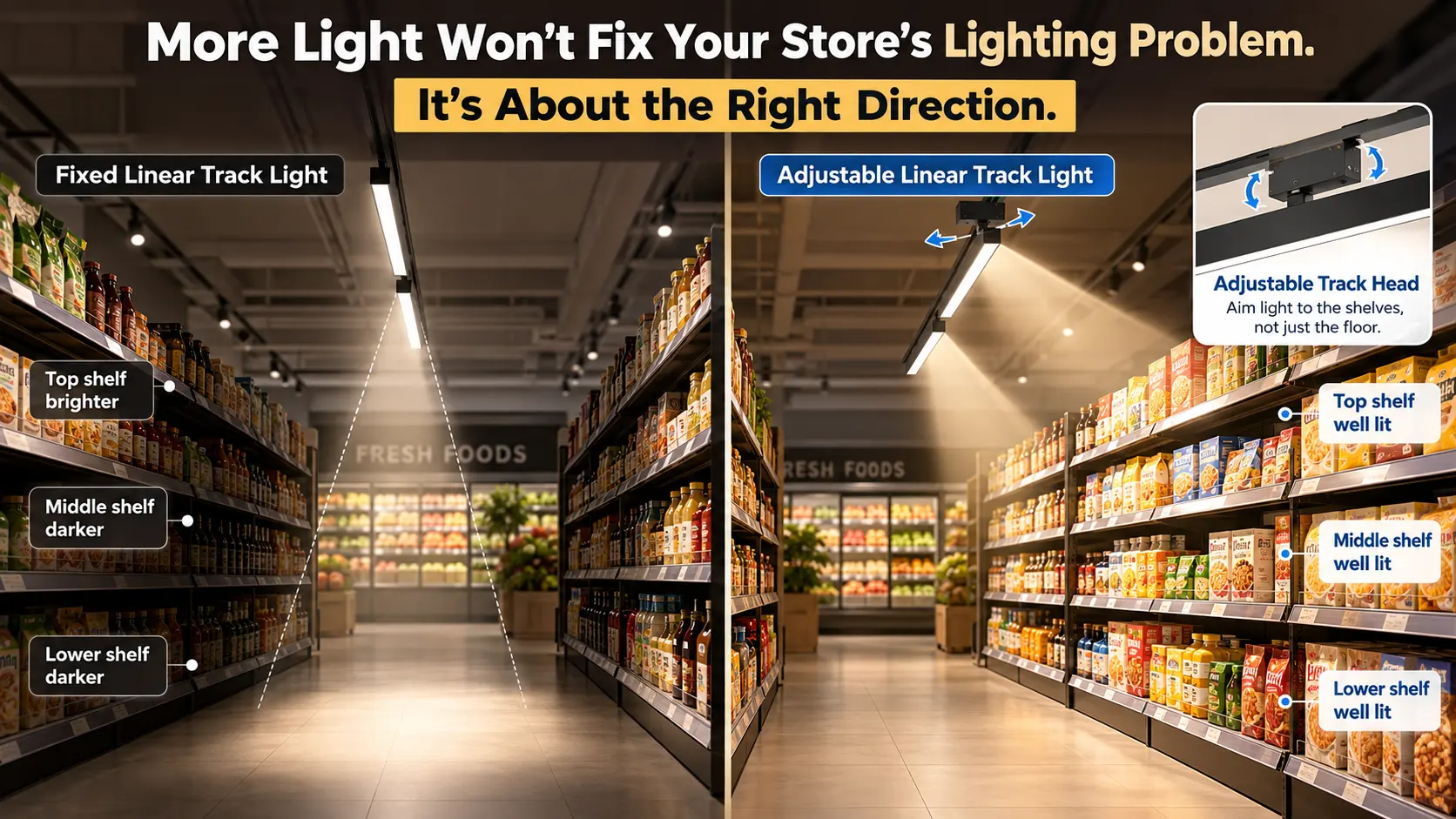
For retail stores, lighting must do more than simply provide sufficient brightness; it must also support product display, ensure visual comfort for customers, and facilitate daily store operations. Adjustable linear track lighting for retail stores offers flexible lighting control.
However, store shelf layouts and product displays are rarely static. Promotional events, seasonal inventory changes, and space reconfiguration can all alter lighting requirements. Traditional, fixed linear lighting provides a stable foundation of ambient light. It is generally difficult to adjust the direction of the illumination once the fixtures are installed.
Adjustable linear track lighting for retail stores offers an alternative solution. By modifying the rotation angle, tilt, and position of the fixtures, store owners can redistribute light to suit current displays, rather than remaining constrained by the original lighting layout.
What Is Adjustable Linear Track Lighting?
Adjustable Lighting Direction
Traditional fixed linear lights typically illuminate in a predetermined direction. If certain shelves are under-illuminated, they might need to reposition the fixtures or even alter the entire installation layout.
Adjustable track-mounted linear lights allow for the adjustment of the illuminated area. Change the angle of the fixture. It’s not requiring any significant change to its installation position.
For instance, if the floor in an aisle is already sufficiently bright but the adjacent merchandise shelves lack adequate illumination, the fixtures can be tilted to redirect some of the light toward the shelves.
Flexible Track Installation
In addition to adjusting the direction of illumination, track mounting also allows for the repositioning of light fixtures.
When using a compatible track system, store owners can rearrange fixtures. Within the limits of the track—to align with product displays, eliminating the need to modify fixed wiring points each time.
This provides the lighting system with greater flexibility to adapt to the long-term operational requirements of a retail space.
Retail Shelf Lighting—Enhancing Shelf Illumination and Product Presentation
Why are the aisles bright, while the shelves are not bright enough?
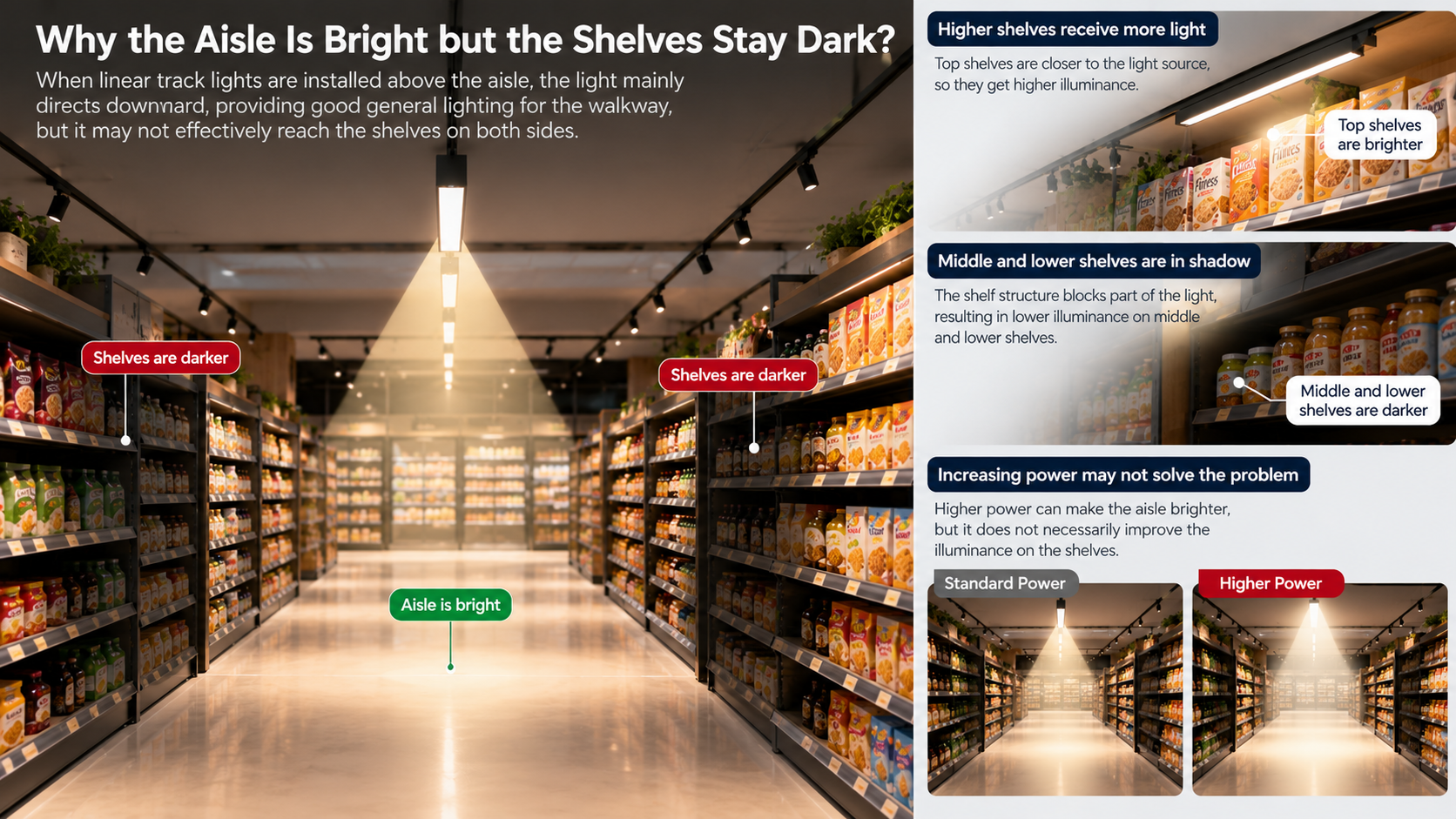
In some stores, linear lights are installed above the shopping aisles, directing light primarily downward. While this provides basic ambient lighting for the aisles, it does not necessarily ensure adequate illumination for the shelves on either side. Adjustable linear track lighting for retail stores directs more light toward products rather than simply brightening the aisle floor.
This is particularly noticeable with taller shelving units: items on the top shelves may receive ample light, whereas those on the middle and lower levels are often obstructed by the structure of the shelving itself, resulting in a stark contrast between light and shadow.
From a store owner’s perspective, simply increasing the wattage of the light fixtures is not necessarily the most sensible solution. While higher brightness might make the aisle floor appear better lit, it fails to effectively improve the illuminance levels on the products themselves.
Vertical Illuminance—Why Is Vertical Illuminance on Shelves Important?
When shopping in a store, customers typically focus on the shelves to find products rather than looking at the floor of the aisles.
In retail lighting design, vertical illuminance on the face of the shelves is just as important a metric as horizontal illuminance.
By carefully adjusting the orientation of track-mounted linear lights, more light can be directed onto product packaging, shelf surfaces, and display areas. It could help customers discern product colors, labels, and visual details.
Reduce inefficient lighting and make illumination more targeted
The value of adjustable lighting lies not in making every part of a store brighter, but in distributing light according to the specific purpose of each area.
For instance, main aisles require sufficient ambient lighting, whereas product display areas may benefit more from lighting directed toward the shelves.
By properly adjusting the orientation of light fixtures, you can improve light distribution in key areas without the need to indiscriminately increase the overall brightness.
Naturally, the final outcome will still depend on factors. The light distribution of the fixtures, their installation height, the structure of the shelving, and the spacing between the fixtures.
Flexible Retail Lighting—Adapting to Evolving Store Layouts
Managing Seasonal Products and Changes in Promotional Areas
Retail stores frequently need to adjust their product displays. Clothing stores may shift their display areas with the changing seasons. Supermarkets might rearrange merchandise arrangements to coincide with holidays or promotional events.
If a lighting system is fixed in place based on an initial layout, it may fail to effectively illuminate key display areas once the merchandise is moved.
In stores equipped with adjustable track lighting, managers can reorient the fixtures to suit the new product placement. Depending on the capabilities of the track system, the fixtures themselves can even be repositioned.
This flexibility eliminates the need to redesign the entire lighting system every time the store’s displays are adjusted.
Reduce lighting retrofit work during store renovations
For retailers who need to periodically refresh their store, a lighting upgrade involves more than the cost of the fixtures; it may also encompass electrical work, modifications to the ceiling, and adjustments to store operations.
If an existing track system is compatible with new lighting fixtures, certain lighting changes can be achieved simply by repositioning the fixtures themselves. It can minimize the need for additional wiring or structural modifications.
For retail brands with multiple locations, this approach also facilitates a consistent lighting configuration across different stores.
It is important to note that the power capacity, interface standards, and mechanical load-bearing limits of the track system must be verified in advance.
Low-Glare Linear Track Lighting—Enhancing Visual Comfort for Customers
Prevent light sources from entering customers’ direct line of sight
Store lighting should not only ensure that merchandise is clearly visible, but also prevent unnecessary direct glare.
When light fixtures are too bright, poorly positioned, or allow the light source to fall directly into a customer’s line of sight, significant glare can occur, compromising visual comfort while shopping.
For adjustable track-mounted linear lights, the beam angle can be fine-tuned—to minimize the chances of high-brightness light sources entering their field of vision.
However, not every tilt angle will effectively reduce glare. If a fixture is oriented poorly, it may actually increase the likelihood of a customer seeing the light source directly; therefore, on-site adjustment after installation is essential.
Improving Lighting Efficiency and Controlling Operational Costs
Direct light to where it is needed
For store owners, lighting efficiency is not merely a matter of comparing the lumens-per-watt of different fixtures; it also requires ensuring that light is actually directed toward the areas that need it.
If shelving is poorly lit, simply adding more fixtures or increasing their wattage may inadvertently brighten aisles or other non-priority areas as well.
Adjustable track lighting offers an alternative approach: by fine-tuning the direction of the light and the positioning of the fixtures, one can optimize the use of existing light before deciding whether additional fixtures are truly necessary.
If a lighting design succeeds in reducing the number of fixtures, it can lead to lower energy consumption. However, adjustability alone does not automatically equate to energy savings; the actual reduction in power usage must be determined through precise illuminance calculations and an assessment of the power configuration.
Considering Lighting Investments from a Long-Term Operational Perspective
The cost of retail lighting should not be judged solely by the initial purchase price.
Track lighting systems, which offer high compatibility and ease of maintenance, can make such future adjustments much more convenient.
Therefore, when evaluating lighting solutions, store owners should consider the initial installation costs, the expenses associated with future adjustments, ease of maintenance, and the overall lighting effect—rather than simply opting for the fixtures with the lowest price tag.
Adjustable vs. Fixed Linear Lighting—Which Is Better for Retail Stores?
The emergence of adjustable track-mounted linear lights does not render fixed linear lighting obsolete.
For retail stores with stable, long-term layouts that require uniform, large-area ambient lighting, fixed linear lights remain a sound choice—especially when the positioning and light distribution have been meticulously planned.
However, for retail spaces where product displays change frequently, or there is a need to adjust localized lighting, adjustable track-mounted linear lights offer a distinct advantage in terms of flexibility.
How do different sizes accommodate store needs?
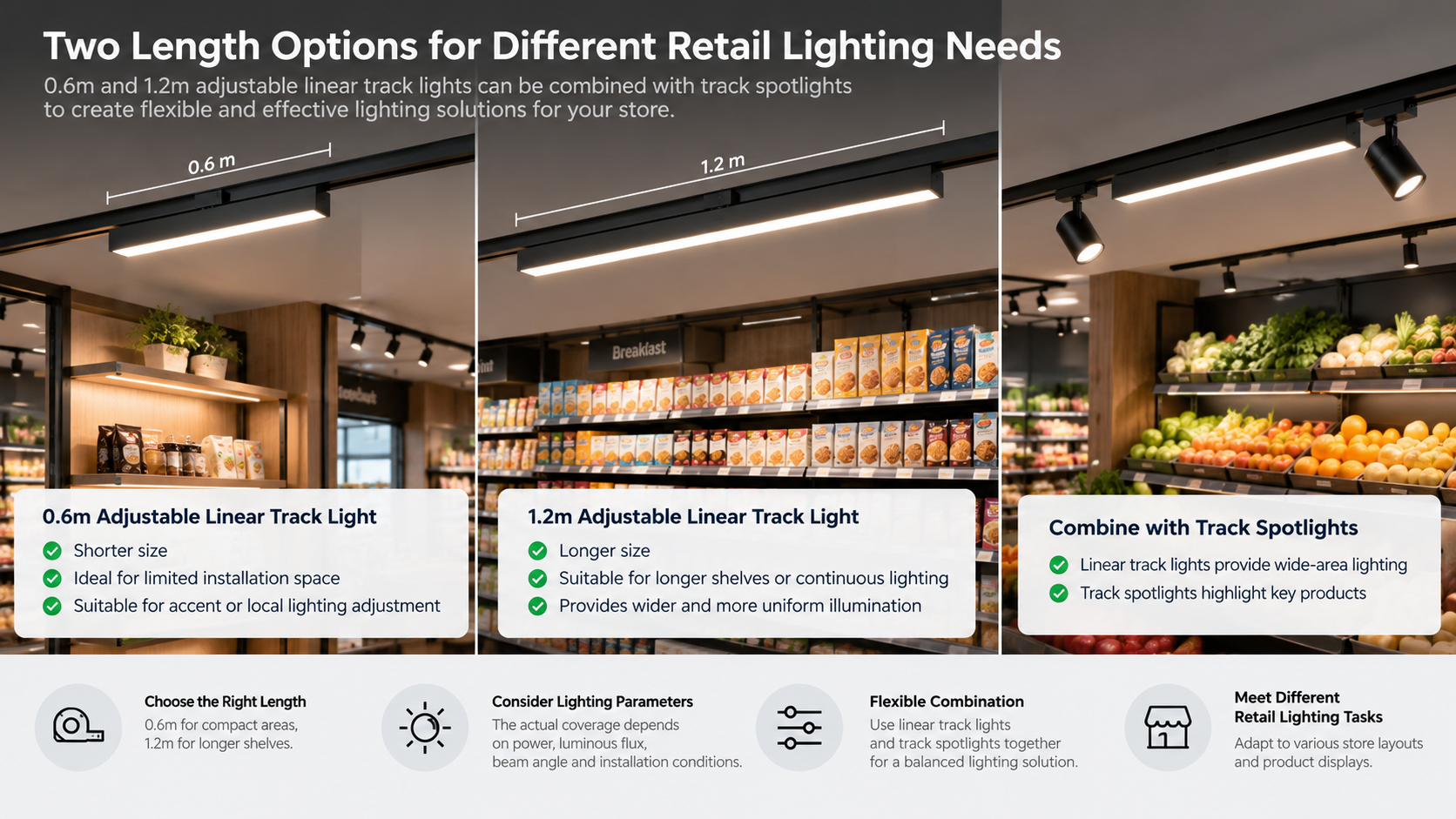
The 0.6-meter is more compact, making it suitable for areas with limited installation space. It also could localize lighting adjustments are needed.
The 1.2-meter version is ideal for longer shelving units or areas requiring continuous linear illumination. However, the actual lighting coverage will depend on factors such as power, luminous flux, light distribution, and installation conditions.
In practical applications, track-mounted linear lights can also be combined with track spotlights. Using the linear lights to provide broader, general illumination, while the spotlights highlight specific products.
Select light distribution based on shelf layout and installation height
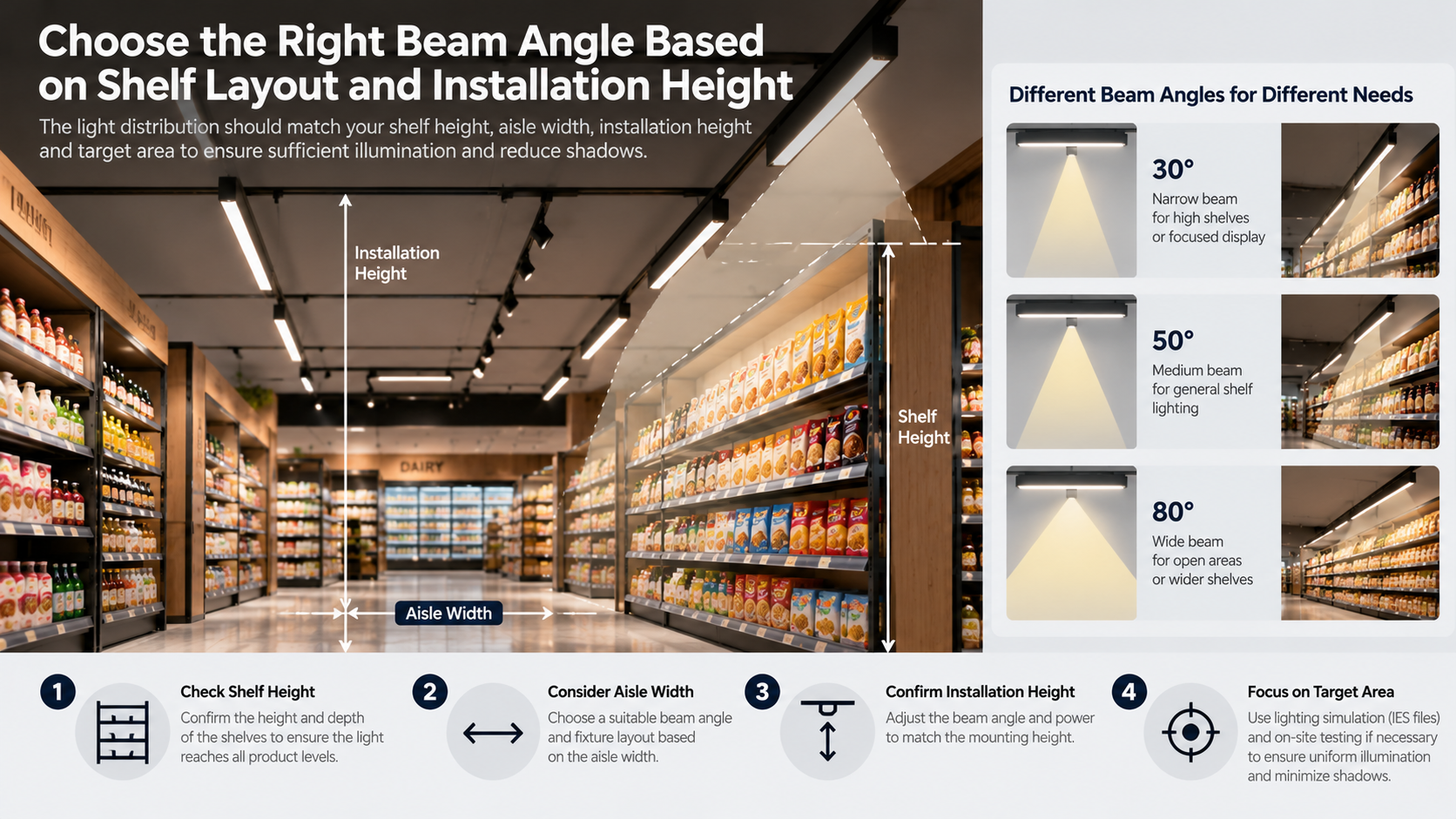
Before selecting lighting fixtures, it is essential to determine the shelving height, aisle width, intended mounting locations, and the specific areas requiring illumination.
For tall shelving units or deep product display areas, pay close attention to whether light can effectively reach the middle and lower levels of the shelves, and whether any significant localized shadows might be cast.
It is recommended to conduct illuminance simulations based on actual photometric data files and, where necessary, carry out on-site testing.
Verify track compatibility and adjustment range
If a track system is already installed in the store, verify its type, power supply method, connection interface, and load capacity requirements.
Additionally, check the actual rotation and tilt range of the light fixtures to ensure that, given the installation constraints, the light can be directed onto the intended shelving units.
If there is a possibility that the light fixtures might be replaced in the future, also consider the versatility of the track system and the ease of future maintenance.
Balancing light quality and visual comfort
Beyond power and dimensions, one should also consider the color rendering index (CRI), color temperature, optical light distribution, and glare control.
For instance, a clothing store needs to accurately showcase the colors and textures of fabrics, while a supermarket requires lighting that allows customers to clearly identify product packaging and pricing information.
Only by combining appropriate light quality with an effective luminaire layout can one create a truly functional retail lighting solution.
Conclusion—Why Is Adjustable Track Linear Lighting Worth Considering?
The core advantage of adjustable linear track lighting for retail stores is that it grants store owners greater flexibility in how they direct and adjust light.
Whether it involves enhancing the illumination of shelving, accommodating seasonal display shifts, or minimizing the need for future lighting retrofits, adjustable linear track lighting offers a highly versatile solution.
Rather than simply increasing the number of light fixtures, a more effective design approach—and one well worth considering—is to first identify exactly where the light needs to be directed, and then select the appropriate fixtures and installation methods accordingly.

